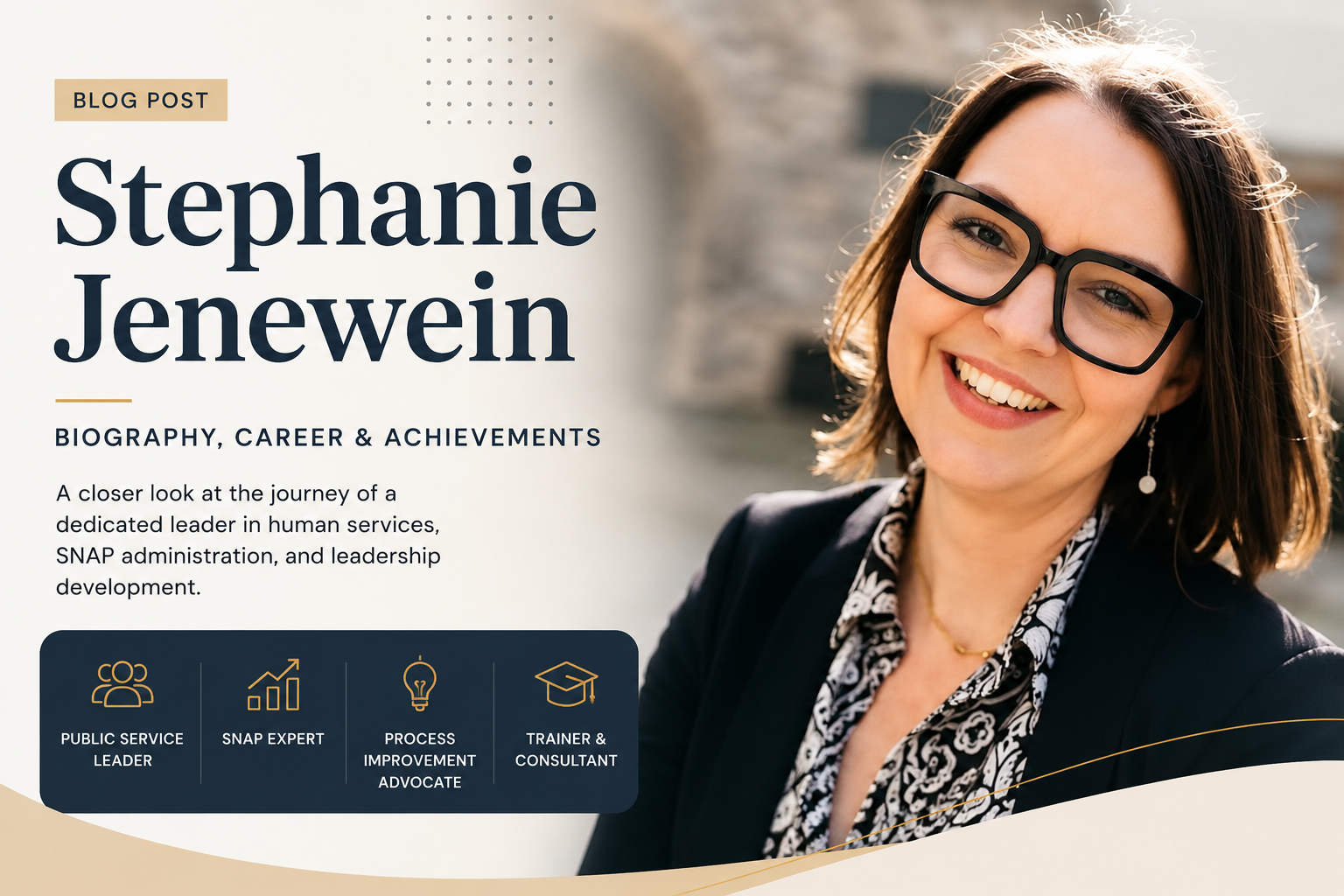
Stephanie Jenewein is an American human-services leader, consultant, trainer, and public-sector professional whose career has focused heavily on improving government programs and strengthening the delivery of social services. She is particularly known for her work in the Supplemental Nutrition Assistance Program (SNAP), including her previous leadership role with Montana’s SNAP program and her later consulting and training work with government agencies.
Today, Jenewein’s professional profile reflects a combination of public-sector leadership, program management, process improvement, strategic planning, and leadership development. Her work has increasingly focused on helping human-services organizations move from reactive problem-solving toward sustainable operational improvement.
This Stephanie Jenewein biography explores her professional background, education, government career, work with SNAP, consulting activities, leadership philosophy, and publicly documented projects.
Note on sources: Publicly available information about Stephanie Jenewein’s private life is limited. This article therefore focuses on her documented professional career and avoids presenting unverified claims about her age, date of birth, family circumstances, income, or other private information as fact.
Stephanie Jenewein Biography at a Glance
| Category | Information |
|---|---|
| Full name | Stephanie Jenewein |
| Profession | Government leader, consultant, trainer, and human-services professional |
| Known for | SNAP administration, public-sector consulting, leadership development, process improvement |
| Former role | SNAP Program Manager, Montana Department of Public Health and Human Services |
| Current professional affiliation | Guidehouse |
| Location publicly associated with her profile | Montana, United States |
| Education | University of Wyoming |
| Professional certification | Lean Six Sigma Green Belt |
| Key areas of expertise | Training, change management, strategic planning, business analytics, project management, consulting |
| Notable projects | WorkPATH Tool for SNAP Backlog, SNAP Management Evaluation training, R3 Leadership Experience, Reset to Rise |
| Public-sector focus | Human services and SNAP operations |
Jenewein’s professional profile identifies her with Guidehouse and lists expertise including training, change management, strategic planning, business analytics, project management, and management consulting.
Who Is Stephanie Jenewein?
Stephanie Jenewein is a public-sector and human-services professional with experience working at the intersection of government administration, program operations, leadership, and process improvement.
Read also Jennifer Wicks McNamara Biography: Career, Education, Family and Ambassador Role
A significant part of her career has been connected to SNAP, the federal nutrition-assistance program administered through state agencies. Before moving into consulting, she worked for the Montana Department of Public Health and Human Services. A federal document from 2020 identifies Jenewein as the SNAP Program Manager for the Montana Department of Public Health and Human Services.
Her experience as a state SNAP leader has become an important part of her professional identity. More recent professional material describes her as a former Montana SNAP director, while her current work focuses on helping other human-services organizations address operational challenges, improve performance, and develop stronger leadership practices.
This combination of hands-on government experience and consulting expertise is one of the defining characteristics
Early Professional Background
There is limited reliable public information about Stephanie Jenewein’s childhood and early personal life. Rather than filling those gaps with speculation, available professional records provide a clearer picture of the path she followed into public service.
Her LinkedIn profile lists the University of Wyoming as part of her educational background, with studies spanning 2001–2007 and activities including athletic training.
Her professional development subsequently moved toward government administration and human services. That transition is significant because her later career required a combination of operational knowledge, leadership skills, data analysis, and an understanding of public-benefit programs.
Over time, Jenewein developed expertise in managing complex government processes and helping organizations translate policies and performance requirements into practical day-to-day operations.
Stephanie Jenewein and the Montana SNAP Program
One of the most important chapters in Stephanie Jenewein’s career was her work with Montana’s SNAP program.
SNAP is a major public-benefit program designed to help eligible households purchase food. Although the program is federally funded and governed by federal requirements, states play a central role in administering it. State SNAP leaders therefore have to balance federal rules, state systems, staffing, customer service, processing requirements, quality control, and changing caseloads.
Jenewein’s work in Montana placed her directly within this complicated environment.
A Montana Department of Public Health and Human Services document dated September 2, 2020, identifies her as SNAP Program Manager and lists her as the official signing a request concerning flexibility for non-extended recertification cases during the COVID-19 emergency.
That document provides independent government evidence of her leadership position and demonstrates that her responsibilities included dealing with federal SNAP requirements and operational changes.
Her experience in Montana later became an important foundation for her consulting career. Professional references to Jenewein now frequently emphasize her background as a former Montana SNAP leader.
Why Her SNAP Experience Matters
Understanding Jenewein’s SNAP background is essential to understanding her later work.
Government benefit programs can be difficult to manage because they involve large numbers of cases, strict eligibility requirements, deadlines, technology systems, quality-control processes, and direct interaction with members of the public.
A small inefficiency can create significant downstream consequences.
For example, an application-processing backlog can lead to longer waiting periods for applicants, greater workloads for employees, more customer-service calls, and additional administrative pressure. Jenewein’s later consulting work has focused on precisely these types of operational challenges.
Her professional content frequently discusses topics such as SNAP error rates, churn, application-processing timeliness, recertification processing, management evaluations, and operational performance.
This gives her career a practical dimension: instead of focusing only on policy in the abstract, she has worked extensively on how policies and programs operate in real organizations.
Career at Guidehouse
Jenewein is currently professionally associated with Guidehouse, a consulting organization that works with government and other sectors.
Her publicly available profile describes services and expertise including:
- Training
- Change management
- Strategic planning
- Business analytics
- Project management
- Business consulting
- Management consulting
At Guidehouse, her work appears to concentrate particularly on government and human-services operations.
Her public professional activity includes discussions with state SNAP leaders, training initiatives, operational-improvement projects, and analysis of challenges facing government agencies.
One example is a Guidehouse-related discussion featuring Jenewein and Dawne Votra, an official from Missouri’s Department of Social Services. The discussion focused on streamlining SNAP operations through assessment and continuous feedback.
Her experience therefore allows her to approach government consulting from the perspective of someone who has previously worked inside a state program.
Stephanie Jenewein biography: WorkPATH Tool for SNAP Backlogs
One of Jenewein’s notable professional projects is the WorkPATH Tool for SNAP Backlog.
According to her publicly listed project description, she served as co-creator and process-improvement consultant on the project for the USDA Food and Nutrition Service (FNS) between July 2024 and January 2025.
The tool was designed to help SNAP agencies understand and manage operational backlogs.
The concept is relatively straightforward but potentially useful: agencies can enter information such as staffing levels, backlog volume, average incoming workload, average output, and working days. The tool then helps estimate how long it could take to reduce the backlog under different operating conditions.
This approach allows leaders to examine possible scenarios rather than relying solely on intuition.
For example, an agency could consider what might happen if staffing increased, workloads were redistributed, productivity changed, or targets were adjusted.
The project’s emphasis on practical decision-making is consistent with Jenewein’s broader professional focus: using data and operational analysis to help public agencies make realistic plans.
SNAP Management Evaluation Training
Another important area of Jenewein’s work has been SNAP Management Evaluation training.
Her professional profile says she led the design and facilitation of a two-part training series for state SNAP agencies between January and August 2024. The training focused on helping state agencies strengthen their Management Evaluation processes.
Management evaluations are important because government agencies need mechanisms for determining whether programs are being administered effectively and consistently.
Jenewein’s training work reportedly covered areas including:
- Understanding the purpose of management evaluations
- Understanding the evaluation process
- Identifying findings
- Root-cause analysis
- Developing recommendations
- Improving consistency in evaluation practices
Her role as both trainer and facilitator demonstrates another dimension of her career. She is not simply involved in designing processes; she also helps government professionals understand and implement them.
Leadership Development Work
Although SNAP and public-sector operations remain prominent themes in Jenewein’s career, her professional activities have expanded into broader leadership development.
Her profile identifies Buffalo Storm Consulting LLC projects involving leadership development, strategic planning, facilitation, and organizational culture.
One of these projects is the R3 Leadership Experience, which Jenewein describes as a three-year leadership-development program for human-services leaders.
The framework is built around three concepts:
- Reset the Past
- Rise with Purpose
- Realize the Future
According to the project description, the program combines an immersive retreat, strategic planning, group coaching, and leadership development. Jenewein is identified as the founder, creator, and lead facilitator.
This work shows how her career has evolved from direct program administration toward helping other leaders develop their own capacity.
Reset to Rise
Another leadership initiative associated with Jenewein is Reset to Rise, described on her professional profile as a nine-module, self-paced online course for human-service leaders.
The course focuses on helping leaders move from reactive management toward more proactive leadership. It includes video lessons, practical assignments, accountability, and live group coaching sessions.
The program reflects a recurring theme in Jenewein’s professional philosophy: government leaders need more than technical knowledge. They also need clarity, confidence, strategic thinking, and the ability to lead organizations through change.
Stephanie Jenewein’s Approach to Government Operations
Jenewein’s public professional commentary provides clues about the issues she considers important.
One recurring subject is the relationship between performance metrics and organizational culture.
In her recent professional writing, she has discussed SNAP error rates and warned against treating performance measurements simply as a source of blame. She argues that leaders need to understand the operational reasons behind the numbers rather than focusing only on how the final metric looks.
This is a meaningful distinction.
A performance metric tells leaders what happened. Operational analysis attempts to explain why it happened.
For example, a high error rate might be associated with training gaps, unclear procedures, technology problems, workload pressure, or weaknesses in quality-control systems. Simply demanding a lower number does not necessarily address the underlying cause.
Jenewein’s public work consistently emphasizes this type of practical problem-solving.
Her Views on Customer Service and Government Systems
Jenewein has also discussed the relationship between government processes and customer-service demand.
In a recent professional post, she argued that long call-center wait times can sometimes be symptoms of unfinished work elsewhere in an agency. Customers may call because notices are unclear, cases have not moved forward, verification requirements are confusing, or systems fail to provide adequate status information.
This reflects a broader operational principle: solving a problem at the final point of contact may not solve the problem that created the demand.
From this perspective, improving government customer service may require changes earlier in the process.
That could include clearer notices, better status information, improved workflows, and more effective automation.
Education and Professional Development
Stephanie Jenewein’s public professional profile lists the University of Wyoming among her educational experiences. It also identifies Lean Six Sigma Green Belt certification, issued in December 2024 by the Council for Six Sigma Certification.
Lean Six Sigma is associated with process improvement, efficiency, quality management, and reducing unnecessary variation or waste.
The certification is particularly relevant to Jenewein’s career because process improvement has become a recurring theme in her work.
Her professional development therefore aligns closely with the problems she addresses in government consulting: how organizations can understand their processes, identify bottlenecks, use data effectively, and improve outcomes without relying solely on additional resources.
Volunteer Activities
Jenewein’s public profile also lists volunteer involvement with the American Cancer Society, where she has been associated with an entertainment-chair role.
While her professional career is primarily centered on government and human services, this volunteer activity provides another example of her involvement in community-oriented work.
However, because publicly available information about her personal life is limited, it is better to avoid making assumptions about her broader family or private circumstances.
Stephanie Jenewein’s Professional Legacy
It is still relatively early to describe Jenewein’s long-term legacy because her career is ongoing. Nevertheless, her professional record already demonstrates several consistent themes.
First, she has substantial practical experience with public-benefit administration.
Second, she has transitioned that experience into consulting and technical assistance for other government organizations.
Third, she has expanded into leadership development, helping human-services leaders address organizational challenges rather than concentrating solely on program compliance.
Finally, her work demonstrates an emphasis on practical, measurable improvements.
Her career illustrates how experience inside government can become valuable in a consulting environment. Someone who has dealt directly with program administration can bring a different perspective to agencies seeking outside assistance.
Frequently Asked Questions About Stephanie Jenewein
Who is Stephanie Jenewein?
Stephanie Jenewein is an American public-sector and human-services professional known for her work in SNAP administration, government consulting, leadership development, training, and process improvement.
What is Stephanie Jenewein known for?
She is particularly known for her experience with SNAP, including her former leadership role with Montana’s SNAP program, as well as her subsequent consulting and training work with government agencies.
Where did Stephanie Jenewein study?
Her public professional profile lists the University of Wyoming as part of her educational background.
What did Stephanie Jenewein do in Montana?
She served in a leadership role with Montana’s SNAP program. A 2020 Montana Department of Public Health and Human Services document identifies her as SNAP Program Manager.
What does Stephanie Jenewein do now?
Her current professional profile associates her with Guidehouse, where her listed expertise includes training, change management, strategic planning, analytics, project management, and management consulting.
What is the WorkPATH Tool?
The WorkPATH Tool is an operational planning resource that Jenewein co-created for SNAP agencies to help analyze and manage backlogs using staffing, workload, productivity, and other operational variables.
Does Stephanie Jenewein work in leadership development?
Yes. Her professional profile documents leadership-development projects, including the R3 Leadership Experience and Reset to Rise, both designed around helping human-services leaders strengthen their leadership and strategic capabilities.
Stephanie Jenewein biography: Conclusion
The story of Stephanie Jenewein is primarily a story of public service, government operations, and leadership development.
Her career began with an educational background that included the University of Wyoming and eventually developed into hands-on work in public administration. Her time with Montana’s SNAP program gave her direct experience with the realities of administering a major public-benefit program, while her later work in consulting allowed her to apply that experience to a broader range of government organizations.
Today, Jenewein’s professional work encompasses SNAP operations, process improvement, management evaluation, training, strategic planning, leadership development, and organizational change. Her projects, including the WorkPATH Tool, SNAP training initiatives, R3 Leadership Experience, and Reset to Rise, demonstrate a consistent interest in turning complex organizational challenges into practical solutions.
Perhaps the most important aspect of her professional profile is the connection between people and processes. Her work suggests that improving government performance is not simply about measuring results. It also requires understanding how employees work, how systems affect customers, how leaders communicate, and where operational problems originate.
For people searching for a Stephanie Jenewein biography, her documented career offers a useful example of how experience in public administration can evolve into a broader career in consulting and leadership development. Rather than relying on unverified personal details, the strongest account of Jenewein is found in her professional record: her work with SNAP, her government leadership experience, her process-improvement initiatives, and her continuing efforts to help human-services organizations become more effective and resilient.