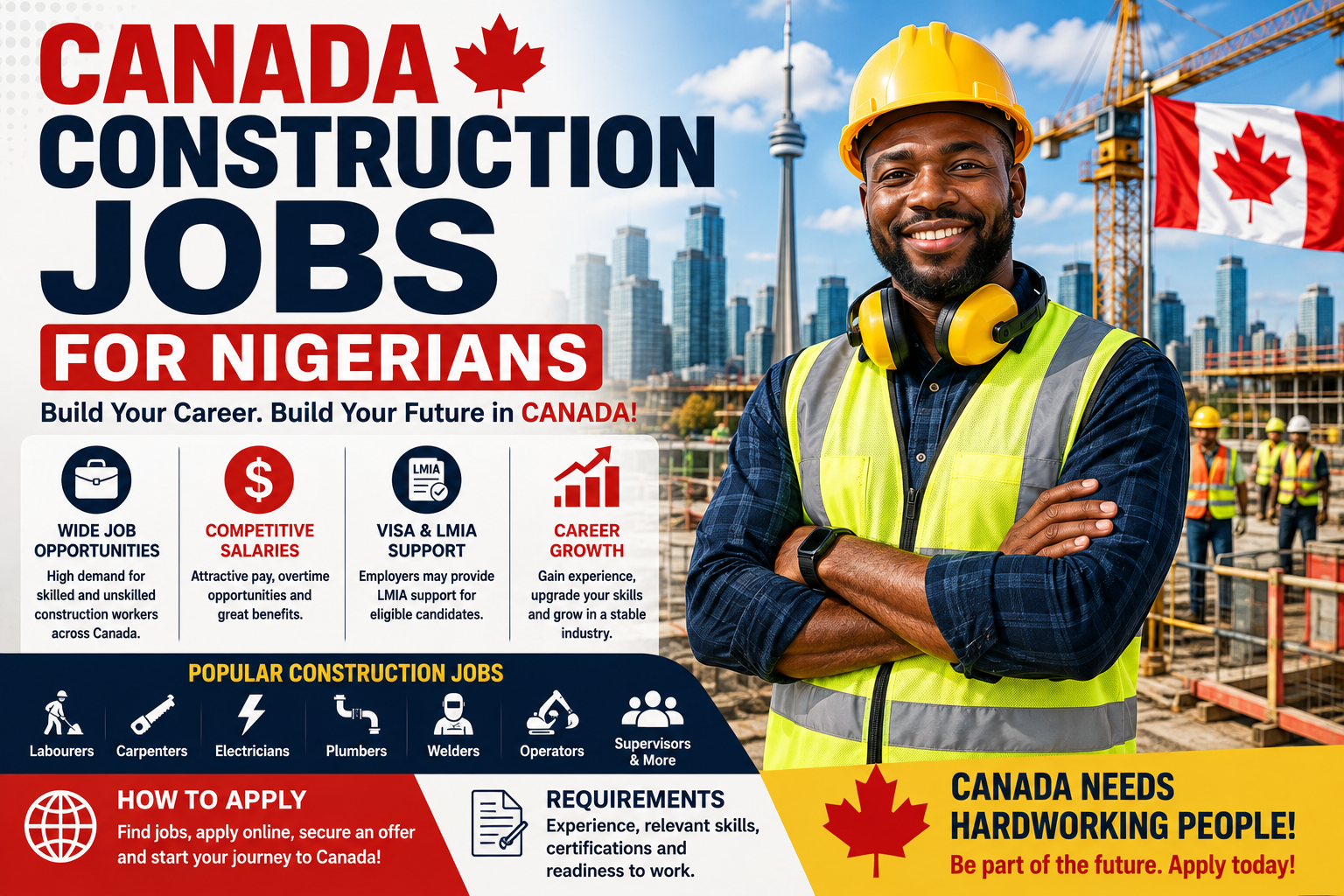
Canada construction jobs for Nigerians are becoming an important topic for skilled workers, tradespeople and labourers looking for international employment opportunities. Canada’s construction industry includes a broad range of occupations, from general construction laborers to carpenters, electricians, plumbers, welders, heavy equipment operators, supervisors and project managers.
For Nigerians who have relevant skills and work experience, construction employment in Canada may offer a pathway to gain international work experience. However, applicants should understand that finding a job is only one part of the process. A foreign worker may also need the appropriate Canadian work authorization, and some occupations require provincial trade certification or licensing.
This guide explains Canada construction jobs for Nigerians, including the types of jobs available, requirements, expected salaries, LMIA information, work permit options and practical steps for applying from Nigeria.
Are Canada Construction Jobs Available to Nigerians?
Yes. Nigerian citizens can apply for construction jobs in Canada if they meet the employer’s requirements and qualify to work in Canada.
The construction sector includes many different types of occupations. Some roles require extensive training, apprenticeships, licences or trade certification, while others may have fewer formal education requirements.
Examples of construction-related jobs include:
- Construction labourer
- Construction helper
- Carpenter
- Electrician
- Plumber
- Welder
- Painter
- Roofer
- Bricklayer
- Concrete finisher
- Heavy equipment operator
- Construction supervisor
- Site superintendent
- Construction estimator
- Project coordinator
- Construction manager
The requirements for each role can be very different. For example, a general construction labourer may not need the same level of formal education or certification as a licensed electrician or plumber.
Nigerian applicants should therefore avoid searching only for the general phrase “Canada construction jobs.” A better approach is to search for job titles that closely match their actual skills and experience.
For example, someone with five years of welding experience should search for welding positions. A carpenter should focus on carpentry jobs. An experienced construction supervisor should target supervisory or site management positions.
Applying for jobs that match your background can significantly improve the quality of your applications.
see also: Canada engineering jobs for Nigerians
see also: Canada Truck Driver Jobs for Nigerians 2026: Requirements, Salary, LMIA and How to Apply
Types of Canada Construction Jobs for Nigerians
Construction Labourer Jobs
Construction labourers perform a variety of physical tasks on building and infrastructure projects.
Typical responsibilities may include:
- Loading and unloading construction materials
- Cleaning and preparing work sites
- Assisting skilled tradespeople
- Operating basic equipment
- Moving materials
- Digging and site preparation
- Removing construction waste
- Following workplace safety procedures
Construction labour positions can be physically demanding. Employers may look for applicants who are capable of performing manual work and following safety instructions.
Previous construction experience can be an advantage, especially if you can provide verifiable evidence of your work history.
Carpenter Jobs
Carpenters work with wood and other materials to construct, install and repair structures.
Common responsibilities may include:
- Reading construction drawings
- Measuring and cutting materials
- Building frameworks
- Installing doors and windows
- Constructing concrete forms
- Completing interior finishing work
- Using hand and power tools
Experienced carpenters may have better opportunities when they can demonstrate specific technical skills and a history of completed projects.
Depending on the province and the nature of the work, trade certification requirements may apply.
Electrician Jobs
Electricians are skilled trades professionals responsible for installing, maintaining and repairing electrical systems.
Jobs may involve:
- Residential wiring
- Commercial electrical installations
- Industrial electrical systems
- Maintenance and repairs
- Control systems
- Electrical testing
Electrician jobs are regulated differently from general labour positions. Nigerian electricians interested in Canada should carefully research the licensing and certification requirements of the province where they intend to work.
Foreign experience can be valuable, but it may not automatically replace Canadian licensing requirements.
Welder Jobs
Welders may find opportunities in construction, manufacturing, fabrication, energy and industrial projects.
Employers may look for experience with processes such as:
- MIG welding
- TIG welding
- Stick welding
- Flux-cored welding
- Structural steel welding
- Pipe welding
Your qualifications, work history and ability to pass an employer’s skills assessment may be important.
If you are a welder, prepare a CV that clearly identifies the welding processes, materials and equipment you have worked with.
Heavy Equipment Operator Jobs
Construction projects require professionals who can operate equipment such as:
- Excavators
- Bulldozers
- Loaders
- Graders
- Cranes
- Backhoes
These positions may require specialized training, safety certification and appropriate provincial licences.
Experience operating heavy machinery in Nigeria can strengthen an application, but employers may still require Canadian training or certification.
Construction Supervisor Jobs
Experienced professionals may apply for supervisory positions such as:
- Construction supervisor
- Site supervisor
- Foreman
- Site superintendent
These jobs often involve:
- Coordinating workers
- Monitoring project schedules
- Enforcing safety procedures
- Managing materials
- Communicating with contractors
- Reporting project progress
Strong leadership and communication skills are important for these roles.
Requirements for Canada Construction Jobs for Nigerians
The requirements depend on the specific occupation, employer and province. However, Nigerian applicants may commonly need the following.
1. Relevant Work Experience
Construction employers generally want applicants with skills relevant to the advertised role.
Your previous work experience should be clearly documented.
Useful evidence may include:
- Employer reference letters
- Employment contracts
- Payslips
- Professional certifications
- Training records
- Project portfolios
- Trade qualifications
Your CV should explain what you actually did in previous roles.
Instead of writing:
“Worked on construction projects.”
Use a more specific description such as:
“Supported residential and commercial construction projects by preparing work areas, handling materials, assisting skilled tradespeople and following established workplace safety procedures.”
Specific descriptions make it easier for an employer to understand your experience.
2. Relevant Training or Trade Qualifications
Some construction jobs require formal training or recognized trade qualifications.
This is particularly important for skilled occupations such as:
- Electricians
- Plumbers
- Welders
- Carpenters
- Heavy equipment operators
Applicants should research whether their target occupation requires certification or licensing in the province where they plan to work.
Do not assume that a Nigerian trade certificate automatically gives you permission to work in a regulated trade in Canada.
3. Physical Fitness
Many construction jobs involve physically demanding tasks.
Depending on the role, workers may need to:
- Lift and carry materials
- Stand for long periods
- Work outdoors
- Climb ladders
- Work in different weather conditions
- Follow strict safety procedures
The exact physical requirements should be listed in the job description.
4. Safety Knowledge
Construction employers take workplace safety seriously.
Previous training in areas such as the following can strengthen an application:
- Workplace safety
- Hazard awareness
- Fall protection
- First aid
- Equipment safety
- Personal protective equipment
- Construction site procedures
However, Nigerian applicants should not falsely claim to possess Canadian safety certifications they have not obtained.
Some employers may provide additional training after hiring, while others may require specific certifications before employment begins.
5. English or French Communication Skills
Language requirements vary by job and province.
A construction labour position may have different communication requirements from a supervisory or management role.
You may need to understand:
- Workplace instructions
- Safety procedures
- Technical documents
- Site communication
Language test requirements for immigration depend on the specific program or pathway. Applicants should not assume that every Canadian work permit automatically requires IELTS.
How Much Do Construction Workers Earn in Canada?
Construction salaries in Canada vary significantly depending on:
- Occupation
- Province
- Experience
- Certification
- Employer
- Type of project
- Overtime
- Union status
- Specialized skills
According to Government of Canada Job Bank wage data, construction labourer and helper wages can vary widely across Canada. Recent national wage data for construction labourer and helper occupations shows a range from approximately CAD $18.25 per hour at the lower end to CAD $40.00 per hour at the higher end, with a national median around CAD $25.00 per hour.
These figures should be treated as general labour-market information rather than a guaranteed salary.
Skilled tradespeople and experienced construction professionals may earn different amounts depending on their specialization and location.
For example, an experienced electrician, specialized welder or construction supervisor may have a different salary range from a general construction labourer.
Before accepting a job offer, carefully review:
- Hourly wage or annual salary
- Working hours
- Overtime arrangements
- Benefits
- Vacation entitlement
- Location
- Accommodation arrangements, if provided
- Transportation arrangements
- Deductions from salary
Never accept a job solely because an advertisement promises a high salary.
Do Nigerians Need an LMIA for Canada Construction Jobs?
Many foreign workers who receive an employer-specific job offer may require a Labour Market Impact Assessment, commonly known as an LMIA.
An LMIA is a process that may be required before a Canadian employer can hire a foreign worker for a particular position.
A positive LMIA generally indicates that there is a demonstrated need for a foreign worker and that the employer has completed the required assessment process.
However, not every work permit requires an LMIA.
Some workers may qualify for LMIA-exempt work permits under specific immigration programs or international agreements.
The important point for Nigerian applicants is this:
The employer generally applies for the LMIA, not the job seeker.
Be cautious of individuals who claim they can sell you an LMIA or guarantee a Canadian work permit.
A positive LMIA also does not automatically guarantee that your work permit application will be approved. You must still meet the requirements of the Canadian immigration program under which you are applying.
How to Find Canada Construction Jobs From Nigeria
Search the Official Canada Job Bank
Canada’s Job Bank is a useful starting point for finding employment opportunities.
Search using specific job titles such as:
- Construction labourer
- Construction helper
- Carpenter
- Electrician
- Welder
- Plumber
- Roofer
- Painter
- Heavy equipment operator
- Construction supervisor
Foreign applicants should pay attention to whether a job is open to candidates outside Canada.
Do not assume that every job advertisement on a Canadian employment website accepts applications from people who do not currently have Canadian work authorization.
Apply Through Company Websites
Many construction companies advertise vacancies through their official career pages.
Before applying, research:
- The company
- Its business activities
- Project locations
- The job description
- Required qualifications
- Application instructions
A genuine employer should have verifiable business information.
Use Professional Networking
Networking can also help construction professionals learn about opportunities.
You can:
- Connect with professionals in your trade
- Follow construction companies
- Participate in industry discussions
- Join professional associations where appropriate
- Attend online career events
Focus on building genuine professional connections rather than sending messages asking strangers to “sponsor your visa.”
How to Create a Canadian-Style Construction CV
A strong CV should be simple, clear and tailored to the position.
Include the following sections.
Professional Summary
Briefly explain:
- Your occupation
- Years of experience
- Key construction skills
- Type of projects completed
Example:
“Experienced construction worker with six years of experience supporting residential and commercial building projects. Skilled in site preparation, material handling, basic equipment operation and workplace safety.”
Work Experience
For every previous job, include:
- Employer name
- Job title
- Dates of employment
- Main duties
- Achievements
Use bullet points to make your experience easy to read.
Skills
List genuine skills such as:
- Construction site preparation
- Concrete work
- Carpentry
- Welding
- Equipment operation
- Material handling
- Blueprint reading
- Workplace safety
Education and Certifications
Include relevant:
- Secondary education
- Trade training
- Technical certificates
- Safety training
- Professional qualifications
Never submit fake certificates or false employment records.
How to Apply for Canada Construction Jobs as a Nigerian
Step 1: Identify Your Best Job Category
Do not apply randomly.
Determine whether your experience is strongest in:
- General construction
- Carpentry
- Electrical work
- Welding
- Plumbing
- Painting
- Roofing
- Equipment operation
- Construction supervision
Then focus your job search on relevant positions.
Step 2: Prepare Your Documents
You may need documents such as:
- Valid passport
- Professional CV
- Job reference letters
- Evidence of work experience
- Trade certificates
- Educational documents
- Relevant licences or certifications
The exact requirements will depend on the employer and immigration pathway.
Step 3: Apply for Suitable Jobs
Tailor your CV to the job description.
If a position requires welding experience, make sure your welding skills are clearly visible.
If a job requires construction supervision, highlight your leadership and project coordination experience.
Step 4: Attend the Interview
Employers may ask questions about:
- Previous work experience
- Tools and equipment
- Safety practices
- Construction techniques
- Availability
- Ability to perform the job
Be honest about your immigration status.
If you do not have authorization to work in Canada, do not claim that you do.
Step 5: Receive a Genuine Job Offer
If selected, carefully review the employment offer.
Check:
- Employer name
- Job title
- Job duties
- Wage
- Working hours
- Work location
- Contract terms
If you are unsure whether the offer is genuine, verify the company independently through official business information and its established website.
Step 6: Follow the Correct Work Permit Process
If you need an employer-specific work permit, the employer may first need to complete certain requirements.
Where an LMIA is required, the employer generally needs to obtain a positive LMIA before you submit the associated work permit application.
Applicants may need to provide evidence of:
- Previous work experience
- Qualifications
- Ability to perform the job
- Relevant licences or certifications
- Employment documentation
Canadian immigration authorities may also require biometrics, a medical examination or other supporting documents depending on your circumstances.
Documents You May Need
The exact document checklist depends on your work permit type and personal situation.
Possible documents can include:
- Valid Nigerian passport
- Completed application forms
- Job offer documentation
- Employment contract
- Positive LMIA information, where required
- CV or résumé
- Reference letters
- Evidence of work experience
- Trade certificates
- Relevant licences
- Educational documents
- Biometrics
- Medical examination results, where required
Always use the document checklist generated for your specific application rather than relying entirely on general information found online.
Can Construction Jobs Lead to Permanent Residence in Canada?
A construction job does not automatically provide permanent residence.
However, Canadian work experience, an eligible occupation, a provincial nomination or another immigration factor may be relevant to certain immigration programs.
Eligibility depends on factors such as:
- Age
- Education
- Work experience
- Language ability
- Occupation
- Province
- Job offer
- Canadian work experience
- Immigration program requirements
Rules and program criteria can change.
For this reason, applicants should avoid anyone who promises “guaranteed permanent residence through a construction job.”
Common Canada Construction Job Scams to Avoid
Unfortunately, international job seekers can encounter fraudulent offers.
Be careful if someone:
- Guarantees a Canadian visa.
- Sells an LMIA.
- Requests a large payment for a job offer.
- Offers employment without checking your experience.
- Refuses to provide a verifiable company name.
- Uses suspicious contact details.
- Pressures you to send money immediately.
- Asks you to submit false documents.
A genuine recruitment process may involve interviews, skills verification and document checks.
Never submit false information to a Canadian employer or immigration authority. Misrepresentation can lead to serious consequences.
Frequently Asked Questions About Canada Construction Jobs for Nigerians
Can Nigerians apply for construction jobs in Canada?
Yes. Nigerians can apply for Canadian construction jobs if they meet the employer’s requirements and qualify for the appropriate Canadian work authorization.
Do I need experience for construction jobs in Canada?
It depends on the job. Some entry-level positions may require less experience, while skilled trades and supervisory positions usually require relevant training and work experience.
Do construction jobs in Canada require an LMIA?
Some employer-specific work permits require an LMIA, while others may be LMIA-exempt. The employer must determine which process applies to the position.
How much do construction workers earn in Canada?
Pay varies by occupation, province and experience. Government Job Bank data for construction labourer and helper occupations shows national wages that can range from approximately CAD $18.25 to CAD $40.00 per hour, with a median around CAD $25.00 per hour.
Can I apply for a construction job in Canada from Nigeria?
Yes. You can apply for suitable jobs from Nigeria. However, you must follow the correct immigration and work authorization process if an employer offers you a position.
Do I need IELTS for a Canadian construction work permit?
Not every work permit application has the same language test requirement. The requirements depend on the specific immigration or work permit pathway.
Can a construction job guarantee permanent residence?
No. A job offer or work permit does not automatically guarantee permanent residence.
Final Thoughts
Canada construction jobs for Nigerians can offer opportunities for workers with practical skills, trade qualifications and relevant experience. The strongest strategy is to focus on your actual area of expertise rather than applying randomly for every available position.
Prepare a professional CV, collect evidence of your work experience, research any provincial certification requirements and apply directly to legitimate employers.
If you receive a genuine job offer, understand whether the position requires an LMIA or qualifies for an LMIA exemption, and then follow the correct work permit application process.
Most importantly, avoid shortcuts and guaranteed visa promises. A successful application should be based on genuine qualifications, a legitimate employer, truthful documentation and compliance with Canadian immigration and employment requirements.
By preparing carefully and applying strategically, Nigerian construction workers and skilled trades professionals can place themselves in a stronger position to pursue suitable employment opportunities in Canada.