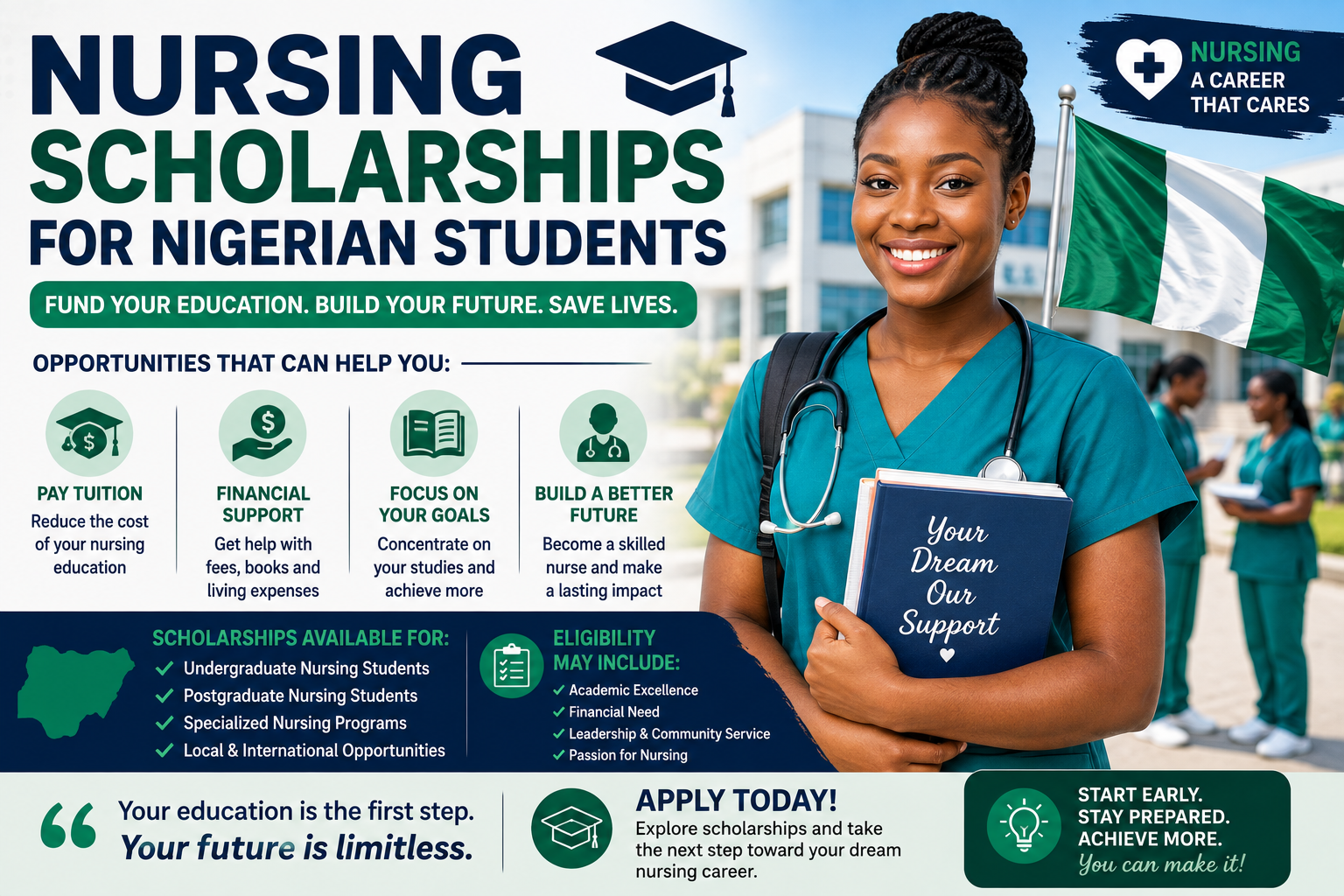
Nursing scholarships for Nigerian students can help reduce the financial pressure associated with studying for a nursing qualification. Whether you are preparing to study Nursing Science in Nigeria or exploring postgraduate opportunities abroad, scholarships, bursaries, tuition discounts and other funding opportunities may be available.
Nursing education can involve significant expenses. Students may need to pay for tuition, accommodation, textbooks, uniforms, transportation, clinical training materials and other academic costs. For many families, these expenses can make it difficult to complete a nursing programme without financial support.
The good news is that Nigerian nursing students can explore funding opportunities offered by government institutions, universities, scholarship foundations, professional organizations, international programmes and private institutions. However, it is important to understand that scholarships are competitive, eligibility requirements differ and funding availability can change from year to year.
This guide explains how to find nursing scholarships for Nigerian students, the common requirements, the types of scholarships available and practical steps to submit stronger applications.
Nursing Scholarships for Nigerian Students: What You Need to Know
A nursing scholarship is a form of financial support designed to help eligible students pay some or all of the costs associated with their education.
Scholarships may be awarded based on factors such as:
- Academic performance
- Financial need
- Leadership ability
- Community service
- Professional goals
- Course of study
- Nationality
- Gender or demographic eligibility
- University admission
- Research interests
- Healthcare experience
Some scholarships cover only part of tuition, while others may provide more extensive support.
Depending on the programme, a scholarship may include:
- Full tuition
- Partial tuition
- Living expenses
- Accommodation support
- Books and study materials
- Research funding
- Travel support
- Health insurance
- Monthly stipends
Applicants should always read the scholarship terms carefully. A scholarship described as “fully funded” should not automatically be assumed to cover every personal expense unless the official award information specifically states what is included.
Types of Nursing Scholarships Available to Nigerian Students
Nigerian students can search for several categories of nursing scholarships.
1. Undergraduate Nursing Scholarships
Undergraduate scholarships are designed for students pursuing qualifications such as a Bachelor of Nursing or Bachelor of Nursing Science.Bachelor of Nursing or Bachelor of Nursing Science.
These opportunities may be offered by:
- Nigerian universities
- Private universities
- Government agencies
- State scholarship boards
- Educational foundations
- Corporate organizations
- International universities
Eligibility may depend on academic performance, admission status and financial need.
Some scholarships are available to students who have already been admitted, while others may allow prospective students to apply before or during the admission process.
2. Postgraduate Nursing Scholarships
read also: Scholarships Open for Application This Month (Fully Funded & Verified)
Nigerian nurses interested in advancing their education may explore scholarships for:
- Master’s degrees in Nursing
- Nursing Education
- Nursing Administration
- Public Health
- Healthcare Management
- Global Health
- Clinical research
- Specialized nursing fields
Postgraduate scholarships may place greater emphasis on academic qualifications, professional experience, leadership potential and research interests.
A strong academic transcript and a clear statement of purpose can be especially important when applying for competitive international programmes.
3. Government Scholarships
Government-funded scholarships can provide opportunities for eligible Nigerian students studying locally or internationally.
Students should monitor official scholarship announcements from relevant government institutions rather than relying only on social media posts.
Scholarship programmes can change, open and close at different times. Requirements may also be updated.
For this reason, applicants should always verify:
- The official opening date
- Application deadline
- Eligible courses
- Required documents
- Academic requirements
- Funding benefits
- Application process
Avoid paying unofficial agents simply to access scholarship information that is publicly available through an official government portal.
4. University Scholarships
Many universities offer scholarships to outstanding students.
These may be based on:
- Excellent grades
- Leadership achievements
- Financial need
- International student status
- Specific academic departments
- Research ability
Students interested in studying nursing abroad should visit the official website of each university they are considering.
Do not assume that every university scholarship applies to nursing students. Some funding opportunities exclude certain professional programmes or have restrictions based on nationality, degree level or mode of study.
5. Healthcare and Nursing-Related Scholarships
Some organizations provide scholarships specifically for students pursuing careers in healthcare.
These opportunities may support:
- Nursing students
- Public health students
- Healthcare professionals
- Nursing educators
- Researchers
- Students working in underserved communities
Specialized scholarships can sometimes be less competitive than general scholarships because they target a specific academic field or professional group.
6. International Scholarships
Nigerian students can also search for international scholarships.
Potential destinations may include:
- The United Kingdom
- United States
- Canada
- Australia
- Germany
- European countries
- Other countries offering international education programmes
However, applicants should carefully confirm whether the scholarship accepts Nigerian applicants and whether the selected nursing programme is eligible for funding.
A scholarship may support healthcare-related postgraduate study but exclude clinical nursing programmes. This is why reading the full eligibility criteria is essential.
Requirements for Nursing Scholarships for Nigerian Students
There is no single set of requirements that applies to every scholarship. However, many scholarship programmes request similar documents and qualifications.
Academic Records
Applicants may be asked to provide:
- WAEC results
- NECO results
- University transcripts
- Degree certificates
- Professional qualifications
Students should ensure that all academic information is accurate and consistent.
Never alter grades, certificates or transcripts.
Submitting false documents can result in disqualification and may create serious problems with future academic or immigration applications.
Admission Letter
Some scholarships require applicants to have already received admission into an eligible institution.
Others allow students to apply before receiving a final admission decision.
Read the application rules carefully to determine whether you need:
- A conditional offer
- An unconditional offer
- Proof of application
- A current student identification document
Personal Statement
A personal statement is often one of the most important parts of a scholarship application.
Your statement should explain:
- Why you chose nursing
- Your academic and professional goals
- Your relevant experiences
- The challenges you have overcome
- How the scholarship would support your education
- How you plan to use your knowledge in the future
Avoid copying personal statements from the internet.
Scholarship committees can often identify generic or recycled applications.
A stronger approach is to write honestly about your own journey.
For example, you might explain how volunteering, caring for a family member, working in a healthcare environment or observing challenges in your community influenced your decision to pursue nursing.
Recommendation Letters
Some scholarships request recommendation letters from:
- Lecturers
- Employers
- Supervisors
- School administrators
- Professional mentors
Choose referees who know your academic ability, work ethic or professional potential.
Give them enough time to prepare a thoughtful recommendation.
Do not wait until the final day before asking someone to support your application.
Evidence of Financial Need
Need-based scholarships may request information about your financial circumstances.
Applicants should provide truthful information.
Possible supporting documents may include:
- Income information
- Financial statements
- Letters explaining financial circumstances
- Evidence of family responsibilities
Never exaggerate or invent financial hardship.
How to Find Nursing Scholarships for Nigerian Students
Finding legitimate scholarships requires patience and consistent research.
Start With Official Government Sources
Government scholarship agencies and education ministries may publish information about local and international opportunities.
These sources can be useful for finding:
- Federal scholarships
- Bilateral education opportunities
- International scholarship nominations
- Healthcare and medical education support
- Undergraduate and postgraduate funding
Because scholarship cycles change, visit official websites regularly.
Do not depend on an old blog post announcing a scholarship from several years ago.
Search University Websites
If you already know where you want to study, go directly to the university’s official website.
Look for sections such as:
- Scholarships
- Financial Aid
- International Students
- Funding
- Graduate Scholarships
- Nursing School Funding
University funding may be awarded automatically based on academic performance or may require a separate application.
Check Professional and Healthcare Organizations
Nursing associations, healthcare charities and professional organizations may occasionally offer scholarships, grants or professional development funding.
These opportunities may be particularly useful for:
- Registered nurses
- Graduate students
- Nursing researchers
- Nurse educators
- Public health professionals
Always confirm that the organization is legitimate before submitting documents.
Use Scholarship Search Platforms Carefully
Scholarship databases can help you discover opportunities, but the final verification should always happen on the official scholarship website.
A scholarship listing can become outdated.
Before applying, check:
- Whether applications are currently open
- The official deadline
- Eligibility requirements
- The organization offering the award
- Whether there is an application fee
Be cautious of websites that guarantee scholarship success.
No legitimate scholarship platform can guarantee that every applicant will receive funding.
How to Improve Your Chances of Winning a Nursing Scholarship
Apply Early
Many students wait until the deadline is close.
Starting early gives you time to:
- Request transcripts
- Prepare your personal statement
- Contact referees
- Review your application
- Correct mistakes
- Upload documents
Create a scholarship calendar to track important deadlines.
Apply for Multiple Opportunities
Applying for one scholarship can be risky because competitive awards often receive many applications.
A better strategy is to apply for multiple opportunities for which you genuinely qualify.
However, quality matters.
Do not submit the same generic application to every scholarship.
Customize your application when necessary.
Build a Strong Academic Profile
Good grades can improve eligibility for merit-based scholarships.
Focus on:
- Maintaining a strong GPA
- Completing assignments successfully
- Participating actively in academic activities
- Developing research skills
- Building relationships with lecturers
Academic performance may not be the only selection factor, but it can be important.
Develop Leadership and Community Experience
Scholarship providers often want to support students who demonstrate potential beyond the classroom.
You can strengthen your profile through:
- Volunteering
- Community health education
- Student leadership
- Public health campaigns
- Peer mentoring
- Charitable activities
Choose activities that genuinely interest you rather than participating only to make your CV longer.
Highlight Your Nursing Goals
A strong nursing scholarship application should demonstrate direction.
Think about questions such as:
- What type of nurse do I want to become?
- What healthcare problems interest me?
- What population do I hope to serve?
- How will additional education improve my ability to contribute?
Clear goals can make an application more memorable.
Scholarships for Nigerian Students Studying Nursing in Nigeria
Students studying nursing in Nigeria should not focus exclusively on foreign scholarships.
Local opportunities may include:
- Federal government scholarships
- State government bursaries
- University scholarships
- Private foundation scholarships
- Corporate educational support
- Healthcare-related grants
Eligibility can depend on the institution, state of origin, academic performance and other programme-specific criteria.
Nursing students should also check whether their university or nursing school has internal scholarships or hardship funds.
Speak with:
- The student affairs office
- Financial aid office
- Nursing department
- Scholarship office
Some students miss opportunities simply because they never ask about available institutional support.
Nursing Scholarships for Nigerians Who Want to Study Abroad
Studying nursing abroad can be expensive, particularly because professional programs may have additional costs for clinical training, equipment and licensing.
Before applying, calculate the total expected cost.
Consider:
- Tuition
- Accommodation
- Transportation
- Health insurance
- Visa expenses
- Books
- Uniforms
- Clinical materials
- Professional examination fees
Do not apply for a scholarship simply because the award amount sounds large.
For example, a scholarship worth a few thousand dollars may be valuable but still leave a significant funding gap.
Look for the exact financial benefits provided.
Also confirm whether the nursing programme accepts international students.
Some countries and institutions have restrictions affecting clinical placements, professional registration or financial support for international students.
Important Warning About Nursing Scholarship Scams
Scholarship scams can target students who are eager to study abroad.
Be cautious if someone:
- Guarantees that you will win a scholarship
- Requests a large payment to “secure” an award
- Promises admission without reviewing your qualifications
- Uses an unofficial email address
- Pressures you to pay immediately
- Requests false documents
- Claims you can receive a scholarship without applying
A legitimate scholarship may sometimes charge an official application fee through the university’s normal admissions process, but applicants should be suspicious of individuals requesting private payments to “process” or “guarantee” scholarship approval.
Always verify the scholarship through:
- The official university website
- The official government website
- The scholarship provider’s official website
How to Write a Strong Nursing Scholarship Essay
Your essay should be personal, focused and easy to understand.
A useful structure is:
Introduction
Briefly introduce yourself and explain your interest in nursing.
Your Background
Describe an experience that influenced your decision to pursue a healthcare career.
Academic and Professional Goals
Explain what you hope to achieve through your education.
Community Impact
Describe how you intend to use your nursing knowledge to help others.
Why You Need the Scholarship
Explain how financial support would help you continue your education.
Conclusion
End with a confident summary of your goals and commitment.
Avoid using dramatic stories that are not true.
Authenticity is more valuable than trying to create a perfect story.
Documents to Prepare Before Applying
Create a scholarship folder containing:
- Academic transcripts
- Certificates
- Passport photograph
- Valid identification
- CV or résumé
- Personal statement
- Recommendation letters
- Proof of admission, where required
- Professional certificates
- Volunteer certificates
- Evidence of work experience
Keep digital copies in a secure location.
Use clear file names such as:
Firstname_Lastname_Transcript.pdf
instead of:
document-final-new2.pdf
Organized documents make the application process easier.
Frequently Asked Questions
Are there nursing scholarships for Nigerian students?
Yes. Nigerian students can explore scholarships offered by government institutions, universities, private organizations, foundations and international scholarship programmes. Eligibility and funding vary by programme.
Can undergraduate nursing students get scholarships?
Yes. Some scholarships support undergraduate students studying Nursing Science or related healthcare programmes. Applicants should confirm that nursing is included among the eligible courses.
Can Nigerian nurses get postgraduate scholarships abroad?
Yes. Nigerian nurses may find funding opportunities for master’s degrees, research programmes, public health, nursing administration and other eligible postgraduate fields.
Do I need excellent grades to win a nursing scholarship?
Not always. Merit-based scholarships may place strong emphasis on academic performance, while other awards may consider financial need, leadership, community service or professional experience.
Are fully funded nursing scholarships available?
Some scholarship programmes provide extensive funding, but benefits differ. Always check whether the award covers tuition only or also includes accommodation, travel, health insurance and living expenses.
Can I apply for several scholarships?
Yes, provided the scholarship rules allow it. However, if you receive more than one award, check whether either provider restricts simultaneous funding.
Do nursing scholarships guarantee admission?
No. A scholarship and university admission are often separate processes. Receiving one does not automatically guarantee the other unless the programme specifically states otherwise.
Final Thoughts
Nursing scholarships for Nigerian students can create valuable opportunities for people who want to develop careers in healthcare but need financial assistance to continue their education.
The best approach is to begin your search early, focus on legitimate opportunities and submit applications that accurately reflect your academic achievements, experiences and professional goals.
Do not limit yourself to one scholarship. Explore government programmes, universities, healthcare organizations and other verified funding sources.
Most importantly, avoid shortcuts.
There is no guaranteed formula for winning every scholarship. Strong academic performance, a well-prepared application, clear career goals and careful attention to eligibility requirements can improve your chances, but selection remains competitive.
Keep checking official scholarship sources, prepare your documents in advance and apply only for opportunities where you meet the stated requirements. With patience and consistent effort, Nigerian students pursuing nursing can identify funding opportunities that may help them move closer to their educational and professional goals.