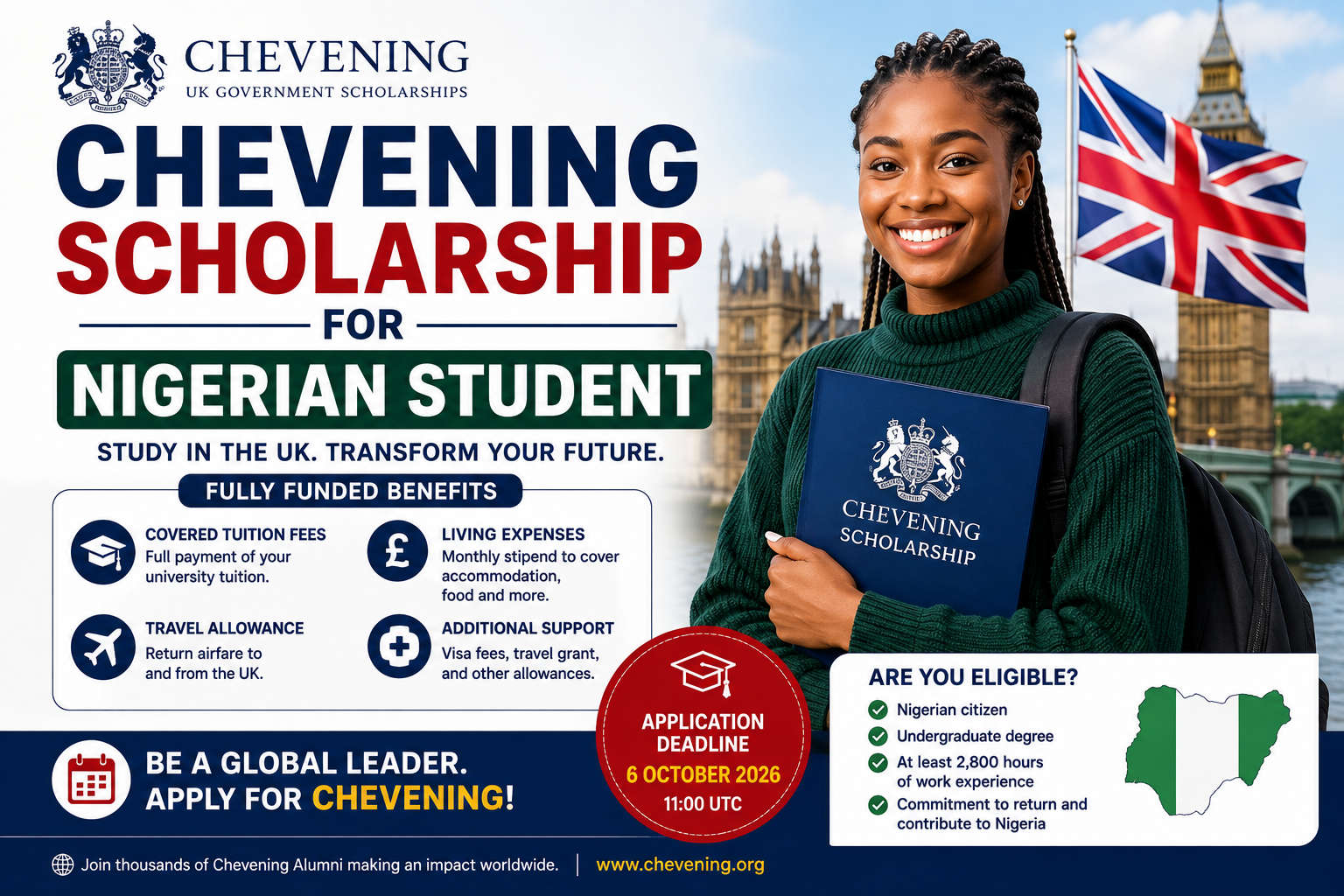
The Chevening scholarship for Nigerian student applicants is one of the most competitive opportunities for Nigerians who want to pursue an eligible one-year master’s degree in the United Kingdom. Funded by the UK government through the Foreign, Commonwealth & Development Office and partner organizations, Chevening focuses on academic potential, leadership, professional experience, networking, and a clear vision for the future.
The article below is written in an original, SEO-friendly style and avoids unsupported claims or promises of guaranteed selection. Because Chevening rules and application dates can change by cycle, applicants should always verify current requirements through official sources.
What Is the Chevening Scholarship?
The Chevening Scholarship is a prestigious international scholarship program funded by the UK government through the Foreign, Commonwealth & Development Office and partner organizations. It gives exceptional future leaders from eligible countries and territories the opportunity to pursue an eligible one-year taught master’s degree in the United Kingdom.
Nigeria is a Chevening-eligible country, and the official Nigeria page confirms that applications for the 2027–2028 Chevening Scholarship cycle are open from 4 August 2026 until 6 October 2026 at 11:00 UTC.
For Nigerian professionals who have already completed an undergraduate degree and gained relevant work experience, Chevening can be a major opportunity to obtain a UK master’s degree while joining an international network of scholars, professionals, and leaders.
However, Chevening is highly competitive. A strong academic record is important, but selection is not based on grades alone. Applicants must also demonstrate leadership, influencing ability, professional experience, relationship-building skills, and a convincing plan for the future.
Is Chevening Scholarship Available to Nigerian Students?
Yes. Nigerian citizens who meet the published eligibility requirements can apply for a Chevening Scholarship through the official Chevening application system.
The program is intended for applicants who want to study an eligible UK master’s degree and then use the knowledge, skills, and networks gained to create positive impact in their home country or area of influence.
The official Nigeria page also highlights Chevening’s focus on future leaders who can contribute to areas of shared priority between the UK and their home countries.
This means your application should not focus only on statements such as:
“I want to study in the UK because the universities are excellent.”
A stronger application explains:
- What you have achieved already.
- How you have demonstrated leadership or influence.
- The problems you want to help solve.
- Why your chosen master’s degree is necessary.
- How studying in the UK fits into your career plan.
- What you intend to do after returning home.
Chevening Scholarship Benefits
read also:Funded Scholarship for Nigerian Students: A Complete Guide to Finding and Applying for Opportunities
Chevening provides a comprehensive scholarship package, but applicants should always check the terms and conditions for their specific award cycle.
A typical Chevening Scholarship can include support for:
- University tuition fees, subject to program terms.
- Travel to and from the UK.
- An arrival allowance where applicable.
- A departure allowance where applicable.
- Visa-related costs.
- A monthly living allowance or stipend.
- Other allowances specified in the final award terms.
The exact funding package should always be confirmed through the official Chevening guidance before making financial decisions.
Important Note for MBA Applicants
Applicants considering an MBA should pay special attention to Chevening’s current rules. Some MBA programs may have tuition costs that exceed the scholarship’s applicable contribution or cap, meaning the student could be responsible for additional costs. Always check the latest official course and funding guidance before choosing an MBA program.
Chevening Scholarship Eligibility Requirements for Nigerian Students
Before spending time writing essays, make sure you meet the minimum eligibility requirements.
According to Chevening’s current published criteria, applicants must meet several conditions.
1. You Must Be Eligible for a Chevening Award
Nigeria is included among the countries eligible for Chevening Scholarships. Nigerian applicants should apply through the official Chevening Nigeria page.
2. You Must Have an Undergraduate Degree
Applicants must hold an undergraduate qualification that makes them eligible for admission to a UK master’s program.
Chevening’s current eligibility guidance also states that applicants must have completed their undergraduate studies at least two years before the application deadline, although the certificate may need to be provided by the interview stage.
3. You Need at Least 2,800 Hours of Work Experience
One of the most important Chevening requirements is work experience.
For the current cycle, applicants need at least 2,800 hours of work experience acquired after completing their undergraduate degree. Chevening describes this as roughly equivalent to two years of full-time work based on a 35-hour week, and the experience must also meet the program’s minimum timing requirements.
Eligible experience can include:
- Full-time employment.
- Part-time employment.
- Voluntary work.
- Paid internships.
- Unpaid internships.
Applicants can enter up to 15 employment periods in the application system to meet the required experience.
This is particularly important for recent Nigerian graduates. If you do not meet the required work experience before submitting the application, you should not assume that experience you will gain later will make the application eligible. Chevening states that applicants must meet the minimum requirement before applying.
4. You Must Return to Your Home Country
Chevening scholars must commit to returning to their home country or country of award for at least two years after the scholarship ends. This is a central condition of the program.
For Nigerian applicants, this requirement should influence long-term career planning. Your application should clearly show how you intend to use your education, experience, and international network after the program.
5. You Must Apply to Three Eligible UK Master’s Courses
Chevening requires applicants to select three eligible UK master’s courses in their application.
Applicants must eventually receive an unconditional offer from at least one of their selected courses by the deadline on the official application timeline.
Do not select courses randomly.
Your three choices should support a logical career direction. If you choose three completely unrelated programs, it may become difficult to explain your academic and professional goals convincingly.
Chevening Scholarship Application Timeline for 2027–2028
For the current 2027–2028 cycle, the official timeline states:
- 4 August 2026: Applications opened.
- 6 October 2026 at 11:00 UTC: Application deadline.
- October 2026 onward: Eligibility screening.
- Mid-October 2026 to January 2027: Applications assessed by independent reading committees.
- Mid-February 2027: Shortlisted applicants invited to interview.
- March to April 2027: Interviews take place.
- Mid-June 2027: Results announced.
- 8 July 2027: Deadline to submit at least one unconditional UK university offer.
- September or October 2027: Successful scholars begin their studies in the UK.
Applicants should not wait until the final day to submit. Technical problems, incomplete information, or simple mistakes can create unnecessary problems.
How to Apply for the Chevening Scholarship
The application process is completed through the official Chevening online application system.
Step 1: Check Your Eligibility
Before creating your application, confirm that you meet the requirements for:
- Nationality.
- Undergraduate education.
- Work experience.
- Return commitment.
- UK master’s course eligibility.
Chevening applications that fail the eligibility criteria can be rejected.
Step 2: Research Your Three Master’s Courses
Spend time researching UK universities before completing the scholarship application.
Look at:
- Course content.
- Entry requirements.
- Tuition costs.
- Duration.
- Career relevance.
- Location.
- Faculty expertise.
Chevening Scholarships are intended for eligible master’s study, and the official guidance recommends researching and selecting appropriate one-year taught master’s programs.
Step 3: Prepare Your Work History
The online system allows applicants to enter their work experience.
Make sure that:
- Dates are accurate.
- Hours worked are realistic.
- Employment periods are not duplicated.
- Your work was acquired after completing your undergraduate degree.
Chevening identifies incorrect work-experience information as a common application problem.
Step 4: Write Your Application Responses
This is where many applicants either strengthen or weaken their chances.
Your answers should be:
- Original.
- Specific.
- Honest.
- Well structured.
- Focused on real experiences.
Do not copy another person’s successful Chevening essay from the internet.
Chevening states that applications undergo plagiarism screening, so originality is essential.
How to Write a Strong Chevening Leadership Essay
Chevening wants evidence, not labels.
Do not simply say:
“I am a great leader.”
Instead, tell a story that demonstrates leadership.
A useful structure is:
Situation
What problem, challenge, or opportunity existed?
Action
What did you personally do?
Result
What changed because of your contribution?
Lesson
What did you learn, and how has the experience shaped your future?
For example, you might discuss:
- Leading a workplace project.
- Organizing a community initiative.
- Starting a business or social project.
- Managing a team.
- Improving an inefficient process.
- Mentoring younger professionals.
- Influencing others to support a solution.
The strongest examples are specific and supported by clear outcomes.
How to Demonstrate Networking and Relationship-Building Skills
Networking is not simply about collecting contacts.
A strong Chevening example may show how you:
- Built a professional relationship.
- Worked with people from different backgrounds.
- Created a partnership.
- Influenced a decision.
- Maintained a useful professional connection.
- Brought different groups together to achieve a result.
Use a genuine example from your professional, academic, voluntary, or community experience.
Explain what you did personally rather than describing only what your organization achieved.
Choosing the Right UK Master’s Courses
Your course choices should support your long-term goals.
For example:
A Nigerian engineer interested in sustainable infrastructure could select related programs in:
- Civil engineering.
- Sustainable infrastructure.
- Environmental engineering.
A professional interested in public policy could choose courses connected to:
- Public policy.
- Public administration.
- Development policy.
The key is consistency.
Your application should answer one important question:
Why is this master’s degree the right next step in your career?
If your proposed course is different from your current career, that does not automatically make your application weak. Chevening’s guidance explains that applicants changing careers should clearly explain the reason for the change and identify the transferable skills that connect their previous experience to their future goals.
How to Write a Strong Career Plan
A vague career plan can weaken an otherwise strong application.
Avoid statements such as:
“After graduation, I will become a successful leader and transform Nigeria.”
Instead, make your goals specific.
A useful approach is to divide your plan into:
Short-Term Goals
What do you intend to do soon after returning to Nigeria?
For example:
- Return to a particular sector.
- Apply advanced knowledge in your current organization.
- Launch a new initiative.
- Move into a leadership role.
Medium-Term Goals
What do you want to achieve over the next several years?
For example:
- Lead larger projects.
- Build a specialist organization.
- Develop expertise in a particular area.
Long-Term Goals
What larger impact do you hope to create?
Your long-term goal should be ambitious but connected to your previous experience and the master’s program.
Documents You May Need
Requirements can vary by stage of the process, but applicants should be prepared to provide information and documentation relating to:
- Passport or photo identification.
- Undergraduate education.
- Academic qualifications.
- Work experience.
- References.
- UK university applications.
- An unconditional university offer, if successful through the scholarship process.
According to the current timeline, shortlisted applicants invited to interview must upload required documentation, including photo ID, undergraduate qualification documents, and reference letters, at least seven working days before the interview.
Always follow the instructions provided in your own Chevening application account.
Common Mistakes Nigerian Applicants Should Avoid
1. Applying Without Enough Work Experience
Do not guess whether you meet the requirement. Calculate your eligible hours carefully.
2. Exaggerating Achievements
Do not invent leadership positions or results.
Interview panels may ask detailed questions about your examples.
3. Writing Generic Essays
Statements such as “I want to change the world” are too broad without evidence.
Use real experiences and measurable outcomes.
4. Copying Essays
Copied content creates plagiarism risks and can damage your application.
Write your own answers.
5. Choosing Unrelated Courses Without an Explanation
If your courses represent a career change, explain why.
Connect your existing skills to your new direction.
6. Ignoring University Application Deadlines
A Chevening application is not the same as applying to a university.
You must manage both processes carefully.
7. Waiting Until the Last Minute
Start researching courses, gathering information, and drafting your examples well before the deadline.
How to Prepare for the Chevening Interview
If you are shortlisted, expect questions related to the information in your application.
Prepare by reviewing:
- Your leadership examples.
- Your professional experience.
- Your networking experiences.
- Your three course choices.
- Your career plan.
- Your plans for returning to Nigeria.
Do not memories a speech.
Instead, understand your own experiences well enough to discuss them naturally and honestly.
A good preparation technique is to ask yourself:
- Why did I choose this example?
- What was my exact role?
- What was the result?
- What would I do differently?
- How does this experience connect to my future plans?
Consistency between your written application and interview answers is essential.
Frequently Asked Questions
Is the Chevening Scholarship available to Nigerian students?
Yes. Nigeria is a Chevening-eligible country, and the official Nigeria page is accepting applications for the 2027–2028 scholarship cycle until 6 October 2026 at 11:00 UTC.
Is the Chevening Scholarship fully funded?
Chevening provides a comprehensive funding package, which may include tuition support and allowances for major study-related costs according to the terms of the award. Applicants should always check the current official terms for exactly what their scholarship covers.
Can a fresh graduate apply for Chevening?
Usually, an applicant must first meet Chevening’s minimum work experience requirement. For the current cycle, this is at least 2,800 hours of eligible experience acquired after completing an undergraduate degree.
Is there an age limit?
Chevening’s current FAQ states that there is no upper age limit for applicants.
Can voluntary work count toward Chevening experience?
Yes. Chevening states that eligible work experience can include full-time employment, part-time employment, voluntary work, and paid or unpaid internships, provided the experience meets the programs rules.
Do I need an unconditional university offer before submitting the Chevening application?
No. Applicants choose eligible master’s courses during the application process, but successful candidates must meet the university-offer requirement by the deadline on the application timeline. For the 2027–2028 cycle, the deadline is 8 July 2027 at 17:00 BST.
Can I apply if I already have a master’s degree?
Having a master’s degree does not automatically prevent you from applying for another master’s degree through Chevening, provided you meet the other eligibility requirements.
Final Thoughts
The Chevening scholarship for Nigerian student applicants is a major opportunity for professionals who want to pursue a UK master’s degree and use the experience to advance their careers and contribute to positive change.
The strongest applicants do not rely on impressive words alone. They provide evidence of leadership, influence, professional growth, relationship-building, and realistic career goals.
Start by confirming your eligibility. Then choose three master’s programs that clearly support your career direction. Prepare accurate work-experience information, write original essays, and use specific examples to demonstrate your achievements.
For the 2027–2028 cycle, Nigerian applicants have until 6 October 2026 at 11:00 UTC to submit their applications, according to the official Chevening timeline.
Most importantly, avoid unofficial agents who promise guaranteed selection. Chevening is competitive, and no one can legitimately guarantee that an applicant will receive the scholarship.