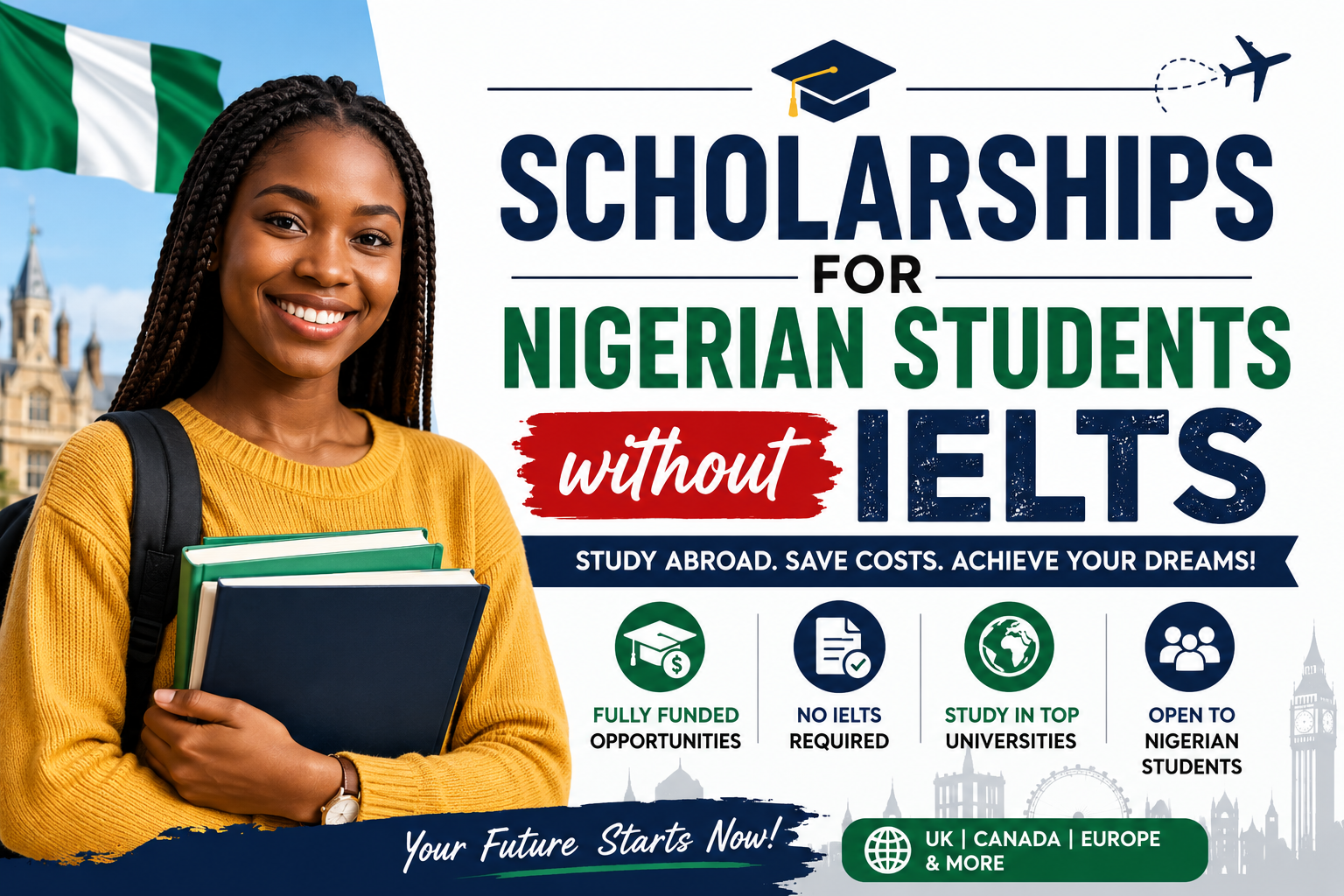
For many Nigerian students, studying abroad is an important academic and career goal. However, the cost of international education is not the only challenge. English-language tests such as IELTS can add another expense and may require weeks or months of preparation.
The good news is that scholarships for Nigerian students without IELTS can be possible, depending on the university, programme, scholarship and method the institution accepts for demonstrating English proficiency.
It is important to understand what “without IELTS” actually means. It does not always mean that a university completely removes its English-language requirement. In many cases, the university may accept another form of evidence instead of IELTS. This could include proof that a previous degree was taught in English, an official statement from the university, another recognized English test, or an institutional assessment.
For example, the University of British Columbia states that applicants from universities in Nigeria are usually not required to provide English-language proficiency examination results for graduate applications, although a graduate programme can still request a language test when necessary.
This guide explains how Nigerian students can find legitimate scholarships that may be available without IELTS, the types of universities to consider, alternative English-language requirements, application strategies, common mistakes and ways to avoid scholarship scams.
What Does “Scholarships for Nigerian Students without IELTS” Mean?
The phrase Scholarships for Nigerian Students without IELTS is commonly used by students searching for international scholarships that do not require an IELTS score.
However, students should distinguish between three different situations.
1. The University Does Not Require IELTS
Some institutions may not require IELTS for applicants from Nigeria under certain circumstances.
For example, UBC’s graduate admissions information says applicants from a university in Nigeria are usually not required to submit an English-language proficiency examination, although individual graduate programs can still request one.
2. The University Accepts Alternative Evidence
A university may require proof of English proficiency but accept something other than IELTS.
Possible alternatives can include:
- TOEFL
- PTE Academic
- Cambridge English qualifications
- A degree taught entirely in English
- An official letter or transcript confirming English as the language of instruction
- An institutional English assessment
The available options depend on the institution.
3. A Scholarship Does Not Mention IELTS
Some scholarships do not list IELTS as a separate scholarship requirement because the scholarship is connected to an academic programme.
In that situation, the university’s admission requirements may still require English-language evidence.
This is why Nigerian students should always check both the scholarship requirements and the university admission requirements.
Can Nigerian Students Study Abroad Without IELTS?
Yes, it can be possible for Nigerian students to study abroad without taking IELTS, but there is no universal rule.
The answer depends on the destination country, university, programme and applicant’s educational background.
For instance, some universities may recognize previous education conducted entirely in English. The University of Oxford allows applicants to request an English-language test waiver in certain circumstances where they have completed a qualifying degree-level course taught and assessed entirely in English. Oxford notes that the waiver is at the discretion of the academic department.
Similarly, some University of Toronto graduate programs accept applicants who completed a qualifying degree where English was the primary language of instruction, subject to the institution’s specific rules.
Therefore, Nigerian applicants should not automatically assume that IELTS is mandatory for every international scholarship.
see also: GREAT Scholarship for Nigerian Students: How to Apply for UK Funding
read also: Chevening Scholarship for Nigerian Student: Complete Guide to Eligibility, Benefits and How to Apply
Why Are Students Searching for Scholarships Without IELTS?
IELTS can be expensive and time-consuming, particularly for students who are already paying for university applications, credential evaluations, visa documentation and other study-abroad costs.
Some students may also have difficulty finding an available test date or travelling to a test center.
Searching for scholarships without IELTS can therefore help students:
- Reduce application expenses.
- Avoid unnecessary testing where an exemption is available.
- Use existing academic records to demonstrate English proficiency.
- Apply to universities with flexible English-language policies.
- Focus on scholarship opportunities that match their academic qualifications.
However, avoiding IELTS should never mean ignoring English-language requirements altogether.
Best Types of Scholarships for Nigerian Students without IELTS
Instead of searching only for scholarships that advertise “no IELTS,” Nigerian students should focus on scholarship programs where the participating university offers alternative ways of satisfying its English requirement.
Here are several categories worth exploring.
1. Erasmus Mundus Joint Master Scholarships
The Erasmus Mundus Joint Masters programme is one of the major international scholarship opportunities Nigerian postgraduate students can investigate.
Erasmus Mundus Joint Masters are delivered by international university consortia, and students can study in multiple countries during their programme.
The European Commission states that students from around the world can apply to Erasmus Mundus Joint Masters, and selected programs can provide full scholarships. These scholarships can contribute to participation costs, travel, visa expenses and living costs.
However, there is an important point about IELTS.
There is no single universal IELTS rule for every Erasmus Mundus programme. Each master’s programme has its own admission requirements.
Therefore, a Nigerian applicant should:
- Find an Erasmus Mundus programme related to their academic background.
- Visit the program’s official website.
- Check its English-language requirements.
- Determine whether IELTS is mandatory.
- Check whether another form of English evidence is accepted.
- Apply for the scholarship through the program’s official application process.
This approach is much safer than relying on websites that simply label every Erasmus Mundus scholarship as “IELTS-free.”
2. University Scholarships in Canada
Canada is another destination Nigerian students can explore.
Some Canadian universities have English-language policies that may allow certain Nigerian applicants to avoid IELTS.
For example, UBC’s graduate school states that applicants from universities in Nigeria are usually not required to provide English-language proficiency examination results as part of their application. However, graduate programs can still request an English test when necessary.
UBC also offers scholarships and awards to international students.
For undergraduate students, UBC says it provides more than $35 million annually in awards, scholarships and other financial support for international undergraduate students. Its International Scholars Program is designed for international students with outstanding academic performance, leadership qualities, community contributions and significant financial need.
This makes Canadian universities worth investigating if you are searching for scholarships for Nigerian students without IELTS.
The key is to check whether your Nigerian qualification qualifies for an English-language exemption.
3. University-Specific Scholarships
One of the best strategies is to search directly through university scholarship pages.
Many universities have their own financial awards for international students.
These scholarships may be based on:
- Academic excellence.
- Leadership.
- Financial need.
- Community service.
- Research interests.
- Specific academic disciplines.
- Nationality.
- Professional achievements.
The advantage of university-specific scholarships is that you can check the admission requirements and scholarship requirements in one place.
If the university accepts an English-medium degree instead of IELTS, you may be able to apply without taking the test.
4. Government-Funded Scholarships
Government scholarship programs can provide significant financial support for international students.
Examples include scholarships funded by governments or government-supported agencies in countries such as the United Kingdom, Canada, Germany, Australia and other countries.
However, applicants should not assume that government-funded scholarships automatically waive IELTS.
The scholarship provider may allow you to apply without IELTS while the university later requires evidence of English proficiency.
Therefore, applicants must examine both stages:
Scholarship eligibility → University admission → English requirement → Visa requirement
This distinction can prevent major problems later.
5. Scholarships Linked to English-Taught Degrees
This is one of the most important routes for Nigerian students.
If your previous degree was taught entirely in English, some universities may accept evidence of this instead of IELTS.
For example, the University of Toronto’s Electrical and Computer Engineering graduate admission information specifically lists Nigeria among countries where applicants completing a degree with English as the uniform language of instruction and examination may not need to provide English-language proficiency proof.
Some programs may require a note on the transcript or official confirmation from the institution.
Therefore, Nigerian students should obtain documents that clearly establish the language of instruction.
Useful documents can include:
- Academic transcript.
- Degree certificate.
- Medium-of-instruction confirmation, where accepted.
- Official university documentation.
- Other evidence specifically requested by the institution.
Universities That May Offer IELTS Alternatives
Different universities have different rules, but several institutions demonstrate that IELTS is not always the only route.
University of British Columbia
UBC provides particularly useful information for Nigerian applicants.
Its graduate school states that applicants from a university in Nigeria are usually not required to submit English-language proficiency examination results. However, graduate programs retain the right to request a language test.
UBC also provides substantial scholarship and award opportunities for international undergraduate students.
University of Toronto
Certain University of Toronto graduate programs recognize previous university education conducted in English.
For example, its Electrical and Computer Engineering graduate admissions page lists Nigeria among countries where qualifying degrees with English as the language of instruction and examination may satisfy the language requirement without additional English testing.
University of Oxford
Oxford has an English-language test waiver process for certain applicants.
The university states that applicants may request a waiver based on previous education when they have completed, or are completing, a qualifying degree-level course taught and assessed entirely in English. The decision is made at the discretion of the academic department.
These examples show why Nigerian students should research university policies instead of assuming IELTS is mandatory everywhere.
Does a Scholarship Without IELTS Mean a Visa Without IELTS?
No.
This is an important distinction.
Being awarded a scholarship without submitting IELTS does not automatically mean you can obtain a student visa without meeting the destination country’s English-language requirements.
For the UK, the Student visa guidance says applicants usually need to prove knowledge of English. However, acceptable evidence can include a qualifying degree taught in English, depending on the circumstances, and a higher education provider may assess English itself for degree-level study.
For a degree from outside the UK, UK government guidance explains that an English-taught degree can be used in relevant circumstances, with an Ecctis assessment required for the applicable visa route.
Therefore, Nigerian students should check:
University requirement + Scholarship requirement + Immigration requirement
All three can be different.
Documents You May Need Instead of IELTS
If a university allows an English-language exemption, you may need to provide alternative documentation.
Depending on the institution, this could include:
Academic Transcript
Your transcript may show the language of instruction or provide evidence that your previous programme was taught in English.
Medium of Instruction Letter
Some universities may accept an official letter from your institution confirming that your programme was taught in English.
However, not every university accepts this document.
For example, UBC Civil Engineering says that when the transcript clearly states that the medium of instruction was English, IELTS or TOEFL may not be required under its stated conditions, while a separate university letter alone is not accepted for that purpose.
Degree Certificate
Your degree certificate may be required as evidence of your academic qualification.
Alternative English Tests
Some institutions may accept tests other than IELTS.
These can include:
- TOEFL
- PTE Academic
- Cambridge English
- Other tests approved by the university
Never assume that an alternative test is accepted. Verify the current list with your chosen university.
How to Apply for Scholarships for Nigerian Students without IELTS
The application process can be straightforward if you plan carefully.
Step 1: Choose Your Study Destination
Decide where you want to study.
Popular destinations include:
- United Kingdom
- Canada
- Germany
- Australia
- United States
- Ireland
- European countries
Your destination will determine the immigration and university requirements you need to satisfy.
Step 2: Select Your Course
Choose a programme that matches your academic background and career plans.
For postgraduate study, make sure your bachelor’s degree meets the entry requirements.
For undergraduate study, check whether your Nigerian secondary-school qualifications are accepted.
Step 3: Search for Scholarships
Look at:
- University scholarship pages.
- Government scholarship portals.
- Official international scholarship platforms.
- Erasmus Mundus programme pages.
- Recognized education organizations.
Step 4: Check English Requirements
This is the most important stage if you want to avoid IELTS.
Look for terms such as:
- English language waiver.
- English proficiency exemption.
- Medium of instruction.
- Previous degree taught in English.
- English language requirement.
- Nigeria-specific requirements.
Step 5: Prepare Your Documents
Start collecting:
- Passport.
- Degree certificate.
- Academic transcripts.
- CV.
- Personal statement.
- Recommendation letters.
- English-language evidence.
- Proof of achievements.
- Financial documents where required.
Step 6: Apply for Admission
Some scholarships require you to apply for university admission first.
Others allow scholarship applications separately.
Follow the exact instructions of the scholarship provider.
Step 7: Apply for the Scholarship
Submit the scholarship application before the stated deadline.
Make your personal statement specific to the scholarship.
Explain:
- What you have achieved.
- Why you selected the course.
- What problem you want to solve.
- How your education will support your goals.
- How you have demonstrated leadership or community impact.
How to Write a Strong Scholarship Personal Statement
A good scholarship statement should not simply say that you need money.
Instead, tell a clear story.
Start with your academic or professional background.
Then explain the problem or area that motivates you.
Next, show what you have already done.
Finally, explain how the proposed programme will help you create greater impact.
For example, instead of writing:
“I need this scholarship because my family cannot afford tuition.”
A stronger approach is to explain your academic achievements, career objectives, relevant community involvement and how financial support would allow you to develop skills that contribute to your long-term goals.
Financial need can be discussed where relevant, but it should not replace evidence of merit and potential.
Common Mistakes to Avoid
Mistake 1: Believing Every “No IELTS” Claim
Some websites advertise scholarships as “100% IELTS-free” without explaining the university’s actual requirements.
Always verify information with the official institution.
Mistake 2: Confusing Scholarship and Admission Requirements
A scholarship may not ask for IELTS, but the university might.
Always check both.
Mistake 3: Ignoring Visa Requirements
A university exemption does not necessarily settle immigration requirements.
Check the current visa rules for your destination.
Mistake 4: Using Fake Documents
Never create or alter a transcript, certificate or English-language letter.
Universities can verify academic documents.
Providing false information can lead to rejection or other serious consequences.
Mistake 5: Waiting Until the Deadline
Scholarship applications can require several documents and references.
Start early.
Mistake 6: Paying for a Guaranteed Scholarship
Be suspicious of anyone who promises a guaranteed international scholarship in exchange for money.
Legitimate scholarships are normally explained through official scholarship or university channels.
How to Improve Your Chances
If you want to compete for scholarships without IELTS, focus on the factors you can control.
Maintain Strong Academic Results
Good academic performance can make you competitive for merit-based scholarships.
Build Leadership Experience
Participate in student organizations, community projects, volunteering and professional activities.
Develop a Strong CV
Include measurable achievements rather than long lists of responsibilities.
Write a Personal Statement That Fits the Scholarship
Avoid sending exactly the same essay to every university.
Apply to Multiple Suitable Opportunities
Do not depend on a single scholarship.
Research several universities and programs that match your qualifications.
Keep Your Documents Ready
Having your transcript, certificates and references available can make the application process much easier.
Are Scholarships without IELTS Fully Funded?
Not necessarily.
The term “without IELTS” refers primarily to the English-language testing requirement.
It does not tell you whether a scholarship covers:
- Tuition.
- Accommodation.
- Food.
- Flights.
- Visa expenses.
- Health insurance.
- Books.
- Transportation.
Some scholarships are fully funded, while others cover only tuition or provide a partial award.
For example, Erasmus Mundus Joint Master scholarships can provide substantial financial support covering participation costs and contributing to travel, visa and living expenses, but the exact details depend on the programme and scholarship arrangement.
Always read the funding section carefully.
Frequently Asked Questions
Can Nigerian students get scholarships without IELTS?
Yes, some Nigerian students may be able to obtain scholarships and admission without IELTS, depending on the university’s English-language policy and accepted alternatives.
Is IELTS compulsory for all Nigerian students?
No. Requirements vary by institution and programme. Some universities provide exemptions or accept alternative evidence.
Can I use my Nigerian university degree instead of IELTS?
Sometimes. Some universities accept a qualifying degree taught entirely in English as evidence of English proficiency. However, the exact conditions vary.
Can I study in Canada without IELTS as a Nigerian?
In some cases, yes. For example, UBC’s graduate admissions guidance says applicants from a university in Nigeria are usually not required to submit an English-language proficiency exam, although individual programs may request one.
Can I study in the UK without IELTS?
It can be possible, depending on how you demonstrate English proficiency and the requirements of your university and visa route. UK government guidance recognizes several ways of proving English knowledge, including certain degrees taught in English.
Does Erasmus Mundus require IELTS?
There is no single IELTS requirement that applies identically to every Erasmus Mundus Joint Master. Each programme sets its own admission requirements, so applicants should check the official programme website.
What can I use instead of IELTS?
Depending on the university, alternatives may include TOEFL, PTE, Cambridge English qualifications, an English-taught degree or other approved evidence.
Is a Medium of Instruction letter always accepted?
No. Some universities accept it, while others require the information to appear on your official transcript or use another verification process. Always check the university’s rules.
Final Thoughts
Finding Scholarships for Nigerian Students without IELTS is possible, but applicants need to approach the process carefully.
The most important lesson is that “without IELTS” does not always mean “without English proficiency requirements.” Instead, it often means that a university may allow another method of demonstrating English ability.
Nigerian students should therefore search beyond scholarship headlines and investigate the actual admission rules of each university.
Universities such as UBC demonstrate that applicants from Nigeria may, under certain graduate admission policies, be exempt from submitting an English-language test. The University of Toronto also provides examples of graduate programs where qualifying Nigerian degrees taught and examined in English can satisfy language requirements. Oxford likewise has a waiver process for certain applicants whose previous education meets its conditions.
At the same time, students should remember that scholarship, admission and visa requirements are separate considerations.
The best strategy is to identify a suitable course, find legitimate scholarship funding, check the university’s specific English-language policy, prepare acceptable documentation and then confirm the immigration requirements for the country where you intend to study.
With careful research and early preparation, Nigerian students can discover international scholarship opportunities without unnecessarily taking an IELTS test when an approved alternative or exemption is available.
Important: Scholarship availability, deadlines and admission policies can change. Always verify the latest requirements directly through the official university, scholarship provider and immigration authority before submitting an application or paying any fees.