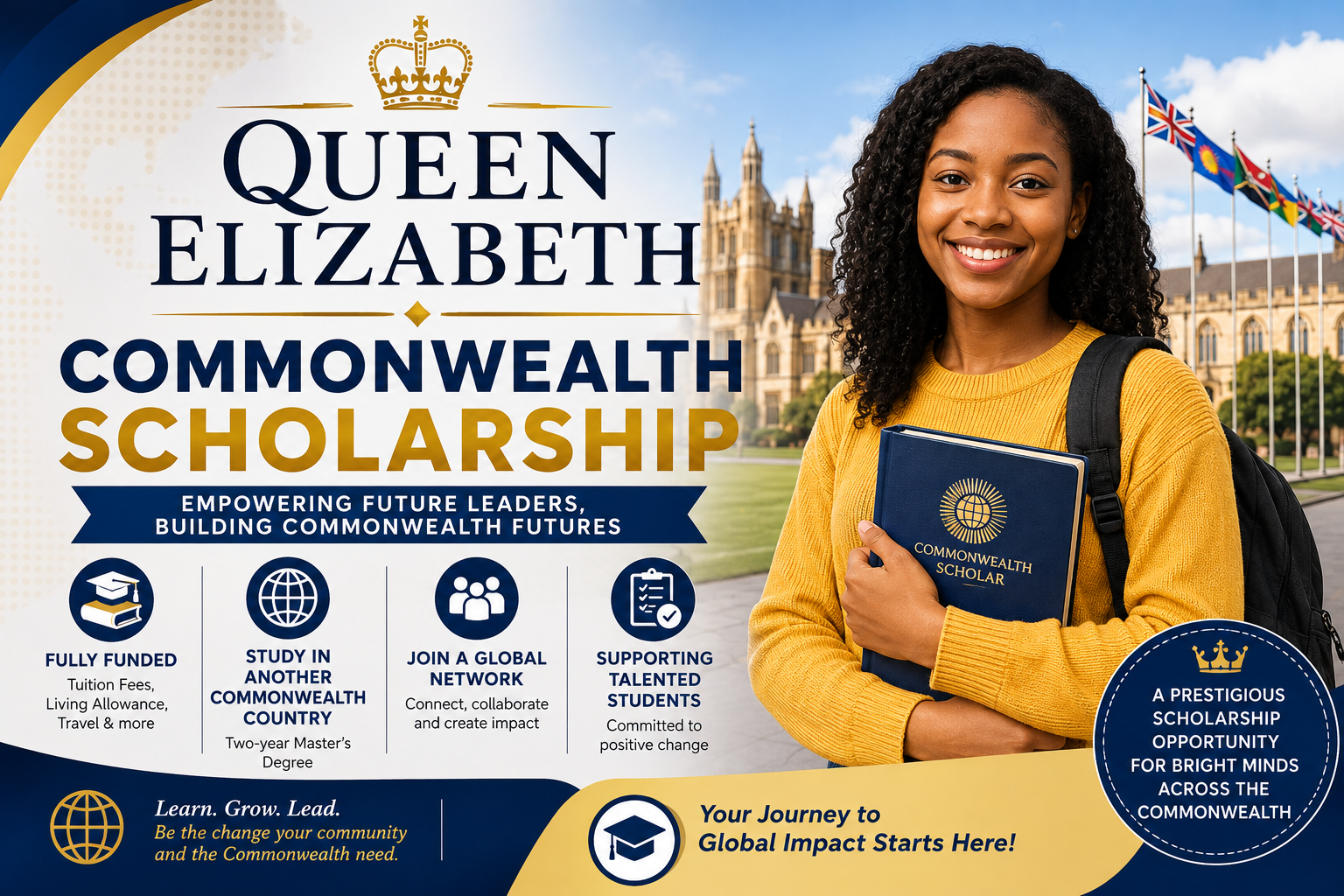
The Queen Elizabeth Commonwealth Scholarship is an international scholarship opportunity designed to support talented students who want to pursue a fully funded master’s degree while gaining international academic and cultural experience.
For students from Commonwealth countries, the programme can provide an opportunity to study in another Commonwealth nation, develop professional networks, gain exposure to a different academic environment and contribute to positive change in their communities.
Unlike some Commonwealth scholarships that fund study in the United Kingdom, the Queen Elizabeth Commonwealth Scholarships are designed around study at participating Association of Commonwealth Universities (ACU) member universities in low- and middle-income Commonwealth countries. The programme normally supports a two-year master’s degree.
This distinction is important for prospective applicants searching online for a “Queen Elizabeth Commonwealth Scholarship UK.” The scholarship is connected to the wider Commonwealth network, but it should not be confused with UK-based Commonwealth Master’s or PhD scholarships administered by the Commonwealth Scholarship Commission in the UK.
This guide explains what the Queen Elizabeth Commonwealth Scholarship is, what it covers, eligibility requirements, the application process, important documents, selection considerations and practical tips for applicants.
What Is the Queen Elizabeth Commonwealth Scholarship?
The Queen Elizabeth Commonwealth Scholarships, commonly abbreviated as QECS, provide opportunities for eligible Commonwealth citizens to study for a two-year master’s degree in a low- or middle-income Commonwealth country.
The programme is intended for students who demonstrate academic potential and a commitment to creating positive change. It also places considerable emphasis on cultural exchange, international collaboration and building relationships between scholars and institutions across the Commonwealth.
Rather than focusing only on financial assistance, QECS is designed to give scholars an international experience that can contribute to their academic, professional and personal development.
A successful scholar may have the opportunity to:
- Study for a master’s degree outside their home country.
- Receive funding toward eligible tuition fees.
- Receive a living allowance.
- Receive return economy airfare to the host country.
- Receive an arrival allowance.
- Request research support, subject to approval.
- Become part of an international community of Commonwealth scholars.
- Experience a new culture and academic environment.
- Develop professional relationships across Commonwealth countries.
The exact participating universities, countries and eligible courses can change from one application cycle to another, so applicants should always check the current official QECS information before applying.
Is the Queen Elizabeth Commonwealth Scholarship for Study in the UK?
READ ALSO: Australian Scholarship Group: Complete Guide to Scholarships in Australia for International Students
SEE ALSO: Finland Scholarship: Complete Guide to Studying in Finland with Financial Aid in 2026
This is one of the most important questions applicants should understand.
The Queen Elizabeth Commonwealth Scholarship is not primarily a scholarship for studying at a UK university.
The programme supports two-year master’s degrees at participating ACU member universities located in low- and middle-income Commonwealth countries.
Students searching specifically for a fully funded master’s degree in the United Kingdom should investigate other opportunities, including Commonwealth Master’s Scholarships administered by the Commonwealth Scholarship Commission.
For example, the Commonwealth Scholarship Commission lists Nigeria among the countries eligible for its Commonwealth Master’s Scholarship programme.
Therefore, applicants should avoid assuming that every scholarship containing the word “Commonwealth” provides funding to study in Britain.
The Queen Elizabeth Commonwealth Scholarship has its own eligibility requirements, participating universities and application process.
Who Can Apply for the Queen Elizabeth Commonwealth Scholarship?
QECS is intended for citizens of eligible Commonwealth countries.
However, being a Commonwealth citizen alone does not guarantee eligibility. Applicants must also meet the academic and programme-specific requirements associated with the scholarship and selected university.
The official QECS guidance states that applicants must have attained at least a 2:1 or equivalent at undergraduate level. Applicants must also select an eligible course at a participating university.
Because participating universities and programmes can change between cycles, candidates should check the current list rather than relying on an old scholarship advertisement.
For Nigerian applicants, this means carefully checking whether Nigeria is included in the relevant application cycle and whether the preferred university and course are available.
Queen Elizabeth Commonwealth Scholarship Eligibility Requirements
Although requirements can vary depending on the participating university and programme, prospective applicants should pay attention to the following areas.
1. Commonwealth Citizenship
The applicant generally needs to be a citizen of an eligible Commonwealth country.
Applicants should verify the current eligible-country list before preparing their application.
2. Undergraduate Degree
Applicants must normally hold an undergraduate qualification that meets the academic standard required by the scholarship.
The official QECS information specifies a minimum of a 2:1 or equivalent at undergraduate level.
International applicants should therefore understand how their national grading system compares with the requirement.
3. Eligible Master’s Programme
The scholarship is not automatically available for every master’s degree.
Applicants must select a course and university included in the particular QECS cycle.
This is extremely important because finding a suitable master’s programme on a university website does not necessarily mean that the programme is funded by QECS.
4. University Admission Requirements
Meeting QECS requirements does not necessarily mean that you automatically meet the admission requirements of your chosen university.
Universities can have additional requirements involving:
- Academic qualifications
- English-language proficiency
- Relevant academic background
- Professional experience
- Research experience
- Personal statements
- References
- Supporting documents
Candidates should therefore examine the university’s own admission requirements before submitting an application.
What Does the Queen Elizabeth Commonwealth Scholarship Cover?
One of the major attractions of the programme is the range of financial support available to successful scholars.
According to the official ACU information, the scholarship includes several forms of support.
1. Fully Funded Tuition Fees
QECS provides funding for eligible tuition fees associated with the approved programme.
This can significantly reduce the financial burden associated with completing a master’s degree overseas.
However, applicants should carefully read the current scholarship terms because not every personal expense is necessarily covered.
2. Living Allowance
Successful scholars receive a living allowance for the duration of the award.
This support is intended to help scholars manage ordinary living expenses while studying.
The amount and payment arrangements should be confirmed in the official scholarship documentation for the relevant cycle.
3. Return Economy Flights
The scholarship includes return economy airfare to the host country.
For an international student, this can remove a significant part of the cost associated with travelling to and from the study destination.
4. Arrival Allowance
QECS also provides a one-off arrival allowance.
This can help a scholar manage some of the initial costs associated with settling into a new country.
5. Research Support Grant
A research support grant may also be available upon request, subject to approval.
Students whose master’s programs involve substantial research should investigate the relevant rules before assuming that additional research expenses will automatically be paid.
How to Apply for the Queen Elizabeth Commonwealth Scholarship
The application process requires careful preparation.
According to the official ACU guidance, applicants should begin by reviewing the participating countries, universities and courses available during the relevant cycle.
A typical process involves the following steps.
Step 1: Research the Available Opportunities
Start by reviewing the current QECS scholarship opportunities.
Look specifically at:
- Host country
- University
- Master’s programme
- Course duration
- Academic requirements
- Additional university requirements
- Application deadline
Do not select a programme simply because its title looks interesting. Make sure it is actually included in the relevant QECS cycle.
Step 2: Check Your Academic Eligibility
Confirm that your undergraduate qualification meets the minimum academic requirement.
The current official QECS guidance states that applicants should have at least a 2:1 or equivalent undergraduate qualification.
If your degree uses a different grading system, research how your qualification is assessed and check the university’s requirements.
Step 3: Research the University
After identifying a suitable QECS programme, visit the official university website.
Look for information about:
- Course structure
- Admission requirements
- Application deadlines
- English-language requirements
- Required documents
- Academic prerequisites
- Application fees, if applicable
- Visa information for international students
Step 4: Prepare Your Documents
Prepare your documents before beginning the application.
Commonly requested documents can include:
- Academic certificates
- University transcripts
- Passport or citizenship documentation
- Curriculum vitae
- Personal statement
- Academic references
- Proof of English proficiency where required
- Other programme-specific documents
The exact requirements can differ, so always follow the current application guidance.
Step 5: Submit the QECS Application
The official ACU guidance directs candidates to complete and submit the QECS application through the official application system.
Applicants who do not already have a myACU account may need to create one.
Step 6: Apply to the University
A scholarship application and university admission application are not necessarily the same thing.
The official QECS guidance instructs applicants to submit an application to their chosen university for admission to the selected course.
Candidates should therefore carefully follow both processes.
When Does the Queen Elizabeth Commonwealth Scholarship Open?
QECS generally has two application opportunities each year.
The ACU states that one cycle normally opens around November/December and another around March/April.
However, applicants should not assume that dates remain identical every year.
For the 2026 cycle currently listed by the ACU, applications for the second round opened on 9 April 2026 and closed on 3 June 2026 at 15:00 UTC.
As of August 2026, that particular application round has therefore closed.
Students planning for a future cycle should monitor the official ACU QECS page for new dates instead of relying on outdated scholarship blogs or social media posts.
What Courses Are Available Under QECS?
The available fields of study can vary by participating university and application cycle.
Depending on the current opportunities, applicants may find programs in areas such as:
- Business and management
- Development studies
- Public health
- Environmental studies
- Agriculture
- Engineering
- Information technology
- Social sciences
- Education
- Law
- Natural sciences
- Other specialist disciplines
There is no guarantee that a particular subject will be available in every cycle.
The safest approach is to begin with the official list of eligible QECS courses and then select a programme that matches your academic background and career plans.
Queen Elizabeth Commonwealth Scholarship for Nigerian Students
Nigerian students are among the audiences who may be interested in Commonwealth scholarship opportunities.
Nigeria is listed among eligible Commonwealth countries for several Commonwealth Scholarship Commission programs, but applicants should understand that eligibility for one Commonwealth programme does not automatically mean eligibility for another. (Scholarship Commonwealth UK)
For Nigerian students interested in QECS, the key steps are:
- Check whether Nigeria is eligible for the relevant QECS cycle.
- Review the available host countries.
- Identify participating universities.
- Find a suitable master’s programme.
- Check the program’s admission requirements.
- Confirm that your undergraduate qualification meets the required standard.
- Prepare strong supporting documents.
- Submit the scholarship application before the deadline.
- Complete the university admission process where required.
Nigerian applicants should also be cautious about websites or individuals claiming to guarantee scholarship awards.
The ACU specifically warns applicants to use official CSC and ACU websites and application systems and to be cautious with third-party organizations requesting personal information or supporting documentation.
How to Write a Strong QECS Personal Statement
Your personal statement can be an important part of a competitive scholarship application.
Instead of simply explaining that you need financial assistance, demonstrate why the scholarship fits your academic and professional goals.
A strong statement can address four major areas.
Academic Motivation
Explain what you want to study and why the programme is important to your academic development.
Career Goals
Show how the master’s degree connects to your future career.
Community Impact
QECS is aimed at students who are committed to creating change.
Explain the problem you want to help solve and how your education could contribute to meaningful solutions.
International Collaboration
Explain how studying in another Commonwealth country could broaden your perspective and help you develop useful international connections.
Avoid making unrealistic promises.
A convincing application should show a practical connection between your education, experience, goals and potential impact.
Tips for Winning the Queen Elizabeth Commonwealth Scholarship
Start Early
Do not wait until the deadline before collecting your documents.
Academic transcripts, references and other supporting materials can take time to obtain.
Choose Your Programme Carefully
A prestigious university is not necessarily the best choice if the programme does not match your academic background or career plans.
Choose a programme that makes sense for your long-term goals.
Demonstrate Impact
Think about the problems you want to address after completing your degree.
Your application should communicate how your education could contribute to your community, profession or wider society.
Follow Instructions
Scholarship applications often contain detailed instructions.
Missing a required document or misunderstanding a question can weaken an otherwise strong application.
Read the application guidance carefully.
Use Official Sources
Scholarship scams are a serious concern.
The ACU has warned prospective applicants about organizations falsely presenting themselves as official partners. It advises candidates to use official scholarship websites and systems.
Never assume that a website is legitimate simply because it uses Commonwealth-related terminology.
Check Deadlines in UTC
International scholarship programs often publish deadlines in Coordinated Universal Time.
Always convert the deadline to your local time and submit your application well before the closing hour.
Common Mistakes to Avoid
Mistake 1: Confusing QECS With UK Commonwealth Scholarships
QECS is not the same as a Commonwealth Master’s or PhD Scholarship for study in the United Kingdom.
Always check the host-country information.
Mistake 2: Applying for an Unlisted Course
Not every course at a participating university is automatically funded.
Only courses listed for the relevant QECS cycle should be considered eligible for QECS funding.
Mistake 3: Waiting Until the Last Day
Technical problems, missing documents and internet disruptions can cause unnecessary stress.
Submit early.
Mistake 4: Using Generic Statements
A generic personal statement can make it difficult for the selection team to understand your motivation.
Make your application specific to your programme, career and impact goals.
Mistake 5: Paying Someone Who Promises an Award
No legitimate consultant can guarantee that you will receive a competitive scholarship.
Use official application systems and verify information directly with the scholarship administrator.
Queen Elizabeth Commonwealth Scholarship vs Other Commonwealth Scholarships
The Commonwealth scholarship landscape includes several different programs.
The Queen Elizabeth Commonwealth Scholarship is focused on two-year master’s study at participating universities in low- and middle-income Commonwealth countries.
The Commonwealth Master’s Scholarship, by contrast, supports master’s study in the UK for eligible candidates from qualifying Commonwealth countries. Nigeria is included on the current eligible-country list. (Scholarship Commonwealth UK)
There are also Commonwealth Shared Scholarships for selected master’s programs at participating UK universities. The CSC states that these are master’s scholarships and not undergraduate or PhD awards. (
This means applicants should identify the exact scholarship programme before beginning an application.
Is the Queen Elizabeth Commonwealth Scholarship Fully Funded?
The QECS is described by the ACU as providing fully funded tuition fees together with a living allowance, return economy airfare, an arrival allowance and potential research support subject to approval.
However, “fully funded” should not be interpreted as meaning that every possible personal expense is automatically covered.
Applicants should read the terms and conditions for the specific award and plan for expenses that may fall outside the scholarship package.
Why Consider the Queen Elizabeth Commonwealth Scholarship?
There are several reasons students may find QECS attractive.
International Education
The programme allows scholars to experience higher education in another Commonwealth country.
Cultural Exchange
Living and studying abroad can expose students to new cultures, perspectives and professional environments.
Financial Support
The scholarship can significantly reduce the cost of earning a master’s degree overseas.
Professional Networking
Scholars can build relationships with students, academics and professionals from different Commonwealth countries.
Personal Development
International study can strengthen communication, independence, adaptability and cross-cultural understanding.
Community Impact
The programme encourages scholars to use their education and international experience to contribute to positive change.
Frequently Asked Questions
What is the Queen Elizabeth Commonwealth Scholarship?
The Queen Elizabeth Commonwealth Scholarship is a scholarship programme supporting eligible Commonwealth citizens pursuing two-year master’s degrees at participating ACU member universities in low- and middle-income Commonwealth countries.
Can Nigerians apply for the Queen Elizabeth Commonwealth Scholarship?
Nigerian students should check the eligible-country list and participating opportunities for the specific application cycle. Eligibility can depend on the current programme and available host universities.
Does QECS fund PhD programs?
No. QECS is designed for two-year master’s study. Students seeking Commonwealth funding for doctoral study should investigate other scholarship programs
Does QECS allow students to study in the UK?
QECS is designed for study at participating ACU member universities in low- and middle-income Commonwealth countries rather than UK-based study.
How long is the scholarship?
The standard QECS award supports a two-year master’s degree.
What does the scholarship cover?
The current official information lists tuition fees, a living allowance, return economy airfare, a one-off arrival allowance and a research support grant upon request and approval.
When should I apply?
QECS normally has two application cycles each year, although exact dates vary. The ACU currently describes one cycle as generally opening around November/December and another around March/April.
Where can I find the official application?
Applicants should use the official ACU QECS information and application system rather than unofficial scholarship websites.
Final Thoughts
The Queen Elizabeth Commonwealth Scholarship can be an excellent opportunity for eligible Commonwealth students seeking an internationally focused master’s education with substantial financial support.
Its value goes beyond tuition funding. Scholars can gain international academic experience, develop relationships across Commonwealth countries, experience a different culture and strengthen their ability to contribute to their communities.
For prospective applicants, preparation is essential. Start by identifying the correct scholarship cycle, checking your eligibility, reviewing participating universities and courses, preparing your documents and developing a clear explanation of your academic and community-impact goals.
Most importantly, remember that QECS is not simply another UK scholarship. Its distinctive feature is the opportunity to undertake a two-year master’s degree at a participating university in a low- or middle-income Commonwealth country.
Students who specifically want to study in the United Kingdom should investigate other Commonwealth scholarship programs, including those administered by the Commonwealth Scholarship Commission. The CSC currently lists Nigeria among the eligible countries for its Commonwealth Master’s Scholarships.
Finally, always verify deadlines, participating universities, eligible courses and requirements using official scholarship sources before submitting an application. Scholarship details can change from one cycle to another, and relying on outdated information can lead to missed opportunities or an ineligible application.
With careful preparation, a well-matched academic programme and a strong explanation of your future goals and potential impact, the Queen Elizabeth Commonwealth Scholarship can be a valuable pathway toward international postgraduate education.