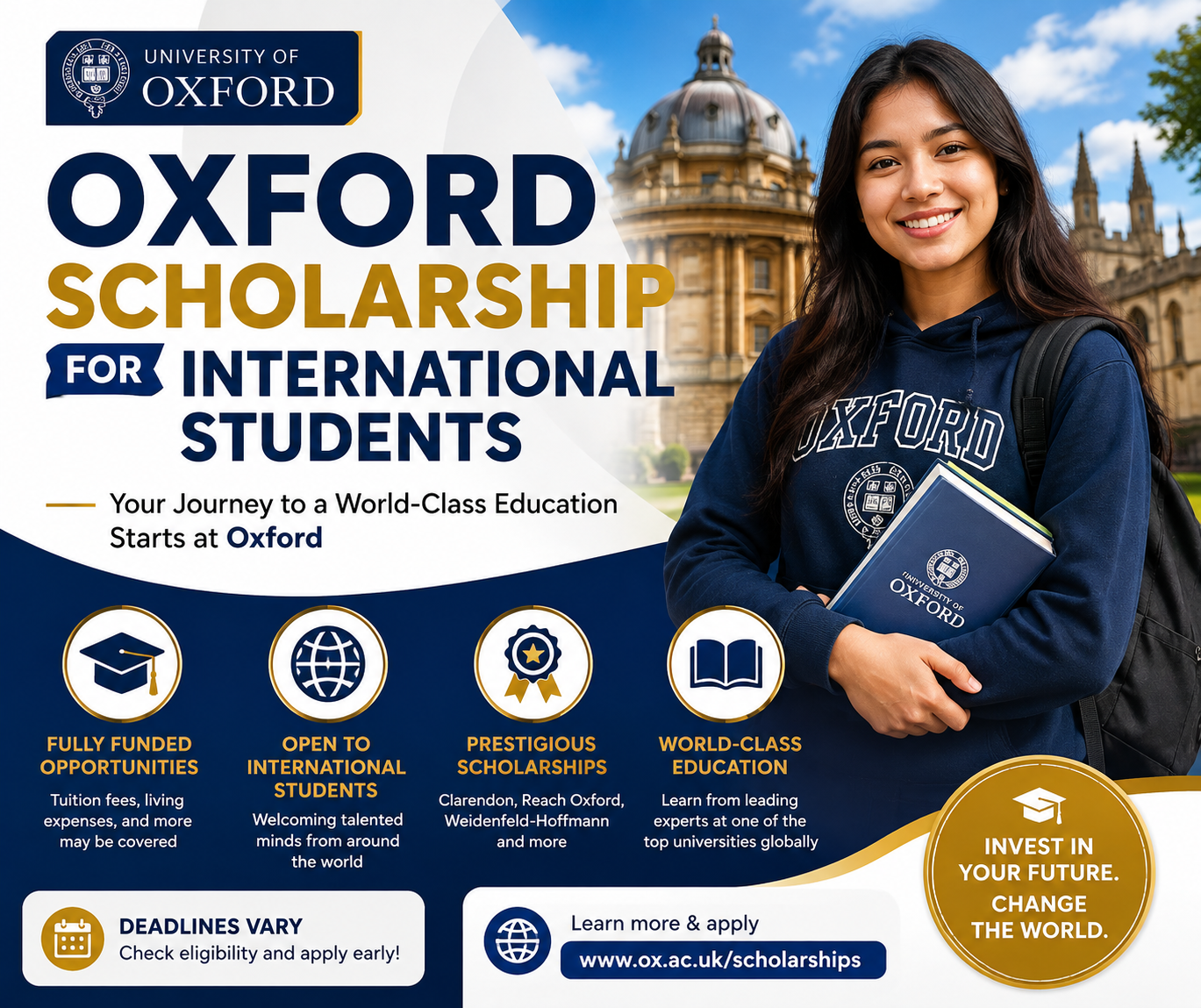
Studying at the University of Oxford is a goal for many students around the world. However, the cost of international education can make an Oxford degree difficult to finance without financial assistance. Fortunately, there are numerous scholarships and funding opportunities available to international students who want to study at Oxford.
The phrase Oxford Scholarship for International Students does not refer to one single scholarship. Instead, it describes a wide range of undergraduate, master’s and doctoral funding opportunities offered by Oxford University, its colleges, academic departments and external organizations.
For the 2026–27 academic year, Oxford says it expects to offer more than 1,100 full or partial graduate scholarships for new students, in addition to external funding opportunities.
Some scholarships cover tuition fees and provide living-cost support, while others may cover only part of the overall cost. Eligibility can depend on nationality, academic subject, degree level, country of residence, financial circumstances and other factors.
This guide explains the major Oxford scholarship opportunities for international students, how funding works, who can apply, what scholarships may cover and how prospective students can improve their chances of receiving an award.
What Is an Oxford Scholarship for International Students?
An Oxford Scholarship for International Students is financial support designed to help eligible students from outside the UK pay for an undergraduate or graduate programme at the University of Oxford.
Oxford has a large number of scholarships rather than one universal award for international applicants.
Some scholarships are open to applicants from virtually any country, while others are restricted to students from particular regions, countries or backgrounds.
For graduate students, Oxford explains that scholarships are generally awarded based on academic excellence and potential, although individual scholarships have their own eligibility criteria. Some awards cover all or part of course fees, while others also provide a grant for living costs.
This means that international students should not search only for scholarships specifically labelled “international student scholarships.” They should also examine Oxford’s wider funding database because many major awards are open to overseas applicants.
Can International Students Get Scholarships at Oxford?
Yes. International students can apply for and receive scholarships at Oxford, although eligibility varies considerably between awards.
One of the strongest examples for graduate students is the Clarendon Fund.
Clarendon provides more than 200 new fully funded scholarships each year and has no nationality, ordinary-residence or subject restrictions. It is available for eligible new master’s and DPhil applicants.
For undergraduate students, the Reach Oxford Scholarship is another important opportunity. It is designed for students from low-income countries who face barriers to studying in their home countries and provides course-fee support, a living-cost grant and one return airfare per year.
Therefore, international students should begin their funding search according to their degree level.
Major Oxford Scholarships for International Students
READ ALSO:Queen Elizabeth Commonwealth Scholarship: A Complete Guide for Students in 2026
SEE ALSO:GREAT Scholarship for Nigerian Students: How to Apply for UK Funding
1. Clarendon Fund
The Clarendon Fund is one of Oxford’s best-known graduate scholarship schemes.
It is particularly attractive to international applicants because there are no restrictions on nationality, ordinary residence or field of study for the scholarship. Eligible full-time and part-time master’s and DPhil applicants can be considered.
What Does Clarendon Cover?
Clarendon scholarships cover course fees and provide a grant for living expenses for the period of fee liability.
For full-time scholars, Oxford states that the annual living-cost grant is at least the UKRI minimum doctoral stipend rate.
How Do You Apply?
One important advantage is that there is normally no separate Clarendon scholarship application.
Applicants who apply for a new master’s or DPhil course by the relevant December or January deadline are automatically considered.
Because Clarendon is highly competitive, applicants should focus on submitting a strong academic application rather than treating the scholarship as an afterthought.
2. Reach Oxford Scholarship
The Reach Oxford Scholarship is primarily an undergraduate opportunity.
It is intended for students from low-income countries who cannot study for a degree in their home country because of political or financial circumstances or because suitable educational facilities are unavailable.
The scholarship can cover:
- Course fees
- A grant for living costs
- One return air fare per year
The award normally lasts for three or four years, depending on the length of the undergraduate course. Oxford indicates that only around two to three awards are available each year, making the competition extremely strong.
Applicants should note that they must first apply for admission to Oxford. Students who have not received an offer of a place cannot be considered for the Reach Oxford Scholarship.
3. Weidenfeld-Hoffmann Scholarships and Leadership Programme
The Weidenfeld-Hoffmann Scholarships and Leadership Programme is another important opportunity for international graduate students.
The programme is aimed mainly at outstanding graduates and professionals from developing and emerging economies who would otherwise struggle to finance their Oxford education.
Applicants must be applying for a new full-time graduate course.
The scholarship also places emphasis on leadership and public impact. Applicants are expected to demonstrate a connection between their chosen subject and their long-term career goals and explain how their future work could contribute to improving public life.
This makes the scholarship particularly relevant for applicants who have clear professional goals involving development, public policy, social impact or related areas.
4. Other Oxford Graduate Scholarships
Clarendon and Weidenfeld-Hoffmann are only two examples.
Oxford maintains a substantial list of graduate scholarships managed by the University, colleges, departments and external organizations.
For the 2026–27 academic year, Oxford’s scholarship information includes awards restricted according to criteria such as nationality, country of residence, academic subject and other characteristics.
Some scholarships may be automatically considered as part of the graduate admissions process, while others require an additional application.
Applicants should therefore never assume that every Oxford scholarship uses the same application procedure.
What Can an Oxford Scholarship Cover?
The amount of financial support depends on the specific scholarship.
A fully funded scholarship may provide substantial assistance with both academic and living expenses.
Possible forms of support include:
Tuition Fees
Some scholarships cover course fees in full.
For example, Clarendon scholarships cover course fees for eligible scholars.
Living Expenses
Certain scholarships provide a grant to help students pay for accommodation, food, transportation and other ordinary living costs.
The amount varies by scholarship.
Travel
Some scholarships, particularly undergraduate awards such as Reach Oxford, provide support for international travel.
Additional Support
Depending on the scholarship, students may receive other forms of assistance.
Because funding packages differ, applicants should read the official scholarship conditions rather than assuming that “fully funded” means every possible expense will be paid.
Oxford Scholarship for International Students: Eligibility Requirements
There is no single eligibility requirement for every Oxford scholarship.
However, applicants should consider several important areas.
Academic Excellence
Academic performance is one of the most important factors in many Oxford scholarships.
Oxford states that its scholarships are usually awarded based on academic excellence and potential, although the exact selection criteria vary.
Applicants should therefore ensure that their academic record is competitive for both the Oxford course and the scholarship.
Course Eligibility
The scholarship may be restricted to particular courses or degree levels.
For example, Clarendon is open across subject areas for eligible master’s and DPhil applicants, while other scholarships may be limited to specific programs.
Nationality or Residence
Some scholarships have no nationality restrictions, while others are specifically designed for applicants from particular countries or regions.
Always check the eligibility requirements for the individual scholarship.
Leadership and Impact
Certain awards consider leadership potential, professional goals and the applicant’s ability to contribute to society.
This is especially relevant to scholarships such as Weidenfeld-Hoffmann.
How to Apply for an Oxford Scholarship as an International Student
The application process depends on the scholarship, but the following approach can help.
Step 1: Choose an Oxford Course
Begin by identifying the degree you want to study.
Oxford offers undergraduate and graduate programs across numerous academic disciplines.
Check the course requirements before searching for funding.
Step 2: Check the Admission Requirements
Review the academic qualifications, language requirements and other conditions for your chosen course.
Remember that scholarship eligibility and course admission are separate considerations.
Step 3: Search for Scholarships
Use Oxford’s official Fees, Funding and Scholarship Search to identify opportunities that may match your profile.
Oxford recommends using the funding search alongside college and department websites because additional funding opportunities may exist.
Step 4: Check the Funding Deadline
Funding deadlines can differ from course deadlines.
Oxford states that for many scholarships, applicants need to submit their course application by the relevant December or January deadline to be considered.
Do not wait until after the funding deadline to submit your Oxford application.
Step 5: Prepare Supporting Documents
Depending on your course and scholarship, you may need documents such as:
- Academic transcripts
- Degree certificates
- Personal statement
- CV
- References
- Research proposal
- Scholarship statement
- English-language evidence
- Other course-specific documents
Only submit documents specifically required by the relevant application.
Step 6: Submit the Application
Complete the Oxford application carefully.
Check every section before submitting and make sure your documents are uploaded in the required format.
How to Improve Your Chances of Winning an Oxford Scholarship
Oxford scholarships are competitive, so simply meeting the minimum eligibility requirements may not be enough.
Build a Strong Academic Profile
Academic performance matters greatly.
Focus on producing excellent results throughout your previous education.
For graduate applicants, relevant research experience, academic achievements and evidence of intellectual potential may strengthen the application.
Choose a Clear Academic Direction
Your application should explain why you want to study your chosen subject.
Avoid vague statements about wanting to study abroad.
Instead, demonstrate a specific academic interest and explain how Oxford fits into your development.
Explain Your Career Goals
Scholarship committees want to understand what you intend to do with your education.
Describe realistic career objectives and show how the Oxford programme could help you reach them.
Demonstrate Impact
If you are applying for a scholarship that emphasizes leadership or social impact, explain how your education could benefit your community, country, profession or wider society.
Use specific examples from your experience.
Write a Strong Personal Statement
Your personal statement should be personal, specific and evidence-based.
Instead of writing:
“I want to study at Oxford because Oxford is one of the best universities in the world.”
Explain why your chosen programme is relevant to your academic background and future plans.
Apply Early
Starting early gives you time to:
- Research scholarships
- Compare courses
- Prepare references
- Review application requirements
- Improve your personal statement
- Obtain official documents
- Check funding deadlines
Oxford itself advises prospective international students to think about funding as early as possible because an offer of admission does not automatically include a scholarship.
Common Mistakes International Students Should Avoid
Mistake 1: Assuming Admission Means Funding
Being accepted into Oxford does not automatically mean you will receive financial support.
Oxford explicitly advises international applicants to plan how they will fund their studies because an offer of a place does not automatically include a scholarship.
Mistake 2: Missing the Funding Deadline
Some scholarships depend on applying by the relevant course funding deadline.
Submitting your application after that deadline can mean losing consideration for certain awards.
Mistake 3: Applying for Every Scholarship Without Checking Eligibility
Not every scholarship is available to every student.
Check nationality, course, degree level and other eligibility requirements before applying.
Mistake 4: Using the Same Personal Statement Everywhere
A generic statement may not address the specific criteria of a scholarship.
Tailor your responses to the scholarship’s objectives.
Mistake 5: Relying on Unofficial Scholarship Websites
Scholarship information changes.
Use Oxford’s official website to verify current deadlines, eligibility requirements and funding amounts.
Is Oxford Free for International Students?
Oxford is not generally free for international students.
International students normally have to pay course fees and living costs unless they receive sufficient funding through scholarships or other financial support.
However, some scholarships can cover course fees and provide living-cost grants.
For example, Clarendon covers course fees and provides a living-cost grant for eligible graduate scholars.
This is why students should begin researching funding before submitting their Oxford application.
How Much Does It Cost to Study at Oxford?
The total cost depends on the programme, fee status and individual living expenses.
Oxford provides course-specific information about fees and encourages prospective students to use its Fees, Funding and Scholarship Search to estimate annual costs for studying and living in Oxford. (Oxford University)
International students should budget for more than tuition alone.
Potential expenses include:
- Accommodation
- Food
- Transportation
- Books and academic materials
- Visa-related expenses
- Health-related costs
- Personal expenses
- Travel
A scholarship can therefore make a significant difference to the overall affordability of an Oxford education.
Oxford Scholarship for International Students from Africa
Students from African countries can find several potential routes to Oxford funding.
The most appropriate opportunity depends on the student’s degree level, nationality, academic field and personal circumstances.
Graduate applicants should investigate broad scholarships such as Clarendon as well as awards restricted by nationality or region.
Applicants from developing and emerging economies may also find opportunities such as Weidenfeld-Hoffmann relevant if they meet its eligibility requirements and demonstrate a strong connection between their studies and long-term public impact.
African students should also research external scholarship organizations in their home countries and international funding bodies.
Oxford’s official funding pages provide information about external scholarships in addition to University-managed awards.
Oxford Scholarship for Nigerian Students
Nigerian students interested in studying at Oxford should consider both Oxford-specific scholarships and external funding opportunities.
The first step is to identify whether you are applying for an undergraduate, master’s or DPhil programme.
For undergraduate applicants, opportunities such as Reach Oxford may be relevant if the applicant meets the specific eligibility criteria.
For graduate applicants, Clarendon is particularly worth investigating because it has no nationality restriction and is open across academic fields for eligible new master’s and DPhil applicants.
Nigerian applicants should also examine scholarships from government agencies, foundations, employers, international organizations and other reputable funders.
Do not pay an individual who promises to secure an Oxford scholarship for you.
Always verify scholarship information using official university or funding-organization websites.
Oxford Scholarship Application Timeline
Planning your application timeline can make the process easier.
Several Months Before Applying
Research:
- Oxford courses
- Admission requirements
- Scholarships
- Funding deadlines
- English-language requirements
- Required documents
Before the Funding Deadline
Prepare your:
- Academic documents
- References
- Personal statement
- Research proposal where applicable
- Scholarship statement where required
December or January
Many Oxford graduate funding opportunities use December or January course deadlines.
For Clarendon, applicants must apply by the relevant December or January deadline for their course to receive automatic consideration.
February to June
Oxford says most scholarships are awarded between late February and June.
Exact notification dates depend on the scholarship.
Frequently Asked Questions About Oxford Scholarship for International Students
Can international students get a full scholarship at Oxford?
Yes. Some Oxford scholarships provide full financial support, including course fees and living-cost funding. Clarendon is one major example for eligible graduate students.
Does Oxford offer scholarships to students from developing countries?
Yes. Oxford offers several scholarships that are available to applicants from developing countries, although eligibility varies by scholarship.
What is the best Oxford scholarship for international students?
There is no single best scholarship for everyone. Clarendon is a major option for graduate applicants because it has no nationality or subject restrictions and provides full course-fee funding plus a living-cost grant for successful scholars.
Can I apply for an Oxford scholarship before being admitted?
The process depends on the scholarship. For many graduate scholarships, scholarship consideration occurs through the graduate admissions application. Reach Oxford, however, requires applicants to apply for admission before they can be considered for the scholarship.
Does Oxford automatically consider students for scholarships?
For many Oxford graduate scholarships, yes. Oxford states that for more than two-thirds of its scholarships, applicants only need to submit their graduate application by the relevant funding deadline to be automatically considered.
However, some scholarships require additional applications.
Can I study any subject with an Oxford scholarship?
Not necessarily.
Some scholarships are open to many subjects, while others are restricted to particular academic fields.
Clarendon is open across subject areas, while individual scholarships can have narrower requirements.
Does Oxford provide scholarships for master’s students?
Yes. Oxford has numerous master’s scholarships, including Clarendon and other University, college, departmental and external awards.
Does Oxford provide scholarships for PhD students?
Yes. Oxford refers to doctoral programs as DPhil programs and offers several scholarships for eligible DPhil applicants, including Clarendon.
Final Thoughts
Finding an Oxford Scholarship for International Students can make an Oxford education significantly more accessible, but applicants need to understand that Oxford does not have one universal scholarship available to every international student.
Instead, the University offers a broad funding landscape that includes undergraduate scholarships, graduate scholarships, college awards, departmental studentships and external funding.
For graduate students, the Clarendon Fund is one of the most important opportunities to investigate because it welcomes eligible applicants regardless of nationality or academic field and provides course-fee funding plus a living-cost grant.
For eligible undergraduate applicants from low-income countries, the Reach Oxford Scholarship can provide course-fee support, living-cost funding and annual return airfare.
Students with strong leadership and public-impact ambitions should also investigate programs such as Weidenfeld-Hoffmann, particularly if their academic and professional goals align with the scholarship’s requirements.
The most important strategy is to start early. Research your Oxford course first, understand its admission requirements, identify scholarships that match your circumstances, prepare your documents carefully and submit your application before the relevant funding deadline.
Remember that scholarship availability and deadlines can change. Always verify current information directly through Oxford University’s official funding and admissions pages before making financial or application decisions.
With strong academic preparation, a clear career direction and a carefully prepared application, international students can compete for some of the significant funding opportunities available at Oxford University.