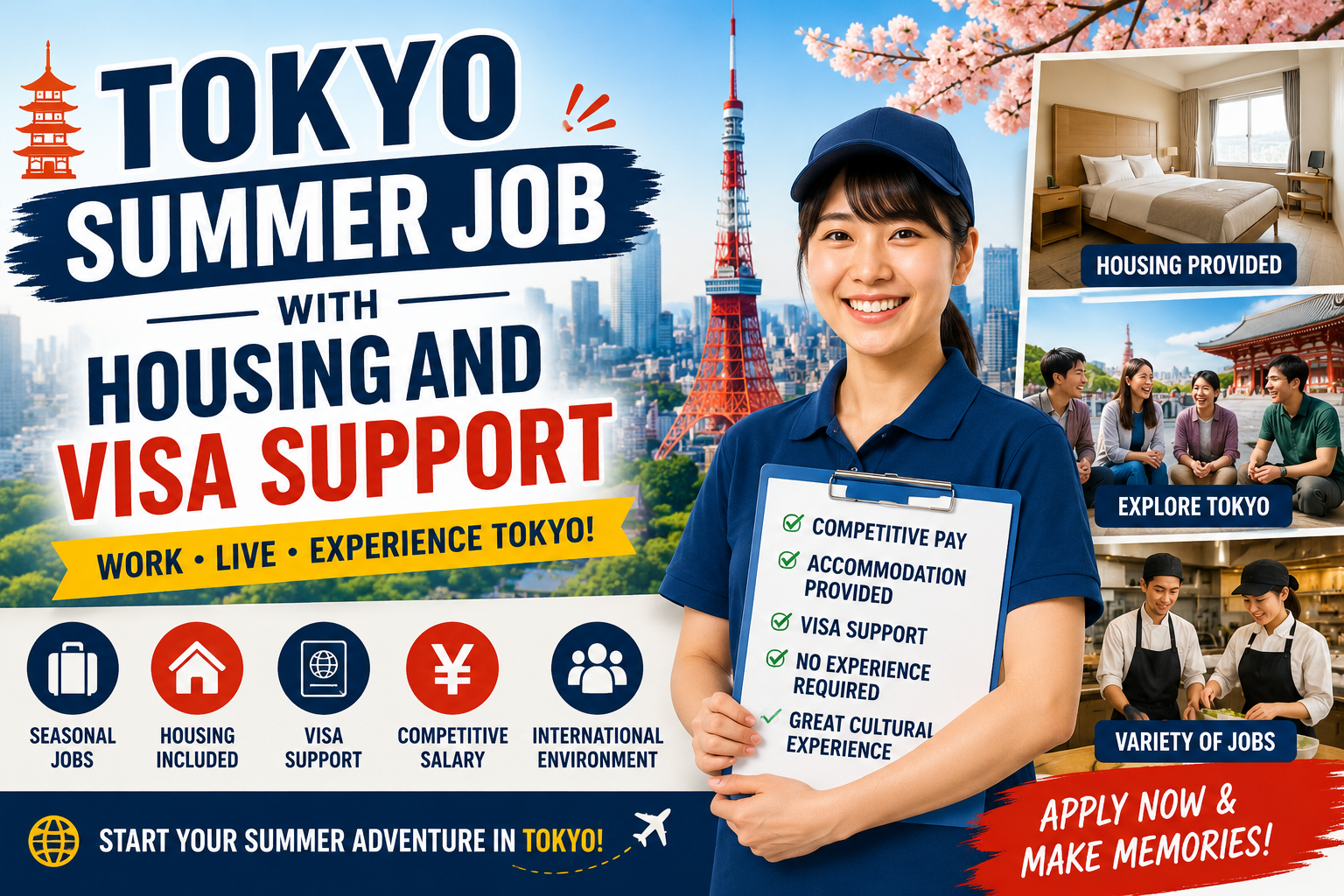
Finding a Tokyo summer job with housing and visa support can be an attractive opportunity for people who want to experience Japan while earning money and developing international work experience. Tokyo is one of the world’s largest cities and has opportunities across hospitality, tourism, food service, cleaning, retail support, events, education, and other sectors.
However, finding legitimate summer employment in Tokyo as a foreign worker requires more than simply searching for a job advertisement. Japan has specific immigration and employment rules, and your ability to work depends on the residence status or permission you hold.
This guide explains how Tokyo summer jobs work, what types of positions may offer accommodation, how visa sponsorship can work, what applicants should prepare, and how to avoid misleading recruitment offers.
Important: A job advertisement saying “visa support” does not necessarily mean the employer will pay every visa-related expense or guarantee approval. Japan’s immigration authorities make the final decision on immigration status and visa issuance. Always verify the employer, contract, work authorization, salary, accommodation terms, and visa requirements before paying money or making travel arrangements.
What Is a Tokyo Summer Job With Housing and Visa Support?
A Tokyo summer job with housing and visa support generally refers to temporary or seasonal employment in Tokyo where an employer or recruitment organization may provide accommodation assistance and help with the immigration paperwork required for lawful employment.
These opportunities can be attractive because housing in Tokyo can be expensive, particularly for people who are unfamiliar with the city. An employer-provided room, dormitory, shared apartment, or housing allowance can reduce the initial cost of relocating.
The phrase “visa support” can have several meanings. For example, an employer may:
- Provide documents needed for an immigration application.
- Help an eligible worker obtain a Certificate of Eligibility.
- Explain the required application process.
- Assist with relocation procedures.
- Provide information about residence status requirements.
- Reimburse certain costs if the employment contract specifically provides for it.
It does not automatically mean a free visa.
Japan’s Ministry of Foreign Affairs explains that many working visa applications involve a Certificate of Eligibility (COE), although a COE itself does not guarantee that a visa will ultimately be issued.
see also: Canada Farm Jobs for Nigerians: Visa Opportunities, Requirements and How to Apply
read also: Warehouse Jobs in USA With Free Visa Sponsorship (Latest Update)
Can Foreigners Get Summer Jobs in Tokyo?
Yes, foreigners can work in Japan when they have an appropriate immigration status or permission to work.
The important issue is not simply whether you have found an employer. Your residence status must authorize the work you intend to perform.
Japan’s immigration authorities state that having a residence card does not automatically mean that a person can work. A foreign national needs a residence status that permits employment or, where applicable, permission to engage in activities outside the original status.
For international students, for example, a Student residence status is primarily for studying. Students who want to work part-time generally need permission for activities outside their status. The official guidance states that students with the relevant comprehensive permission can generally work up to 28 hours per week, with a higher daily limit during designated long school vacations.
This distinction is extremely important for anyone searching for a Tokyo summer job with housing and visa support.
Types of Summer Jobs Available in Tokyo
The exact availability of seasonal work changes from employer to employer. International applicants may encounter opportunities in several broad categories.
1. Hotel and Hospitality Jobs
Tokyo has a large hospitality industry serving domestic and international visitors.
Possible positions can include:
- Hotel housekeeping assistant
- Room attendant
- Kitchen assistant
- Restaurant support worker
- Laundry assistant
- Banquet staff
- Hotel maintenance support
- Guest-service support
Some hospitality employers may offer staff accommodation or assistance locating housing, particularly when workers are recruited from outside the local area.
However, front-desk and guest-facing positions often require stronger Japanese-language skills than back-of-house jobs.
2. Restaurant and Food-Service Jobs
Restaurants, cafés, food courts, catering companies, and hotels may recruit temporary staff during busy periods.
Potential duties include:
- Food preparation assistance
- Dishwashing
- Kitchen cleaning
- Restaurant cleaning
- Stock organization
- Table preparation
- Catering support
- General restaurant assistance
Applicants should carefully check whether the employer accepts foreign workers and whether the required residence status allows the specific position.
3. Cleaning and Housekeeping
Cleaning is another area that can involve entry-level work.
Jobs may include cleaning:
- Hotels
- Offices
- Commercial buildings
- Guest facilities
- Restaurants
- Shared accommodation
These positions may have relatively straightforward duties, but applicants should not assume that no Japanese language ability is required.
4. Warehouse and Logistics Support
Tokyo and surrounding areas have major distribution networks.
Temporary workers may encounter jobs involving:
- Packing
- Sorting
- Labeling
- Inventory assistance
- Loading and unloading
- Order preparation
- General warehouse support
Working conditions can vary significantly. Some jobs involve long periods of standing, repetitive tasks, lifting, or early shifts.
Before accepting an offer, ask about working hours, overtime, transportation, wages, insurance, and accommodation.
5. Event and Tourism Support
During busy travel periods, companies may need temporary workers for events, exhibitions, visitor services, cleaning, food service, or venue preparation.
Some positions may require conversational Japanese or another language.
International applicants should be particularly careful with event jobs because some advertisements posted on social media may not clearly explain whether the worker has legal authorization to perform the job.
6. Agricultural or Rural Seasonal Work Near Tokyo
Not every seasonal job associated with Tokyo is physically located in central Tokyo.
Some employment opportunities may be available in surrounding prefectures or other parts of Japan and may involve:
- Fruit harvesting
- Vegetable work
- Greenhouse assistance
- Farm packing
- Food processing
These jobs can sometimes be more likely to include employer-arranged accommodation because workers are recruited from outside the local area.
If an advertisement says “Tokyo area,” verify the exact work location before applying.
Housing: What Does “Accommodation Provided” Actually Mean?
One of the most attractive parts of a Tokyo summer job with housing and visa support is employer-assisted accommodation.
But “housing provided” can mean different things.
An employer could provide:
- A private room
- A shared room
- A company dormitory
- A shared apartment
- A hostel-style residence
- Temporary accommodation
- A housing allowance
- Assistance finding private accommodation
The accommodation may be completely free, partially subsidized, or deducted from your wages.
Therefore, never rely only on the phrase “free accommodation.”
Ask for the housing terms in writing.
Questions to Ask About Housing
Before accepting a position, ask:
- Is accommodation completely free?
- If not, how much is deducted from my salary?
- Is the room private or shared?
- How many people share the apartment?
- Are utilities included?
- Is internet included?
- Is a security deposit required?
- Is there a cleaning fee?
- How far is the accommodation from the workplace?
- Is transportation provided?
- What happens to the accommodation when the contract ends?
These questions can prevent unexpected expenses.
What Does Visa Support Mean?
Visa support is one of the most misunderstood phrases in international recruitment.
An employer cannot simply promise that an applicant will automatically receive permission to work in Japan.
The correct process depends on the job, nationality, qualifications, and immigration category.
For many long-term work applications, the employer or another authorized party in Japan may help with the Certificate of Eligibility process. The Japanese Ministry of Foreign Affairs notes that the COE confirms that the proposed activity meets the relevant conditions for landing, but it does not guarantee visa issuance.
Therefore, an advertisement offering “visa support” should be understood as potential assistance with the immigration process—not an unconditional promise of a visa.
Japan’s Working Holiday Route
A working holiday arrangement can be one possible route for eligible young people, but it is not available to every nationality.
As of April 1, 2026, Japan’s Ministry of Foreign Affairs lists 32 partner countries and regions under its working holiday programs. The list includes countries such as Australia, New Zealand, Canada, the United Kingdom, France, Germany, Ireland, Denmark, Portugal, Spain, Sweden, Finland, Italy, and others.
Applicants generally need to meet conditions concerning age, nationality, passport, funds, health, and other requirements established under the applicable arrangement.
This means a person should never assume that a Japanese working holiday visa is available simply because they want to take a summer job in Tokyo.
Check the current rules for your nationality through the Japanese embassy or consulate responsible for your country.
What About Applicants From Nigeria?
For Nigerian applicants searching for a Tokyo summer job with housing and visa support, it is especially important to distinguish between a job offer and actual immigration eligibility.
Japan’s 2026 working holiday list published by the Ministry of Foreign Affairs does not include Nigeria among its 32 working holiday partner countries and regions.
Therefore, Nigerian applicants should not assume that they can use a Japanese working holiday route for a summer job.
Instead, they should investigate whether the particular job qualifies under another Japanese residence status and whether the employer is able and willing to support the required immigration process.
A legitimate employer should be able to explain:
- The exact job title.
- The workplace.
- The contract period.
- The applicable residence status.
- Whether the employer provides immigration documents.
- The qualifications required.
- Salary and working hours.
- Accommodation arrangements.
If someone promises a guaranteed Japanese work visa without asking about your job, qualifications, passport, or immigration eligibility, treat the offer with caution.
Do You Need Japanese Language Skills?
Japanese ability can make a major difference in your job search.
Some employers may recruit foreign workers for roles where communication in Japanese is limited. Other jobs—especially customer-facing positions—may require Japanese proficiency.
For example, Japan’s Specified Skilled Worker program has different requirements depending on the field. In the accommodation field, the official program identifies jobs such as hotel reception, hospitality, and restaurant services and specifies Japanese-language and skills requirements.
Consequently, you should not assume that an entry-level job automatically means “no Japanese required.”
Learning basic Japanese can improve your chances of finding work and make daily life easier.
Useful areas to study include:
- Greetings
- Numbers
- Directions
- Workplace instructions
- Food vocabulary
- Safety instructions
- Transportation terms
- Basic customer-service expressions
Does No Experience Mean Anyone Can Get the Job?
Not necessarily.
Some entry-level jobs may accept applicants without previous experience, but employers can still require other conditions.
For example, a company may require:
- Minimum age
- Legal work authorization
- Physical fitness
- Basic communication skills
- Japanese language ability
- Specific immigration status
- Availability during the entire contract
- Background checks
- Health documentation
“No experience required” generally means previous professional experience is not essential. It does not mean there are no eligibility requirements.
How to Find Legitimate Tokyo Summer Jobs
Finding a genuine opportunity requires careful research.
Step 1: Identify Your Immigration Route
Before applying, determine which Japanese residence status could legally cover the work.
Do not start by buying a plane ticket.
Start by determining whether you are legally eligible to perform the proposed job.
Step 2: Research the Employer
Look for:
- Official company website
- Physical business address
- Company registration information
- Contact details
- Employment information
- Reviews from workers
- Written employment conditions
Be cautious if the recruiter refuses to identify the actual employer.
Step 3: Ask for a Written Job Description
The job description should explain:
- Job title
- Duties
- Location
- Working hours
- Contract length
- Pay
- Overtime
- Days off
- Accommodation
- Transportation
- Immigration support
Avoid accepting major employment terms through informal chat messages alone.
Step 4: Verify the Immigration Information
If an employer says it can support your visa or residence-status application, ask exactly what support it provides.
For many work visa categories, documentation from the employer and the appropriate immigration process are important. Japan’s Ministry of Foreign Affairs advises applicants to check the specific requirements applicable to their nationality and visa category.
Step 5: Check the Housing Contract
Never assume accommodation is free simply because an advertisement says “housing included.”
Find out whether the employer charges:
- Rent
- Utilities
- Deposit
- Administration fees
- Cleaning fees
- Transportation charges
Step 6: Keep Copies of Everything
Save copies of:
- Job advertisement
- Employment contract
- Employer correspondence
- Passport documents
- Immigration paperwork
- Accommodation agreement
- Payment receipts
This documentation can be extremely useful if a dispute occurs.
Warning Signs of a Fake Tokyo Job Offer
International job seekers are attractive targets for recruitment scams.
Be particularly careful when an advertisement contains several of these warning signs.
“Guaranteed Visa”
No private recruiter can guarantee that Japanese immigration authorities will approve your application.
Large Upfront Payment
Be cautious when a person demands a large amount of money before providing a verifiable employment contract or official documentation.
No Interview
A company offering overseas employment without asking about your identity, experience, availability, or legal eligibility deserves additional scrutiny.
Unclear Employer
If you cannot determine who will actually employ you, do not rush into payment.
Payment to a Personal Account
A request to send recruitment or visa money to an unrelated individual’s personal account is a serious warning sign.
Fake Immigration Documents
Never use altered or fraudulent immigration documents. Immigration violations can have serious consequences.
Pressure to Act Immediately
Statements such as “pay today or lose your visa” should make you stop and verify the opportunity independently.
What You May Need to Prepare
Requirements vary according to the job and immigration route, but international applicants may need some combination of:
- Valid passport
- Passport photographs
- Employment offer
- Employment contract
- Immigration forms
- Certificate of Eligibility where applicable
- Educational records where required
- Skills certificates where required
- Police or background documentation where required
- Medical documentation where required
- Proof of funds where required
- Japanese-language evidence where required
The exact requirements should always come from the relevant Japanese government authority or Japanese diplomatic mission.
Tokyo Summer Jobs for Students
Students already studying in Japan may have different options from people attempting to enter Japan specifically for temporary employment.
Japan’s official immigration guidance states that international students generally need permission to engage in activities outside their Student status before beginning paid part-time work. The normal limit is 28 hours per week, while work during certain long school vacations can be permitted up to eight hours per day when the relevant permission applies.
This can make summer employment more straightforward for an eligible international student already living in Japan, provided the job complies with the conditions of their permission.
Japan’s Tokyo Employment Service Center for Foreigners also provides employment-related support for foreign nationals and international students.
Benefits of a Tokyo Summer Job
A legitimate summer job in Tokyo can provide several potential advantages.
International Work Experience
Working in Japan can add international experience to your CV and expose you to different workplace practices.
Cultural Experience
Living in Tokyo can provide opportunities to experience Japanese food, language, transportation, traditions, and everyday life.
Reduced Housing Pressure
Employer-supported accommodation can reduce the difficulty of finding a place to live, especially for short-term workers.
Networking
A temporary position can help you meet employers, colleagues, and other international workers.
Language Development
Daily interaction with Japanese speakers can help improve practical communication skills.
Challenges to Consider
Tokyo is an exciting destination, but temporary employment also comes with challenges.
Cost of Living
Tokyo can be expensive, especially when accommodation is not fully subsidized.
Language Barriers
Some jobs require Japanese, and daily tasks can be more difficult without basic language knowledge.
Long Working Hours
Certain entry-level jobs can involve repetitive or physically demanding work.
Immigration Restrictions
You cannot legally perform a job merely because an employer has offered it. Your immigration status must authorize the work.
Temporary Contracts
A summer position may end after a few weeks or months, so you need a plan for your accommodation and finances after the contract ends.
How to Improve Your Chances of Getting Hired
If you want to compete for a Tokyo summer position, start preparing before applications open.
Improve Your CV
Keep your CV clear and easy to read.
Include:
- Education
- Previous employment
- Volunteer experience
- Languages
- Practical skills
- Availability
- Contact information
Even if you have no formal experience, mention transferable skills such as teamwork, punctuality, customer service, physical fitness, computer skills, or communication.
Learn Basic Japanese
Even basic Japanese can demonstrate motivation and make you more useful to employers.
Apply Early
Seasonal positions can attract many applicants. Starting early gives you more time to research employers and complete immigration procedures.
Be Flexible
Consider different roles, locations, shift patterns, and accommodation arrangements.
Verify Before Paying
Never send money simply because an advertisement uses phrases such as “Tokyo summer job,” “visa sponsorship,” or “free accommodation.”
Questions to Ask an Employer
Before signing anything, ask these questions:
Job
- What exactly will I do?
- Where is the workplace?
- How long is the contract?
- How many hours will I work?
Pay
- What is the hourly or monthly salary?
- How is overtime paid?
- When will I receive my salary?
- Are taxes and other deductions explained?
Housing
- Is accommodation free?
- Is the room private or shared?
- What expenses will be deducted?
- How far is it from work?
Visa
- Which residence status applies?
- Who handles the immigration paperwork?
- What documents will the employer provide?
- Which costs are covered or reimbursed?
Travel
- Who pays transportation to Japan?
- Who pays transportation between the accommodation and workplace?
- What happens if the visa is refused?
A trustworthy employer should be willing to explain these matters clearly.
Tokyo Summer Job With Housing and Visa Support: A Practical Checklist
Before accepting an opportunity, use this checklist:
Employment Checklist
- I know the employer’s legal name.
- I have a written job offer.
- I understand my duties.
- I know the work location.
- I understand the contract period.
- I know the salary and deductions.
- I understand the working hours.
Visa Checklist
- I know which immigration status applies.
- I have checked the official requirements.
- I understand what “visa support” means.
- I know which documents the employer provides.
- I understand which costs I must pay.
- I know that visa approval is not guaranteed.
Housing Checklist
- I have written accommodation terms.
- I know whether the room is shared.
- I know the monthly cost.
- I understand utility charges.
- I know the distance from work.
- I know what happens when employment ends.
Frequently Asked Questions
Can I get a Tokyo summer job without experience?
Some entry-level jobs may accept applicants without previous professional experience. However, you still need to satisfy the employer’s requirements and have legal authorization to perform the work.
Can an employer provide visa support?
An employer may assist with immigration documentation or procedures when the relevant employment and residence-status category permits it. However, “visa support” does not mean guaranteed visa approval.
Is accommodation always free?
No. Accommodation may be free, subsidized, shared, or subject to deductions. Always confirm the terms in writing.
Can Nigerians use Japan’s Working Holiday Program?
Japan’s current working holiday list published April 1, 2026 contains 32 partner countries and regions, and Nigeria is not included. Nigerian applicants therefore should not assume that the working holiday route is available to them.
Do I need Japanese to work in Tokyo?
It depends on the position. Some jobs may have limited language requirements, while customer-facing and specialized positions may require Japanese proficiency.
Can international students work during summer?
Eligible international students in Japan can work part-time when they have the required permission. Official guidance states that the normal limit is 28 hours per week, with special rules during designated school vacation periods.
Does a Certificate of Eligibility guarantee a Japanese visa?
No. Japan’s Ministry of Foreign Affairs specifically states that a Certificate of Eligibility does not guarantee visa issuance.
Final Thoughts
A Tokyo summer job with housing and visa support can be an appealing option for international workers who want temporary employment and the opportunity to experience Japan. Hospitality, food service, cleaning, logistics, events, and other entry-level sectors may offer possibilities depending on the season, employer, applicant’s nationality, and immigration status.
The most important point is to separate genuine opportunities from exaggerated recruitment advertisements.
A legitimate opportunity should provide clear information about the employer, job duties, salary, contract, accommodation, and immigration process. You should also understand that visa support is not the same as guaranteed visa approval, and “free accommodation” may have conditions or deductions.
For people outside Japan, immigration eligibility should be checked before making travel arrangements. For students already in Japan, the rules surrounding permission for part-time work are particularly important. Official Japanese government information should be your primary source when confirming whether you can legally work.
If you find an attractive Tokyo summer position, take your time, verify the employer, read the contract carefully, confirm the housing arrangements, and check the applicable immigration requirements. A careful application process can help you avoid scams and make your international work experience safer and more rewarding.