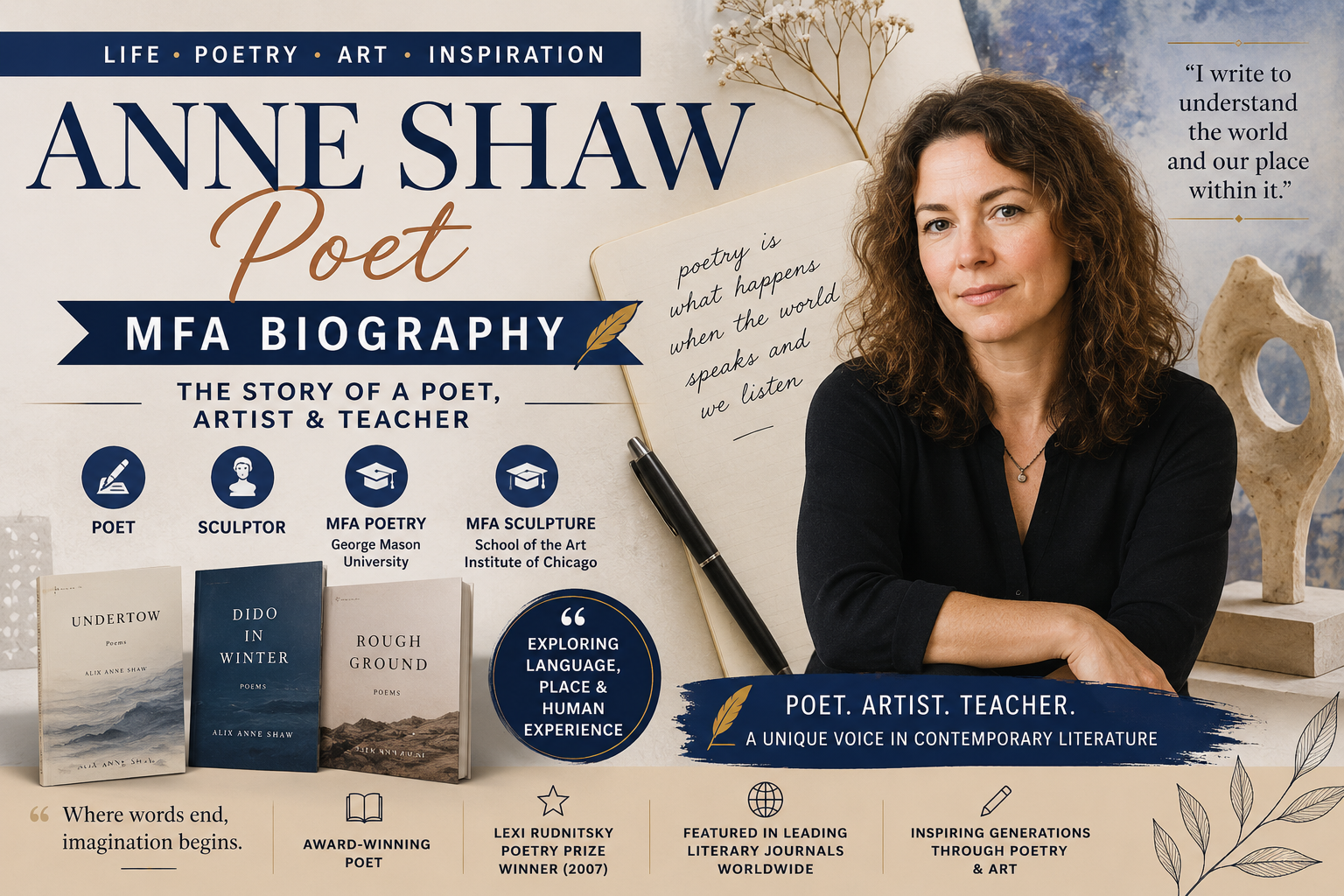
If you are searching for an Anne Shaw poet MFA biography, you are most likely looking for Alix Anne Shaw, an American poet, visual artist, sculptor, and teacher whose work brings together poetry, philosophy, language, travel, memory, and visual art. Shaw has earned attention for her experimental approach to poetry and for creating work that often challenges conventional ideas about language and meaning.
She holds an MFA in Poetry from George Mason University and later earned an MFA in Sculpture from the School of the Art Institute of Chicago. She also earned a bachelor’s degree from Yale University. Her literary career includes the poetry collections Undertow, Dido in Winter, and Rough Ground. Her debut collection, Undertow, won the 2007 Lexi Rudnitsky Poetry Prize, helping establish her as an important contemporary poetic voice.
This Anne Shaw poet MFA biography explores her education, literary career, major books, artistic interests, awards, writing style, and continuing influence.
Who Is Anne Shaw?
Anne Shaw is the name commonly used in searches for Alix Anne Shaw, a contemporary American poet and visual artist. Her literary work has appeared in numerous journals, while her artistic practice extends beyond poetry into sculpture, installation, performance, and other forms of visual expression.
The Academy of American Poets lists her as Alix Anne Shaw and notes that she received an MFA in poetry from George Mason University as well as an MFA in sculpture from the School of the Art Institute of Chicago. The same biography identifies her three major poetry collections as Undertow (2007), Dido in Winter (2014), and Rough Ground (2018).
Her career is particularly interesting because she does not treat poetry and visual art as completely separate disciplines. Instead, her creative practice frequently explores how language, physical materials, space, memory, and human experience interact.
That combination makes Shaw an interesting figure for readers searching for an Anne Shaw poet MFA biography, particularly students and readers interested in contemporary poetry, creative writing, experimental literature, and interdisciplinary art.
Anne Shaw’s Early Education
READ ALSO:Jimmy Buffett: A Little Golden Book Biography – Life, Music, Legacy and Book Guide
SEE ALSO:Phil Ivey Biography Book: The Life, Career, Legacy, and Books About the Poker Legend
According to biographical information published by Franconia Sculpture Park, Alix Anne Shaw was born in Tecumseh, Michigan, in 1972 and has been associated with both Chicago and Milwaukee. The same profile lists her undergraduate education at Yale University and her MFA from the School of the Art Institute of Chicago. (Franconia Sculpture Park)
Her educational background demonstrates an early connection between literature and other forms of intellectual and artistic inquiry.
Shaw earned a Bachelor of Arts from Yale University in 1994. Her earlier résumé also identifies English and Psychology as her fields of study, with academic honors. She subsequently pursued graduate study in poetry at George Mason University.
Her academic journey is important when understanding her later writing. Poetry for Shaw is not simply an exercise in producing beautiful language. Her work often investigates questions about perception, identity, knowledge, communication, memory, and the limitations of words.
Anne Shaw’s MFA in Poetry
One of the most important details in an Anne Shaw poet MFA biography is her graduate education in poetry.
Shaw received her MFA in Poetry from George Mason University in 1999. Her résumé describes the degree as being completed with high honors.
An MFA in poetry provides intensive exposure to literary craft, workshops, criticism, reading, and the development of an individual poetic voice. For Shaw, that education became part of a broader creative career that eventually crossed the boundaries between poetry and visual art.
Her training in poetry can be seen in the attention she gives to language and structure. At the same time, her later interest in sculpture demonstrates that she was not interested in limiting artistic expression to words alone.
A Second MFA: Sculpture and Visual Art
Shaw’s educational path became even more distinctive when she pursued advanced study in sculpture at the School of the Art Institute of Chicago.
The Academy of American Poets confirms that she holds an MFA in sculpture from the institution, while Franconia Sculpture Park lists the degree as completed in 2015.
Her second MFA helped expand her artistic practice beyond conventional literary forms.
Shaw has described her artistic interests in terms of changing the way people encounter familiar spaces and objects. Her visual work has explored environments, materials, public spaces, natural surroundings, and the traces humans leave behind.
This interdisciplinary background is one reason her career is especially relevant to readers interested in creative writing MFA programs, experimental poetry, and contemporary art.
Anne Shaw and Her Poetry Career
Shaw’s literary career developed through both book publication and appearances in literary journals.
Her poems and reviews have appeared in publications including Harvard Review, New American Writing, Black Warrior Review, Denver Quarterly, Colorado Review, and other literary journals.
Her first major poetry collection, Undertow, was published by Persia Books in 2007. The collection won the Lexi Radinsky Poetry Prize, an important recognition that helped draw attention to her work.
Rather than relying solely on conventional storytelling or straightforward lyric poetry, Shaw’s work often creates unusual connections between places, objects, ideas, and emotions.
Her poetry can move between physical landscapes and psychological landscapes, allowing readers to experience a sense of movement, uncertainty, discovery, and transformation.
Undertow: Anne Shaw’s Award-Winning Debut
Undertow is an important starting point for anyone researching an Anne Shaw poet MFA biography.
Published by Persea Books, the collection won the 2007 Lexi Radinsky Poetry Prize. The publisher describes the book as being driven by a sense of wanderlust and movement, with poems connected to both literal and imaginative waterways.
The collection moves through a variety of locations and imaginative environments. Its geographical range includes places such as Maine, Arizona, Ecuador, and Thailand.
One of the book’s distinctive characteristics is its interest in travel and exploration. Rather than simply describing destinations, Shaw uses locations as a way of investigating perception, memory, uncertainty, and human experience.
The collection also incorporates reimagined material associated with historical explorers and naturalists, creating a dialogue between travel writing, history, imagination, and contemporary poetry.
The success of Undertow established Shaw as a poet whose work could combine intellectual curiosity with vivid imagery and experimental thinking.
Dido in Winter
Shaw’s second major poetry collection is Dido in Winter, published by Persia Books in 2014.
The collection continues her interest in exploration, but its focus is not limited to physical geography. Persia Books describes the poems as exploring physical and emotional landscapes while examining the relationship between beauty, truth, rapture, and disillusionment.
The title itself connects the collection to Dido, the legendary founder and queen associated with Carthage. Shaw uses literary and cultural associations as starting points for exploring contemporary emotional and intellectual questions.
For readers researching Anne Shaw poet MFA biography, Dido in Winter is important because it demonstrates the development of her poetic voice after the publication of Undertow.
The collection also reinforces an important characteristic of Shaw’s writing: she often approaches language as something that can be rearranged, questioned, challenged, and reinvented.
Rough Ground and Wittgenstein
Another major work in Shaw’s career is Rough Ground, published by Etruscan Press in 2018.
The book is particularly distinctive because it is based on Ludwig Wittgenstein’s philosophical work Tractates Logico-Philosophical. Rather than simply translating the philosophical text in the traditional sense, Shaw developed a creative process that transformed philosophical ideas into poetic language.
This project reflects Shaw’s long-standing interest in the relationship between language and the world.
The Etruscan Press description explains that Rough Ground explores the consequences of trauma for the ability to speak about experience and uses poetry to examine the distance between words and reality.
This makes the book particularly interesting for readers of experimental poetry and philosophy.
Rather than presenting philosophy as something separate from creative writing, Shaw uses poetry as a way of engaging with philosophical questions.
Anne Shaw’s Interest in Language
Language is one of the central themes of Shaw’s creative career.
In an interview with the University of Arizona Poetry Center, Shaw discussed her project of translating Wittgenstein’s Tractates into poetry. She explained that she became interested in the philosophical text because of its concern with language and its relationship to the external world.
Her approach was not simply to reproduce Wittgenstein’s ideas. Instead, she experimented with substitutions and poetic structures to transform abstract philosophical concepts into more concrete poetic forms.
This approach reveals an important principle behind her work: poetry can be a method of thinking.
For Shaw, writing is not merely a way to communicate an idea that has already been completed. The writing process itself can become a method of discovery.
That perspective helps explain why her work can feel experimental and intellectually challenging.
Anne Shaw as a Visual Artist
Although Shaw is widely recognized as a poet, she is also a visual artist and sculptor.
Her artistic work has included sculpture, installations, performance-based projects, and mixed-media works. The School of the Art Institute of Chicago’s MFA exhibition profile describes her as both a sculptor and poet and notes exhibitions in Chicago, Providence, and Varanasi, India.
Her sculpture practice often investigates the relationship between people and their environments.
Franconia Sculpture Park describes Shaw’s artistic interests as involving public spaces, natural environments, human experience, and the marks people leave on the world. (Franconia Sculpture Park)
This artistic perspective connects closely with her poetry.
In both forms, she appears interested in making ordinary things unfamiliar. An object, place, word, or physical space can become a starting point for deeper questions.
Poetry and Sculpture: Two Connected Practices
The combination of poetry and sculpture is one of the most distinctive aspects of Shaw’s biography.
A poet traditionally works with words, while a sculptor works with physical materials and three-dimensional space. Shaw’s career demonstrates how the two disciplines can influence one another.
Her visual art has used materials including resin, metal, sand, asphalt, wood, textiles, and other media. One example, Core Samples / Material Timelines, explores material histories associated with industrial sites along the Calumet River.
This kind of work reflects an interest in layers: layers of material, history, place, memory, and meaning.
That same interest can be found in her poetry, where words and images often carry multiple possible meanings.
Anne Shaw as a Teacher
Shaw has also worked as a teacher and poetry instructor.
The Newberry Library identifies Alix Anne Shaw as a poet and teacher with more than twenty years of experience. Its community poetry workshop materials show her teaching subjects such as imagery, line and line breaks, stanza forms, rhyme, and meter.
Teaching poetry gives Shaw another opportunity to explore the mechanics of writing with students and readers.
Her background is especially valuable in this setting because she has experience not only writing poetry but also studying it academically and working across multiple artistic disciplines.
Students interested in creative writing can therefore find her career particularly instructive.
Major Awards and Recognition
One of the most significant achievements in Shaw’s career is winning the 2007 Lexi Rudnitsky Poetry Prize for Undertow.
Her later work has also received critical attention.
Her poetry has appeared in numerous respected literary publications, while her visual art has been exhibited in galleries and public settings. The School of the Art Institute of Chicago and other arts organizations have documented her interdisciplinary practice.
Her recognition is therefore not limited to poetry. Shaw has developed a career that crosses literature and visual art.
What Is Anne Shaw’s Writing Style?
Describing Shaw’s poetry with a single label can be difficult because her work changes depending on the project.
Several characteristics, however, appear repeatedly.
1. Experimental Language
Shaw is interested in testing what language can do. Her Rough Ground project is a strong example of this approach because it transforms philosophical writing into poetry.
2. Strong Sense of Place
Her debut collection, Undertow, demonstrates a fascination with travel and geographical locations. Places are not merely backgrounds; they can become part of the intellectual and emotional structure of the poems.
3. Intellectual Curiosity
Philosophy, history, literature, science, travel, and visual art can all enter Shaw’s creative world.
4. Interdisciplinary Creativity
Her work as a sculptor and poet means that she approaches creative problems from more than one artistic perspective.
5. Attention to Ordinary Details
Shaw’s writing often gives importance to objects and experiences that might initially appear ordinary. Through poetic transformation, those details can become sources of larger questions.
Why Anne Shaw’s MFA Background Matters
The phrase Anne Shaw poet MFA biography is popular because her academic background provides important context for understanding her career.
Her first MFA in poetry helped develop her literary practice, while her second MFA in sculpture expanded her creative work into physical space and visual materials.
This dual training demonstrates that an MFA does not necessarily have to lead to a conventional career path.
Shaw’s career shows how advanced creative education can support an interdisciplinary practice involving writing, teaching, sculpture, performance, and installation.
For aspiring writers, her biography offers an example of how literary education can become one part of a larger creative career.
Where Does Anne Shaw Live?
Public biographies have associated Shaw with Chicago and Milwaukee.
The Academy of American Poets lists her as living in Chicago and Milwaukee, while other literary organizations have similarly identified her with those cities. connection to Chicago is also significant because of her education at the School of the Art Institute of Chicago and her subsequent involvement in the city’s artistic community.
Anne Shaw’s Literary Legacy
Alix Anne Shaw’s contribution to contemporary poetry can be understood through her willingness to cross boundaries.
She is not simply a poet who occasionally makes visual art. Her career demonstrates a sustained relationship between language, objects, environments, and artistic experimentation.
Her three major poetry collections—Undertow, Dido in Winter, and Rough Ground—show different stages of this development.
Undertow established her literary reputation and won an important poetry prize.
Dido in Winter continued her exploration of physical and emotional landscapes.
Rough Ground moved deeply into the relationship between philosophy and poetry, using Wittgenstein as the foundation for an ambitious experiment in language.
Her visual-art career adds another dimension to this legacy.
Frequently Asked Questions About Anne Shaw Poet MFA Biography
Who is Anne Shaw the poet?
Anne Shaw is commonly used in searches for Alix Anne Shaw, an American poet, sculptor, visual artist, and teacher. She is the author of Undertow, Dido in Winter, and Rough Ground.
Where did Anne Shaw earn her MFA?
Alix Anne Shaw earned an MFA in Poetry from George Mason University and later an MFA in Sculpture from the School of the Art Institute of Chicago.
What is Anne Shaw’s most famous book?
Her debut collection, Undertow, is among her best-known books and won the 2007 Lexi Radinsky Poetry Prize.
What books has Anne Shaw written?
Her three major poetry collections are Undertow (2007), Dido in Winter (2014), and Rough Ground (2018).
What is Rough Ground about?
Rough Ground is an experimental poetry project based on Ludwig Wittgenstein’s Tractatus Logico-Philosophical. It examines language, meaning, trauma, and the relationship between words and the world.
Is Anne Shaw also a visual artist?
Yes. Alix Anne Shaw is also a sculptor and visual artist. Her artistic practice has included sculpture, installations, performance, and mixed-media projects.
Where does Anne Shaw live?
Public literary biographies identify Shaw with Chicago and Milwaukee.
Final Thoughts on Anne Shaw Poet MFA Biography
The story of Anne Shaw, poet and MFA graduate, is ultimately a story about creative experimentation.
Known professionally as Alix Anne Shaw, she has developed a career that combines poetry, sculpture, visual art, teaching, philosophy, and interdisciplinary research. Her MFA in poetry from George Mason University provided an important foundation for her literary career, while her later MFA in sculpture expanded her work into visual and physical forms.
Her award-winning debut, Undertow, introduced readers to a poet fascinated by movement, travel, place, and uncertainty. Dido in Winter continued that exploration through physical and emotional landscapes. With Rough Ground, Shaw took an especially ambitious step by transforming philosophical material associated with Wittgenstein into an experimental poetic project.
Her career is a useful example for aspiring writers because it demonstrates that poetry can connect with many other disciplines. A poet can be a teacher, sculptor, researcher, performer, and visual artist while continuing to explore the possibilities of language.
For readers searching for an Anne Shaw poet MFA biography, the most important point is that her career cannot be reduced to a single degree or book. Her work represents an ongoing investigation into how words, objects, places, ideas, and human experiences can create new forms of meaning.