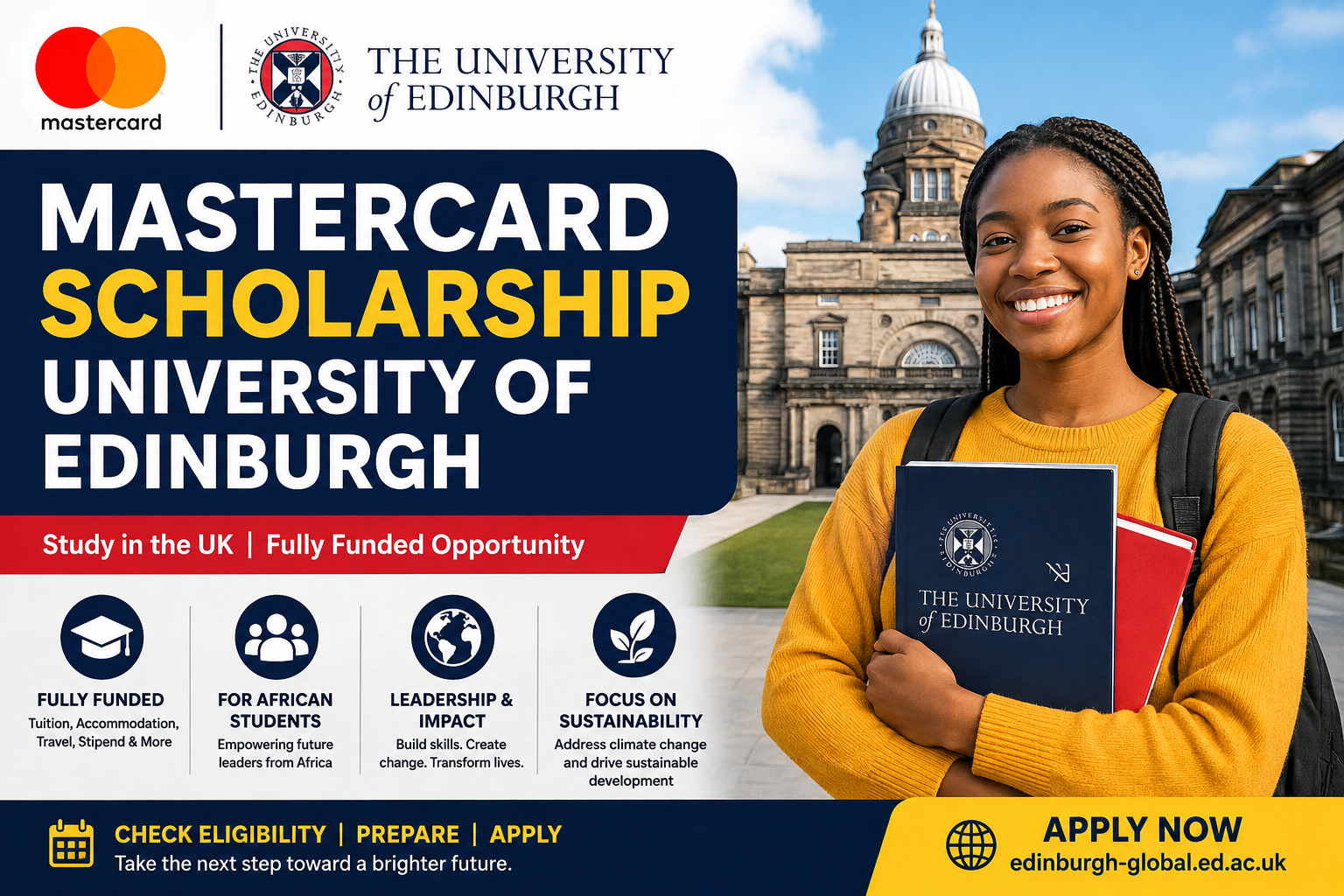
he Mastercard scholarship University of Edinburgh is an important opportunity for talented young people from Africa who have demonstrated academic potential, leadership ability, and a commitment to creating positive change in their communities. Through its partnership with the Mastercard Foundation, the University of Edinburgh provides postgraduate scholarship opportunities designed to help talented African students overcome barriers to higher education.
The program is particularly focused on developing future leaders who can contribute to sustainable development and help address the climate crisis. Depending on the scholarship route and academic program, successful scholars may study through an on-campus master’s program or an eligible online postgraduate program.
For prospective applicants, understanding the eligibility requirements, available courses, application procedure, scholarship benefits, deadlines, and selection criteria is essential. The application process for the 2027/28 academic year has also changed, with prospective applicants required to attend a virtual information session before they can access the scholarship application.
This guide explains everything prospective applicants need to know about the Mastercard scholarship University of Edinburgh, including who can apply, what the scholarship covers, eligible programs, important dates, and practical tips for preparing a strong application.
What Is the Mastercard Scholarship at the University of Edinburgh?
The Mastercard Foundation Scholars Program at the University of Edinburgh is a postgraduate scholarship initiative created through a partnership between the university and the Mastercard Foundation.
The University of Edinburgh and Mastercard Foundation have worked together since 2016. During the first phase of the partnership, the university awarded 240 scholarships to talented students from Africa between 2016 and 2023.
The second phase of the partnership runs from 2023 to 2030 and is expected to provide 850 postgraduate scholarships. The program is designed to develop a community of talented, entrepreneurial, compassionate, and justice-oriented leaders from across Africa.
The current program has a strong emphasis on sustainability and climate leadership. Scholars are expected not only to succeed academically but also to use their education and leadership skills to contribute to meaningful development in their communities and countries.
This means the scholarship is not simply a financial award. It is designed around academic development, leadership, community engagement, networking, and preparation for long-term social impact.
Who Is the Mastercard Scholarship University of Edinburgh For?
The scholarship is primarily designed for talented applicants from African countries who have experienced significant barriers to education and demonstrate strong leadership potential.
Applicants need to satisfy both the academic requirements for their chosen University of Edinburgh program and the additional Mastercard Foundation Scholars Program requirements.
The university states that applicants should demonstrate academic ability, leadership experience or potential, community service, and a commitment to addressing the climate crisis.
Applicants must also have faced significant barriers to education. These barriers can be social, financial, personal, practical, or health-related.
Therefore, simply having excellent grades does not automatically make someone a strong candidate.
A competitive applicant should be able to explain:
- What educational barriers they have experienced
- How they responded to those challenges
- How they have served or led within their community
- Why their proposed academic program is important
- How their education can contribute to solving problems in their community or country
- How their long-term goals connect with sustainable development and climate-related challenges
Mastercard Scholarship University of Edinburgh Eligibility Requirements
READ ALSO:UOW Scholarships: Complete Guide to Scholarships for International Students in Australia
SEE ALSO:Top 10 Nursing Scholarship Opportunities for Nigerian Students 2026/2027
Eligibility requirements can change from one application cycle to another, so applicants should always check the official University of Edinburgh scholarship website before submitting an application.
For the current 2027/28 cycle, the university identifies several important requirements.
1. You Must Be From Africa
Applicants must be citizens and residents of, or hold refugee status in, an African country.
This makes the program particularly relevant to students across the continent who have the academic potential to pursue postgraduate education but have faced barriers that have limited their educational opportunities.
For example, eligible applicants may come from countries such as Nigeria, Ghana, Kenya, Uganda, Tanzania, Rwanda, Ethiopia, South Africa, Zambia, Zimbabwe, Malawi, Cameroon, and other African countries, provided they meet all the program’s requirements.
Being from an African country alone, however, does not guarantee eligibility.
2. Academic Qualification
Applicants must qualify academically for admission to their selected University of Edinburgh degree program.
The university states that applicants will generally need the equivalent of a UK Second Class Upper bachelor’s degree or higher, although specific academic requirements can vary according to the selected program and applicant’s educational background.
Applicants should therefore carefully investigate the admission requirements for the particular degree they intend to study.
A strong scholarship application cannot compensate for failure to meet the academic entry requirements of the university.
3. You Must Have Faced Significant Educational Barriers
One of the distinctive features of this scholarship is its focus on applicants who have overcome barriers to education.
The University of Edinburgh specifically identifies social, financial, personal, practical, and health-related barriers as examples.
Applicants should therefore be prepared to explain their circumstances honestly and clearly.
For example, a candidate may have experienced financial difficulties that made higher education difficult, limited access to educational resources, displacement, challenging family circumstances, or other significant obstacles.
The important point is not simply to describe hardship. Applicants should demonstrate how they responded to their circumstances and what they learned from the experience.
4. Leadership and Community Service
The Mastercard Foundation Scholars Program places considerable emphasis on leadership.
Applicants need to demonstrate a track record of leadership and service within their communities.
Leadership does not necessarily mean holding an official political, corporate, or organizational title.
Leadership can include:
- Starting or supporting a community project
- Volunteering
- Mentoring younger students
- Supporting educational initiatives
- Working with a nonprofit organization
- Developing an environmental project
- Helping vulnerable members of a community
- Organizing community activities
- Creating a social enterprise
- Participating in youth development initiatives
The strongest applications explain the applicant’s actual contribution and the results of their work rather than simply listing activities.
5. Commitment to Climate Action
The current University of Edinburgh program has a strong climate focus.
Applicants must demonstrate experience or at least ambition in making a meaningful contribution to addressing the climate crisis.
This does not mean that every applicant must already be a climate scientist or environmental professional.
Instead, applicants should consider how their education, career, leadership, and community work can contribute to sustainable development.
For example, a student interested in food security could discuss sustainable agriculture. Someone interested in finance could explore climate finance. A public health applicant could discuss the relationship between environmental change and health.
The key is to establish a credible connection between the applicant’s academic goals and their intended contribution.
6. Age Requirement
For the 2027/28 academic year, applicants must be aged 35 or under in the year the program begins.
The University of Edinburgh states that applicants born on or after January 1, 1992, are eligible for the 2027/28 cycle, while applicants born in 1991 or earlier are not eligible.
Because age requirements can change in future cycles, applicants should verify the requirement for the specific year in which they plan to apply.
7. Previous Postgraduate Study
Applicants applying for the master’s scholarship should not have previously completed a postgraduate degree.
They should also not be enrolled at, or planning to enroll at, another university while participating in the Mastercard Foundation Scholars Program.
There are different rules for applicants seeking eligible postgraduate diploma opportunities, so candidates should carefully review the requirements for their particular study route.
What Does the Mastercard Scholarship University of Edinburgh Cover?
One of the most attractive features of the program is the financial support available to successful scholars.
For the current on-campus postgraduate scholarship, the University of Edinburgh states that the scholarship provides:
- Full approved tuition fees
- Accommodation
- Travel support
- A living-cost stipend
- Study materials
- Participation in a climate leadership program
This level of support can significantly reduce the financial burden associated with studying abroad.
For international students, tuition fees are only one part of the cost of studying in the United Kingdom. Accommodation, transportation, food, study materials, visa-related expenses, and other living costs can also be significant.
The scholarship is therefore structured to provide broader support rather than simply paying tuition.
Applicants should nevertheless read the current scholarship terms carefully because the exact coverage and conditions can vary depending on the study route and academic year.
Mastercard Scholarship University of Edinburgh Eligible Courses
The scholarship is not available for every postgraduate degree offered by the University of Edinburgh.
This is an important point for applicants.
The University currently lists specific eligible programs for the Mastercard Foundation Scholars Program. For the current cycle, eligible on-campus programs include:
- Africa and International Development
- Climate Change Finance and Investment
- Data, Inequality and Society
- Entrepreneurship and Innovation
- Food Security
- Environment and Development
- Environmental Sustainability
- Operational Research
- Planetary Health
- Sustainable Energy Systems
The university also lists eligible online postgraduate programs, including:
- Climate Change Management
- International Development
- Global Food Security and Nutrition
- One Health
- Social Justice and Community Action
- Global Health and Infectious Diseases
- Biodiversity, Wildlife and Ecosystem Health
- Data-Driven Breeding and Genetics
- Digital Education
- Data Science Technologies
Some programs are available only at master’s level, while others have master’s and postgraduate diploma routes. The university also notes that the list of eligible programs can change, so applicants should confirm the current list before applying.
On-Campus and Online Scholarship Options
The Mastercard Foundation Scholars Program at Edinburgh offers different postgraduate study routes.
On-Campus Master’s Scholarship
The on-campus scholarship supports eligible scholars studying a one-year, full-time postgraduate taught master’s degree at the University of Edinburgh.
Successful scholars study in Edinburgh and become part of the university’s academic and student community.
The university describes the on-campus award as providing approved tuition, accommodation, travel, living-cost support, and study materials, alongside the climate leadership program.
Online Postgraduate Scholarships
The program also offers online postgraduate opportunities.
These can be particularly valuable for eligible applicants who are unable to relocate to the United Kingdom.
Current online opportunities include master’s and postgraduate diploma routes in selected areas such as international development, global health, food security, digital education, data science technologies, biodiversity, social justice, and climate change management.
The exact duration depends on the program. The University of Edinburgh’s funding information describes online master’s scholarships as three-year part-time opportunities and postgraduate diploma scholarships as two-year part-time opportunities.
How to Apply for the Mastercard Scholarship University of Edinburgh
The application process for the 2027/28 cycle is particularly important because the University of Edinburgh has introduced a new procedure.
Applicants should not assume that the process is identical to previous years.
Step 1: Check Your Eligibility
The first step is to review the eligibility criteria.
Confirm that you:
- Are eligible as an African citizen, resident, or refugee
- Meet the age requirement
- Have the necessary academic background
- Have faced significant barriers to education
- Demonstrate leadership and community service
- Have a connection to climate action or a credible ambition to contribute to addressing climate challenges
- Meet the requirements concerning previous postgraduate study
- Are interested in one of the eligible degree programs
Applicants who do not satisfy the basic eligibility requirements should not proceed simply because they have strong academic results.
Step 2: Research the Eligible Degree Programs
Before applying, carefully examine the available programs.
Think about which program fits your previous education, professional experience, leadership activities, and future ambitions.
Your selected degree should not appear to be an arbitrary choice.
For example, if your community leadership has involved sustainable agriculture, a program related to food security or environmental development may provide a logical connection.
If your professional experience involves financial systems and climate investment, a sustainability-focused finance program could potentially align more naturally with your goals.
Step 3: Attend the Mandatory Information Session
This is one of the most important changes for the 2027/28 cycle.
The University of Edinburgh states that prospective applicants must attend one of the mandatory virtual information sessions scheduled between September 15 and September 24, 2026.
Attendance is required to gain access to the scholarship application form. However, attending a session does not automatically guarantee an invitation to apply. Applicants must also meet the eligibility requirements.
The university lists separate information-session dates for on-campus and online applicants.
Prospective applicants should register as early as possible and carefully follow the instructions provided by the university.
Step 4: Receive an Invitation to Apply
Eligible attendees are scheduled to receive notification about whether they have been invited to apply on October 13, 2026.
Applicants invited to continue will receive the application invitation through SurveyMonkey Apply.
This means that prospective applicants should monitor their email carefully, including their spam or junk folder.
Step 5: Complete the Applicant Declaration Form
The next stage is the Applicant Declaration Form.
For the 2027/28 cycle, the deadline is October 19, 2026, at 5:00 p.m. UK time.
The university warns that the form may close earlier if the application limit is reached, so applicants are encouraged to submit early rather than waiting until the final day.
Step 6: Complete the Main Scholarship Application
Applicants who successfully pass the declaration stage will be invited to complete the main scholarship application.
The main application deadline for the 2027/28 cycle is:
November 19, 2026, at 5:00 p.m. UK time.
Applicants should prepare their documents and written responses well before this deadline.
Step 7: Wait for Assessment and Interview
Applications are assessed by the relevant university committees.
According to the published 2027/28 timeline, assessment takes place from late November through January, with successful and unsuccessful applicants expected to receive notifications in early February 2027.
Shortlisted applicants will then be invited to interviews.
On-campus interviews are scheduled for mid-February through March, while online applicant interviews take place from late February through mid-March.
Interview outcomes are expected by the end of March 2027.
Mastercard Scholarship University of Edinburgh Application Timeline
For applicants planning for the 2027/28 academic year, the key dates currently published by the University of Edinburgh are:
| Stage | Date |
|---|---|
| Mandatory information sessions | September 15–24, 2026 |
| Scholarship applications open/invitations | October 13, 2026 |
| Applicant Declaration deadline | October 19, 2026, 5 p.m. UK time |
| Main application deadline | November 19, 2026, 5 p.m. UK time |
| Application assessment | Late November 2026–January 2027 |
| Initial decisions | Early February 2027 |
| On-campus interviews | Mid-February–March 2027 |
| Online interviews | Late February–mid-March 2027 |
| Interview outcomes | End of March 2027 |
| Admission and immigration support | April–August 2027 |
| Academic program begins | September 2027 |
These dates are subject to change, particularly depending on application volume, so applicants should check the official University of Edinburgh scholarship page regularly.
Documents You May Need
Applicants should prepare their academic and supporting documents before beginning the application.
For postgraduate applicants, the University of Edinburgh states that a final official university degree certificate and final official transcript must be available for upload by the main application deadline.
Applicants who cannot obtain these required documents by November 19, 2026, should not proceed with the application.
Depending on the application stage, applicants may also need information relating to:
- Academic qualifications
- Leadership experience
- Community service
- Educational barriers
- Career aspirations
- Climate-related interests
- Future impact
- Personal background
- Proposed area of study
Always follow the current instructions in the official application system rather than relying on information from older scholarship articles.
How to Write a Strong Mastercard Scholarship Application
A competitive application should tell a coherent story.
One common mistake applicants make is treating every question as an opportunity to list achievements.
Instead, think of your application as a connected narrative.
Start With Your Educational Journey
Explain your academic background and the barriers you encountered.
Do not exaggerate your circumstances.
Be factual, specific, and honest.
If financial hardship affected your educational opportunities, explain how. If you experienced another significant obstacle, explain its practical effect on your education.
Demonstrate Leadership With Evidence
Avoid simply saying:
“I am a great leader.”
Instead, explain what you did.
A stronger approach is to describe:
- The problem you identified
- The action you took
- The people involved
- The result
- What you learned
- How the experience influenced your future goals
This makes your leadership experience easier for reviewers to understand.
Connect Your Degree to Your Future Goals
Your chosen degree should have a clear relationship with your future plans.
Ask yourself:
Why this program?
Then ask:
Why now?
Finally:
How will this education help me create meaningful change?
The answers should be specific rather than generic.
Show Your Connection to Climate Action
Because the current Edinburgh program places strong emphasis on climate leadership, applicants should carefully consider how their ambitions relate to climate and sustainability.
This can be direct or interdisciplinary.
Climate-related challenges affect agriculture, public health, food security, infrastructure, finance, energy, biodiversity, communities, and economic development.
The important thing is to explain a genuine connection between your goals and the wider climate challenge.
How Are Mastercard Scholars Selected?
The selection process considers several dimensions of an applicant’s profile.
The University of Edinburgh identifies criteria including:
- Academic merit
- Transformative leadership
- Community service
- The quality of the application in relation to climate justice
- Potential impact on the applicant’s home country
- Significant barriers to education
This demonstrates why applicants should not focus exclusively on grades.
Academic performance matters because applicants need to qualify for university admission. However, the scholarship is looking for people who can combine academic potential with leadership, resilience, service, and future impact.
Is the Mastercard Scholarship University of Edinburgh Fully Funded?
For the on-campus postgraduate scholarship, the University of Edinburgh describes the award as covering approved tuition, accommodation, travel, living-cost support, and study materials.
For this reason, the scholarship can be considered a comprehensive funding opportunity for successful on-campus scholars.
However, applicants should avoid assuming that every possible personal expense is automatically covered.
Always review the official scholarship terms and conditions for the relevant application cycle to understand exactly what is included and what responsibilities remain with the scholar.
Can Nigerian Students Apply?
Yes. Nigerian applicants can be eligible because Nigeria is an African country, but nationality alone is not enough.
A Nigerian applicant must satisfy all applicable Mastercard Foundation Scholars Program and University of Edinburgh requirements.
This includes academic eligibility, age requirements, educational barriers, leadership and community service, climate-related commitment, and the requirements relating to previous postgraduate study.
Nigerian applicants should also make sure that their academic documents meet the university’s requirements and that their chosen course is among the programs covered by the scholarship.
Common Mistakes to Avoid
Applying for an Ineligible Course
One of the biggest mistakes is choosing a University of Edinburgh degree that is not included in the Mastercard Foundation Scholars Program.
Always check the current eligible-course list.
Ignoring the Information Session
For the 2027/28 cycle, the information session is mandatory.
Applicants should not wait until the scholarship application opens before checking the process.
Submitting at the Last Minute
The university has indicated that the Applicant Declaration Form may close early if the application limit is reached.
Early preparation is therefore important.
Focusing Only on Financial Need
Although educational barriers are an important part of eligibility, the scholarship is not simply a financial-need award.
Leadership, academic merit, service, climate commitment, and potential impact are also important.
Using Generic Scholarship Essays
Avoid submitting an essay that could apply to any scholarship.
Your application should demonstrate why your background, degree choice, leadership experience, and future ambitions fit the Mastercard Foundation Scholars Program at Edinburgh.
Exaggerating Achievements
Authenticity is more valuable than impressive-sounding claims.
Use real examples and measurable outcomes where possible.
How to Improve Your Chances
There is no guaranteed formula for winning a scholarship, but applicants can improve the quality of their application by preparing carefully.
Research Early
Do not wait until the application opens.
Research eligible programs, requirements, deadlines, and the scholarship’s objectives ahead of time.
Build a Clear Personal Story
Your application should make sense from beginning to end.
Your educational background, barriers, leadership experience, chosen course, climate interests, and future goals should connect logically.
Quantify Your Impact
Instead of saying you “helped many students,” explain approximately how many students you supported if you have reliable figures.
Instead of saying you “organized an environmental project,” explain what the project achieved.
Specific evidence makes your story stronger.
Prepare for the Interview
If shortlisted, be prepared to explain:
- Your educational journey
- Why you selected your degree
- Your leadership experience
- The challenges you have overcome
- Your understanding of climate-related issues
- Your future plans
- How your education can benefit your community or country
Practice answering questions naturally rather than memorizing a script.
What Happens After a Successful Scholarship Decision?
Successful applicants receive a conditional scholarship offer and subsequently go through the University’s admission process.
For the 2027/28 cycle, the university explains that applicants should initially apply for the Mastercard Foundation scholarship rather than the academic degree itself if this is the only University of Edinburgh scholarship they are pursuing.
If they receive a scholarship offer, they will then be invited to apply for their chosen degree through the standard university admissions process.
The program provides support through the admission process and, for on-campus applicants, immigration procedures.
The academic year is scheduled to begin in September 2027.
Frequently Asked Questions
What is the Mastercard scholarship University of Edinburgh?
It is a Mastercard Foundation Scholars Program at the University of Edinburgh that provides postgraduate scholarship opportunities to eligible students from Africa who demonstrate academic potential, leadership, community service, and a commitment to creating positive change.
Is the University of Edinburgh Mastercard scholarship fully funded?
The on-campus postgraduate scholarship provides approved tuition, accommodation, travel, living-cost support, study materials, and participation in the climate leadership program, according to the university’s current information.
Can Nigerian students apply for the scholarship?
Yes. Nigerian students can apply if they meet all applicable eligibility requirements and choose an eligible program.
Do I need a first-class degree?
Not necessarily. The university states that applicants will generally need the equivalent of a UK Second Class Upper bachelor’s degree or higher, while specific academic requirements depend on the selected degree.
Can I apply for any master’s course at Edinburgh?
No. The scholarship covers specific postgraduate programs. Applicants must select an eligible course from the current scholarship list.
Can I apply if I already have a master’s degree?
For the master’s scholarship, applicants should not have previously completed a postgraduate degree. Different rules apply to eligible postgraduate diploma applicants.
Is an information session required?
For the 2027/28 application cycle, yes. Prospective applicants must attend a mandatory virtual information session before they can access the scholarship application form.
When does the 2027/28 scholarship application close?
The main scholarship application deadline is November 19, 2026, at 5:00 p.m. UK time. The earlier Applicant Declaration Form deadline is October 19, 2026, at 5:00 p.m. UK time.
When will successful applicants be notified?
The published 2027/28 timeline indicates that initial successful and unsuccessful applicants will be notified in early February 2027, while interview outcomes are expected by the end of March 2027.
Does applying to a degree automatically enter me into the Mastercard scholarship?
No. Applying for a University of Edinburgh degree does not automatically put an applicant forward for the Mastercard Foundation Scholars Program.
Final Thoughts
The Mastercard scholarship University of Edinburgh represents a significant postgraduate opportunity for talented African students who have overcome educational barriers and want to use advanced education to create positive change.
The scholarship is particularly distinctive because it combines academic funding with leadership development, community engagement, and climate-focused learning. Successful on-campus scholars receive comprehensive financial support, while the wider program is designed to create a network of future leaders across Africa.
For the 2027/28 academic year, prospective applicants should pay special attention to the new application process. The mandatory virtual information sessions take place in September 2026, eligible applicants are expected to receive invitations in October, the Applicant Declaration Form closes on October 19, and the main application closes on November 19, 2026, at 5:00 p.m. UK time.
Most importantly, applicants should not view the scholarship simply as a way to obtain free education. The University of Edinburgh is looking for individuals who have demonstrated resilience, leadership, service, academic potential, and a genuine desire to contribute to sustainable development.
If your academic background, personal experiences, leadership journey, and future goals align with those priorities, the Mastercard Foundation Scholars Program could be an important pathway toward postgraduate study at the University of Edinburgh.
Always verify deadlines, eligible courses, eligibility rules, and application instructions directly with the University of Edinburgh before submitting your application because scholarship requirements and timelines can change between application cycles.