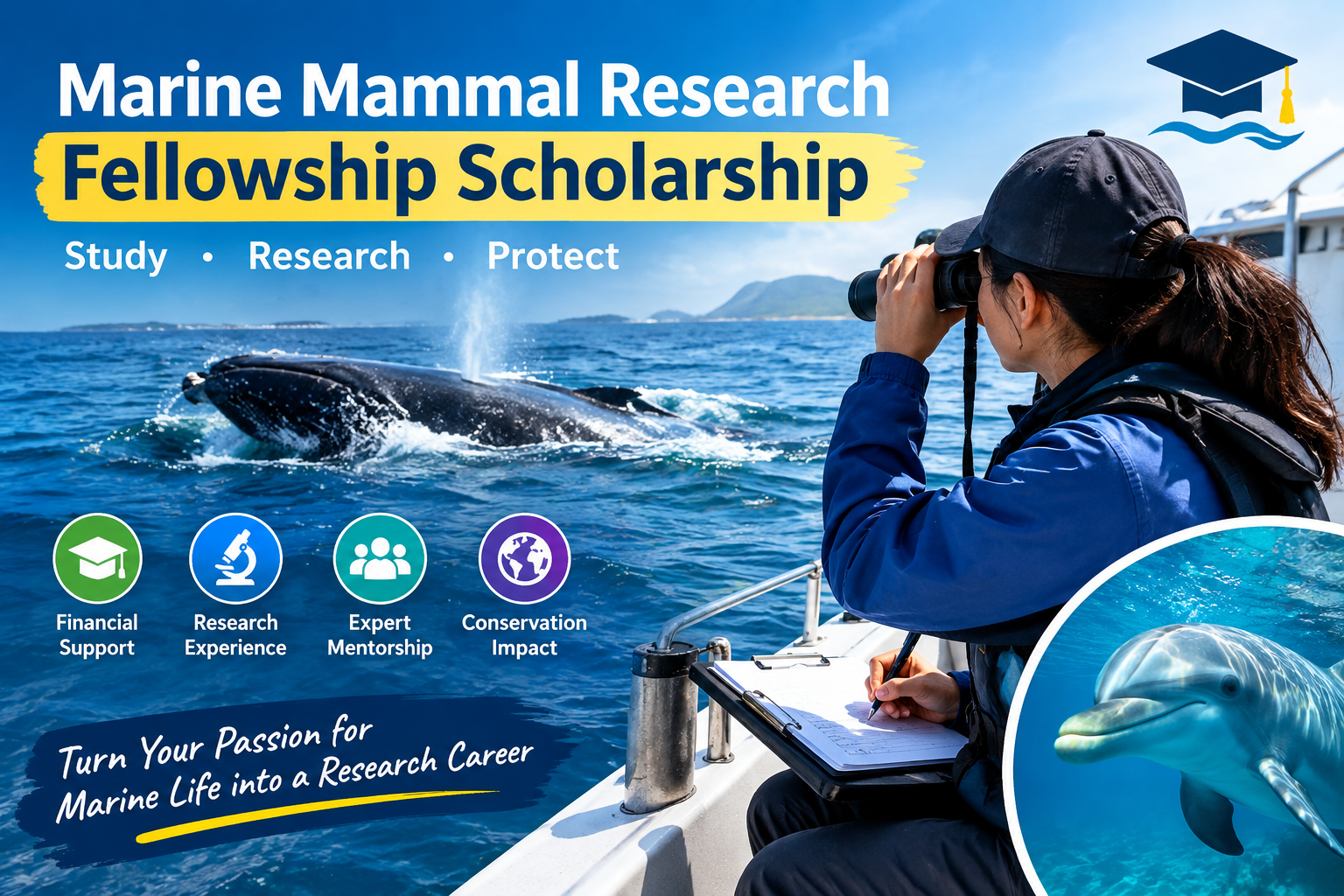
Marine mammal research fellowship scholarship opportunities can provide students and early-career scientists with valuable financial support, research experience, mentorship, and professional connections in marine biology and conservation. These opportunities may support research involving whales, dolphins, seals, sea lions, manatees, polar bears, and other marine mammals.
Marine mammal science is an interdisciplinary field. Researchers may specialize in animal behavior, ecology, genetics, physiology, acoustics, conservation, veterinary medicine, population biology, toxicology, or marine policy. The Marine Mammal Commission notes that marine mammal research is often connected to several broader scientific disciplines rather than being limited to one academic subject.
For students searching for a marine mammal research fellowship scholarship, it is therefore important to look beyond programs with the exact words “marine mammal” in their titles. Some relevant funding opportunities are offered through marine science departments, universities, government agencies, conservation organizations, and professional societies.
This guide explains what these opportunities are, who can apply, what funding may cover, how to find suitable programs, and how to prepare a competitive application.
What Is a Marine Mammal Research Fellowship Scholarship?
A marine mammal research fellowship scholarship is broadly understood as financial or professional support for students, researchers, or early-career scientists interested in studying marine mammals or related marine science topics.
The terminology can vary.
A scholarship usually helps support education-related expenses such as tuition, fees, books, or living costs.
A fellowship may provide financial support while a student or researcher completes academic or research work. Depending on the program, it may include a stipend, research expenses, travel funding, mentorship, or professional development.
A research grant generally supports a specific research project rather than providing general educational funding.
An internship or research placement may offer practical experience, mentorship, and sometimes a stipend.
This distinction is important because a student searching for a “marine mammal research fellowship scholarship” may find all of these categories.
The Marine Mammal Commission maintains a career-resource page that lists fellowships and scholarships relevant to marine science students, graduate students, and recent graduates. Its list includes programs associated with NOAA, Sea Grant, NSF, coastal management, environmental science, and other areas.
Why Study Marine Mammals?
SEE ALSO: Swedish Institute Scholarship for Global Professionals: Eligibility, Benefits and How to Apply
Marine mammals play important roles in marine ecosystems and are also indicators of environmental change.
Research can help scientists understand:
- Population trends
- Migration patterns
- Feeding behavior
- Reproductive biology
- Disease
- Human-wildlife interactions
- Ocean pollution
- Climate-related changes
- Underwater noise
- Habitat use
- Conservation strategies
- Marine ecosystem health
A marine mammal research career can also extend beyond fieldwork with whales and dolphins.
For example, students may work with statistical models, satellite tracking, bioacoustics, genetics, environmental data, geographic information systems, veterinary science, policy, or conservation education.
The Society for Marine Mammalogy emphasizes that internships, volunteer positions, and early-career opportunities can be important steps toward becoming an experienced marine mammologist.
Types of Marine Mammal Research Fellowships and Scholarships
There is no single funding model for marine mammal research. Opportunities can be divided into several categories.
1. Undergraduate Research Opportunities
Undergraduate students can sometimes participate in summer research programs, research experiences, internships, and university-based fellowships.
These programs can introduce students to marine mammal research before graduate school.
For example, the Society for Marine Mammalogy maintains listings for student-level opportunities, including research experiences and other positions related to marine mammal science.
Undergraduate opportunities may involve:
- Field observations
- Laboratory research
- Data entry and analysis
- Photo-identification
- Acoustic monitoring
- Conservation education
- Literature reviews
- Research cruises
- Biological sampling
Not every undergraduate program requires previous marine mammal research experience.
2. Graduate Fellowships
Graduate students are among the most common applicants for specialized marine mammal research funding.
A master’s or doctoral student may develop a research project focused on a particular species, ecosystem, geographic area, or scientific question.
Possible research topics include:
- Dolphin communication
- Whale migration
- Seal population dynamics
- Marine mammal genetics
- Human impacts on marine mammals
- Marine mammal acoustics
- Climate change and habitat use
- Marine mammal disease
- Conservation biology
One example is the Rebecca and Steve Sooy Graduate Fellowship in Marine Mammals at the University of California, Santa Cruz. The fellowship supports UCSC graduate students studying marine mammals and can provide support for expenses such as educational fees, housing, conference travel, and field research.
This demonstrates why applicants should search individual universities as well as general scholarship databases.
3. Research Fellowships for Recent Graduates
Some opportunities are aimed at researchers who have completed undergraduate or graduate study.
These positions may provide opportunities to work with established scientists while developing research skills.
A fellowship could involve:
- Conducting field research
- Managing datasets
- Writing scientific reports
- Presenting research
- Supporting conservation projects
- Conducting statistical analysis
- Developing research proposals
- Working with government or nonprofit organizations
The Marine Mammal Commission specifically provides career information for students, early-career scientists, and people exploring careers related to marine science, policy, and management.
4. Marine Science Fellowships With Marine Mammal Components
A common mistake is searching only for fellowships that explicitly say “marine mammal.”
Many relevant programs are classified under broader fields such as:
- Marine biology
- Oceanography
- Environmental science
- Fisheries science
- Ecology
- Conservation biology
- Wildlife science
- Coastal science
- Veterinary medicine
- Ocean policy
The Marine Mammal Commission’s fellowship and scholarship directory includes opportunities in broader marine science fields.
Therefore, expanding your search terms can significantly increase the number of opportunities you discover.
Who Can Apply?
Eligibility depends entirely on the specific fellowship or scholarship.
However, applicants commonly fall into several categories:
Undergraduate students
Some programs are designed for students pursuing bachelor’s degrees in biology, marine science, environmental science, zoology, or related subjects.
Graduate students
Master’s and PhD students may be eligible for research fellowships, graduate scholarships, and project-specific awards.
Recent graduates
Some internships and fellowships accept people who have recently completed their undergraduate or graduate studies.
Early-career researchers
Postdoctoral and early-career funding may be available for scientists developing independent research programs.
International students
Eligibility varies considerably. Some programs accept applicants worldwide, while others are restricted by citizenship, residency, university enrollment, or location.
For example, certain U.S.-based programs have specific citizenship requirements, while university fellowships may be restricted to students enrolled at that institution.
Never assume that a program is open internationally simply because it appears in a global scholarship search. Always verify the official eligibility rules.
Common Eligibility Requirements
Although requirements differ, a marine mammal research fellowship scholarship application may ask for some combination of the following:
- Academic transcripts
- Curriculum vitae or résumé
- Research proposal
- Statement of purpose
- Personal statement
- Letters of recommendation
- Academic references
- Proof of university enrollment
- Evidence of research experience
- Proposed research budget
- Supervisor endorsement
- Research permits
- Evidence of relevant technical skills
Some programs place greater emphasis on academic performance, while others prioritize research potential, conservation impact, financial need, or professional development.
For instance, the Soy Graduate Fellowship at UC Santa Cruz considers academic merit, financial need, and progress toward the degree.
What Can a Marine Mammal Research Fellowship Cover?
Funding varies significantly from one opportunity to another.
Potential benefits can include:
Tuition support
Some scholarships may contribute toward tuition or academic expenses.
Research expenses
Funding can sometimes support field equipment, laboratory supplies, data collection, or other research-related costs.
Travel
A fellowship may provide funding for research travel, conferences, workshops, or fieldwork.
Living expenses
Some fellowships provide stipends that can help students with housing, food, transportation, and other living costs.
Mentorship
Mentorship can be one of the most valuable benefits of a research fellowship.
Professional development
Programs may provide opportunities to attend conferences, participate in workshops, develop presentations, or learn specialized research methods.
For example, the California Ocean Alliance’s Blundy Family Marine Science Fellowship is designed as a paid research experience combining training, mentoring, research, and preparation for graduate study and marine mammal science careers.
How to Find a Marine Mammal Research Fellowship Scholarship
Finding the right opportunity requires more than entering one keyword into a search engine.
Step 1: Search Professional Organizations
Professional organizations can be excellent sources of current opportunities.
The Society for Marine Mammalogy maintains a job and opportunity section that can be filtered for student positions, fellowships, internships, postdoctoral positions, and other roles.
This is particularly useful because marine mammal opportunities can appear throughout the year.
Step 2: Check University Research Departments
Search universities that have marine biology, marine science, zoology, ecology, oceanography, or wildlife research programs.
Look for faculty members whose research matches your interests.
The Marine Mammal Commission recommends that prospective graduate students identify institutions and research groups conducting marine mammal research and contact potential advisors about graduate opportunities and funding.
Step 3: Explore Government Programs
Government agencies can provide scholarships, fellowships, internships, and research opportunities.
In the United States, examples include NOAA-related programs and Sea Grant opportunities.
The Marine Mammal Commission’s fellowship directory includes programs such as NOAA’s Hollings Undergraduate Scholarship, the Dr. Nancy Foster Scholarship Program, Coastal Management Fellowship, and Sea Grant opportunities.
Applicants outside the United States should similarly investigate government marine research agencies in their own countries.
Step 4: Search Conservation Organizations
Nonprofit organizations can offer research placements and conservation fellowships.
These organizations may focus on:
- Whales
- Dolphins
- Seals
- Sea lions
- Marine ecosystems
- Endangered species
- Marine pollution
- Coastal conservation
The Society for Marine Mammalogy and Marine Mammal Commission both provide career and opportunity resources that can help applicants locate relevant organizations and programs.
How to Prepare a Strong Application
Competition for research funding can be significant. A well-prepared application should show more than enthusiasm for marine animals.
Develop a Clear Research Question
Instead of saying:
“I want to study whales.”
Explain the scientific question you want to investigate.
For example, your proposal might explore how changes in ocean conditions influence the distribution of a particular marine mammal population.
A clear research question demonstrates that you understand the difference between an interest and a research project.
Explain Why the Research Matters
A strong application connects the project to a meaningful scientific or conservation problem.
Explain:
- What is already known?
- What remains uncertain?
- What question will your project investigate?
- How will you collect or analyze information?
- Why could the results be useful?
This structure makes your proposal easier for reviewers to evaluate.
Highlight Relevant Skills
Useful skills may include:
- Statistical analysis
- R or Python
- GIS
- Geographic mapping
- Field observation
- Photo-identification
- Acoustic analysis
- Laboratory methods
- Genetics
- Scientific writing
- Data management
- Research design
You do not need every skill before applying.
Instead, clearly explain what you already know and what you hope to learn.
What If You Have No Marine Mammal Experience?
Do not automatically assume that you are ineligible.
Some programs are designed specifically to introduce students to marine research.
For example, the Blundy Family Marine Science Fellowship states that prior laboratory or research experience is not required and combines research with mentoring and preparation for graduate study. (California Ocean Alliance)
Other internships may similarly prioritize curiosity, commitment, academic potential, and willingness to learn.
If you lack marine mammal experience, emphasize transferable experience.
This could include:
- Biology laboratory work
- Environmental volunteering
- Undergraduate research
- Statistics
- Animal care
- Conservation projects
- Academic projects
- Data analysis
- Science communication
Marine Mammal Research Opportunities for International Students
International applicants should pay special attention to eligibility conditions.
Before investing time in an application, check:
- Citizenship requirements
- Residency requirements
- University enrollment requirements
- Degree requirements
- Language requirements
- Visa restrictions
- Research permit requirements
- Funding restrictions
- Application deadlines
Students from countries such as Nigeria may find opportunities through international universities, global research organizations, marine science institutions, and programs that explicitly accept international applicants.
However, eligibility must be confirmed directly from the official program website.
A scholarship database or third-party article should be treated as a starting point rather than the final authority.
Tips for Students Applying From Nigeria
For Nigerian students interested in marine mammal science, building a strong academic profile can be particularly useful.
Consider studying or gaining experience in fields such as:
- Marine biology
- Zoology
- Environmental science
- Fisheries
- Ecology
- Veterinary medicine
- Oceanography
- Conservation biology
- Statistics
- Environmental management
You can also build experience through research projects related to aquatic ecosystems even if marine mammal research opportunities are limited locally.
For example, experience with fisheries, aquatic ecology, biodiversity surveys, environmental monitoring, GIS, or statistical analysis can demonstrate relevant preparation.
International applicants should also investigate whether their target university offers funded master’s or PhD positions where the research project involves marine mammals.
Common Mistakes to Avoid
Applying Without Checking Eligibility
A great-looking fellowship is useless if you do not meet its requirements.
Always check the official announcement.
Using the Same Personal Statement Everywhere
Your statement should be tailored to each opportunity.
Explain why the particular program, university, supervisor, or research area matches your goals.
Submitting a Vague Research Proposal
A proposal should have a defined question, methodology, expected outcomes, and justification.
Ignoring Application Instructions
If the program requests a specific word count or document format, follow it carefully.
Waiting Until the Deadline
Letters of recommendation and transcripts can take time to obtain.
Start early.
Paying Unofficial Agents for “Guaranteed” Scholarships
Be cautious about anyone promising guaranteed funding in exchange for money.
Legitimate scholarship and fellowship programs normally publish their eligibility criteria, application instructions, and official contact information.
Frequently Asked Questions
What is a marine mammal research fellowship scholarship?
It is a broad term describing scholarships, fellowships, research awards, internships, or other funding opportunities supporting education or research related to marine mammals and marine science.
Can undergraduate students apply?
Yes. Some programs specifically support undergraduate research, internships, and summer research experiences. Eligibility varies by program.
Can master’s and PhD students apply?
Yes. Graduate students are eligible for many research fellowships and scholarships. Some awards are specifically designed for students conducting marine mammal research.
Do I need previous marine mammal research experience?
Not always. Some programs are designed to provide introductory research experience and mentorship. Others require substantial research experience.
Can international students apply?
Some programs accept international applicants, while others have citizenship or residency restrictions. Always check the official eligibility requirements.
What should I study to become a marine mammal researcher?
Relevant degrees can include marine biology, biology, zoology, ecology, environmental science, fisheries, oceanography, veterinary medicine, and related fields.
Where can I find marine mammal research opportunities?
Professional organizations, universities, government agencies, conservation organizations, and marine research institutions are useful places to search. The Society for Marine Mammalogy and Marine Mammal Commission both provide opportunity and career resources. (Society for Marine Mammalogy)
Final Thoughts
Finding a marine mammal research fellowship scholarship requires a broad and strategic approach. There is not necessarily one scholarship with this exact name. Instead, students can find funding through marine mammal organizations, universities, government agencies, conservation groups, marine science programs, and broader scientific fellowships.
The best strategy is to begin with your academic level and research interests. An undergraduate student might focus on summer research experiences and internships, while a master’s or PhD student may benefit more from graduate fellowships, research grants, and university funding.
Most importantly, do not limit your search to programs containing the phrase “marine mammal.” Many valuable opportunities are classified under marine biology, ecology, oceanography, fisheries, conservation, environmental science, or wildlife research.
The Society for Marine Mammalogy regularly provides professional-development resources and listings for students and early-career scientists, while the Marine Mammal Commission maintains a broader directory of fellowships and scholarships relevant to marine science. (Society for Marine Mammalogy)
With a strong academic background, a focused research question, relevant skills, carefully prepared application materials, and consistent searching, aspiring marine scientists can identify opportunities that help turn an interest in marine mammals into a meaningful research career.