The Swedish Institute Scholarship for Global Professionals is one of the most competitive fully funded scholarship opportunities available to international students who want to pursue a master’s degree in Sweden. Funded by the Swedish government and administered by the Swedish Institute, the scholarship is designed for ambitious professionals who want to develop their expertise and use their education to contribute to sustainable development in their home countries and regions.
Unlike scholarships that focus mainly on academic grades, the Swedish Institute Scholarship for Global Professionals places significant emphasis on professional experience, leadership, development impact and the applicant’s potential to contribute to positive change.
The scholarship can be particularly attractive to qualified professionals from countries such as Nigeria, Kenya, Uganda, Ghana’s neighboring eligible regions, South Africa and other eligible countries across Africa, Asia, Latin America and Eastern Europe. Nigeria, for example, is among the countries eligible for the Global Professionals scholarship.
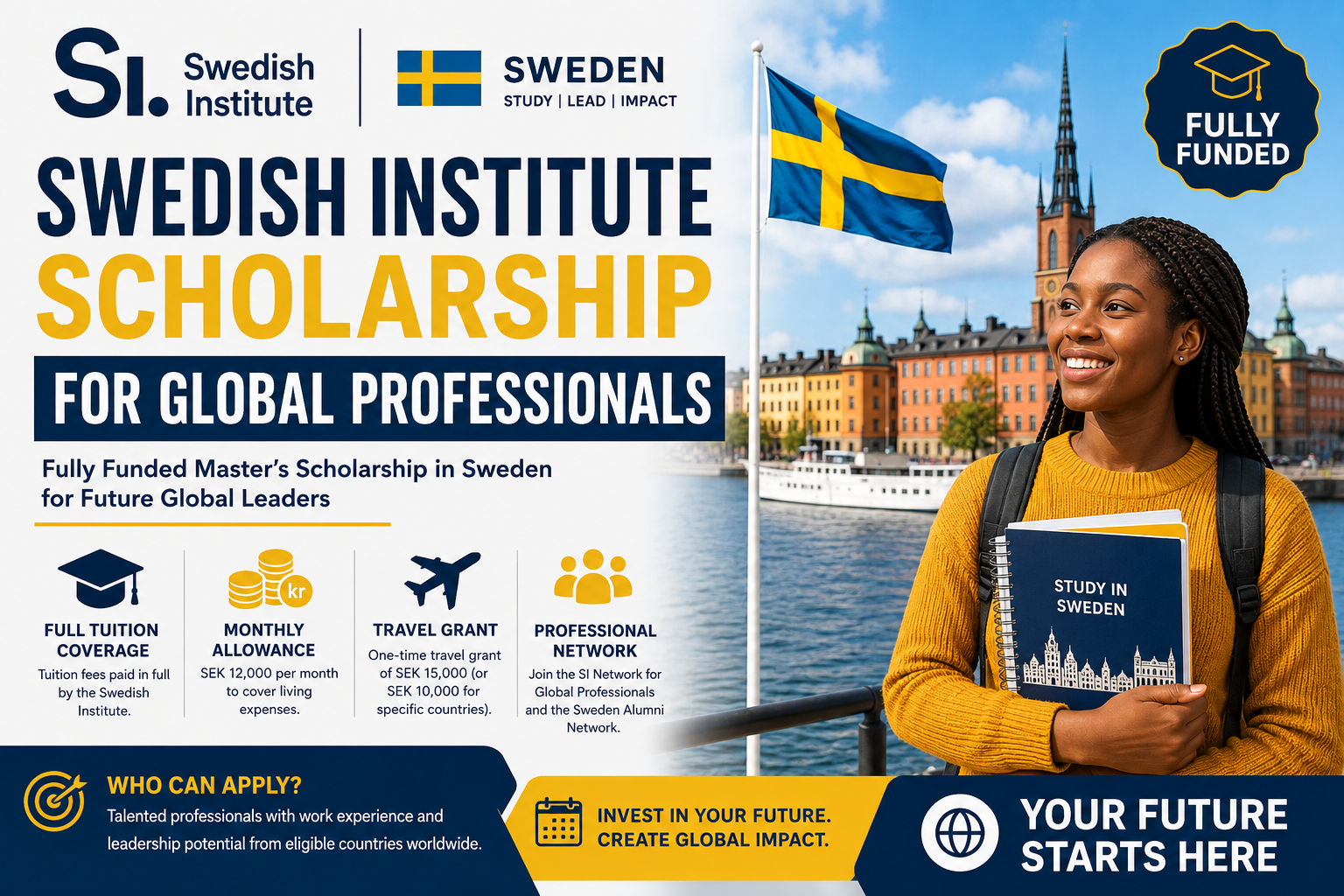
For the 2026/2027 academic year, the scholarship covered full tuition fees, provided a monthly living allowance of SEK 12,000 and included a one-time travel grant of SEK 15,000 for most eligible scholars. Scholars also become part of the SI Network for Global Professionals and, after their scholarship period, the Sweden Alumni Network.
This comprehensive guide explains the Swedish Institute Scholarship for Global Professionals, including its benefits, eligible countries, academic requirements, work experience requirements, leadership criteria, application process, important dates and practical tips for preparing a competitive application.
Important update: The 2026/2027 scholarship application period has already closed. The previous master’s application period ran from October 2025 to January 2026, followed by the SI scholarship application window in February 2026. Prospective applicants should monitor the official Swedish Institute website for the next application cycle rather than assuming that the 2026 dates will remain unchanged.
What Is the Swedish Institute Scholarship for Global Professionals?
The Swedish Institute Scholarship for Global Professionals, commonly abbreviated as SISGP, is a government-funded scholarship for international professionals who want to undertake eligible master’s studies in Sweden.
The scholarship is intended to develop a network of professionals and future leaders who can contribute to sustainable development in their home countries and regions.
This purpose is important because the award is not simply designed to fund students who want an overseas degree. Applicants are expected to demonstrate how their education, professional experience and future plans can contribute to positive development.
The scholarship therefore combines financial support with professional networking and leadership development.
Successful applicants study at participating Swedish universities in eligible master’s programs. The programs are taught in English and cover a wide range of academic and professional fields.
According to the official Swedish university admissions information, Swedish Institute scholarships are available for international students from specific countries applying for master’s studies that begin in the autumn semester. The scholarship is not available for bachelor’s programs or programs beginning in the spring semester.
see also: Canadian Scholarship Trust 2026: Scholarships, Bursaries, Eligibility and How to Apply
read also: Open Door Scholarship: Eligibility, Benefits, Requirements and How to Apply
Is the Swedish Institute Scholarship Fully Funded?
Yes. The Swedish Institute Scholarship for Global Professionals is generally described as a fully funded scholarship because it covers major costs associated with studying in Sweden.
For the 2026/2027 cycle, the main benefits included:
- Full tuition fee coverage.
- A monthly living allowance of SEK 12,000.
- A one-time travel grant of SEK 15,000 for most eligible countries.
- A lower travel grant of SEK 10,000 for scholars from Armenia, Azerbaijan, Belarus, Georgia, Moldova and Ukraine.
- Membership in the SI Network for Global Professionals.
- Access to the Sweden Alumni Network after the scholarship period.
The tuition fee is paid directly by the Swedish Institute to the Swedish university.
The monthly allowance is intended to help scholars meet living expenses during their studies.
The travel grant is a one-time payment and generally does not apply to students who are already living in Sweden when they receive the scholarship.
However, applicants should understand that “fully funded” does not mean every possible personal expense is covered.
The scholarship does not necessarily cover every cost a student may encounter, such as expenses for family members, certain personal costs or every type of insurance. Applicants should read the current scholarship terms carefully before making financial commitments.
How Much Is the Swedish Institute Scholarship Worth?
The exact monetary value depends on the length and tuition cost of the eligible master’s programme, but the scholarship’s core benefits are substantial.
The SEK 12,000 monthly living allowance is paid throughout the scholarship period.
For example, if a student receives the allowance for 12 months, the living allowance alone would total SEK 144,000 over that period.
The scholarship also covers the approved tuition fee directly through the Swedish university.
In addition, eligible scholars receive a one-time travel grant.
This means the overall financial value can be considerably higher than the cash allowance alone because tuition fees can represent a major portion of the cost of an international master’s degree.
Applicants should nevertheless avoid calculating the scholarship as guaranteed cash in hand. Tuition is paid directly to the university, while the living and travel components follow the scholarship’s specific payment conditions.
Who Can Apply for the Swedish Institute Scholarship for Global Professionals?
The scholarship has strict eligibility requirements.
Applicants generally need to satisfy several conditions before they can compete for the award.
These include citizenship, master’s programme eligibility, tuition-fee liability, professional experience and leadership experience.
1. Citizenship of an Eligible Country
For the 2026/2027 Global Professionals scholarship, citizens of 34 countries were eligible.
The list included:
- Armenia
- Azerbaijan
- Bangladesh
- Belarus
- Bolivia
- Brazil
- Colombia
- Ecuador
- Egypt
- Ethiopia
- Georgia
- Guatemala
- Indonesia
- Iraq
- Jordan
- Kenya
- Liberia
- Malaysia
- Mexico
- Moldova
- Morocco
- Nigeria
- Peru
- Philippines
- Rwanda
- Senegal
- South Africa
- Tanzania
- Thailand
- Uganda
- Ukraine
- Uzbekistan
- Vietnam
- Zambia
The published 2026/2027 eligibility information confirms that applicants must be citizens of one of the 34 specified countries. Applicants do not necessarily need to be physically residing in their country of citizenship when applying.
The country list is particularly important because nationality is a basic eligibility condition.
If your country is not included in the current list, you should not assume that you can apply simply because you meet the academic or professional requirements.
2. You Must Apply for an Eligible Master’s Programme
The Swedish Institute Scholarship for Global Professionals is specifically intended for master’s-level study.
Applicants must apply to an eligible master’s programme in Sweden.
The scholarship does not cover ordinary bachelor’s programs, PhD programs or spring-start programs under the Global Professionals scheme. University Admissions confirms that Swedish Institute scholarships are directed toward international students applying for eligible master’s studies beginning in the autumn semester.
One of the biggest mistakes applicants can make is choosing a master’s programme without checking whether it appears on the current SI eligible-programme list.
Not every master’s programme offered by a Swedish university automatically qualifies.
Therefore, applicants should select their degree carefully before applying.
3. You Must Be Liable to Pay Tuition Fees
Applicants must normally be liable to pay tuition fees at Swedish universities.
This requirement is significant because the scholarship is designed primarily for international students who would otherwise be required to pay tuition.
University Admissions explains that most applicants who are not citizens of the EU, EEA or Switzerland are required to pay application and tuition fees, subject to the applicable rules and exemptions.
Applicants should check their own fee status rather than assuming they qualify.
4. You Need Work Experience
Professional experience is one of the most important features of this scholarship.
For most eligible countries in the 2026/2027 cycle, applicants were required to demonstrate at least 3,000 hours of work experience.
This requirement applied to countries including Nigeria, Kenya, Liberia, Uganda, Zambia, South Africa and many others on the relevant country list.
The experience can generally come from different types of professional activity, including full-time and part-time employment, freelancing, entrepreneurship and other qualifying work.
Applicants from Armenia, Azerbaijan, Belarus, Georgia, Moldova and Ukraine were subject to a different rule: proof of work experience was required, but there was no minimum number of hours, with greater experience being prioritized.
Because these rules can be updated, future applicants should check the current year’s official requirements.
5. You Need Leadership Experience
Work experience alone is not enough.
The scholarship also requires applicants to demonstrate leadership experience from employment or civil society engagement.
Leadership does not necessarily mean that an applicant must have been the chief executive of an organization.
It can involve taking responsibility for people, projects, decisions, initiatives or organizational development.
For example, leadership may be demonstrated through:
- Managing a team.
- Coordinating a professional project.
- Supervising employees.
- Leading a community initiative.
- Organizing a development programme.
- Managing a volunteer group.
- Influencing decisions within an organization.
- Leading a social or environmental initiative.
The key is to demonstrate actual responsibility and impact rather than simply listing a job title.
Why Is Work Experience So Important?
The scholarship is called the Global Professionals scholarship for a reason.
It is intended for people who have already started building professional experience and who want to strengthen their skills through advanced education.
The Swedish Institute is therefore interested in applicants who can connect their professional history with their future goals.
For example, an environmental professional might apply for a master’s programme related to sustainability and explain how the degree could improve their ability to develop climate-adaptation projects in their country.
A public-sector employee could explain how advanced training in public administration, governance or policy could improve institutional performance.
An entrepreneur might describe how studying innovation or business development could help build more sustainable enterprises and create employment.
The important point is that the degree should fit into a larger professional and development plan.
How to Apply for the Swedish Institute Scholarship for Global Professionals
The application process has two major stages.
This is one of the most important things prospective applicants need to understand.
Stage One: Apply for Master’s Programs
The first step is to apply for eligible master’s programs through University Admissions in Sweden.
For the 2026/2027 cycle, the international master’s application period ran from 16 October 2025 to 15 January 2026.
Applicants can apply for up to four master’s programs through University Admissions.
Applicants should carefully rank their programs because the order can influence the admissions process.
The application should be submitted before the deadline, and all required supporting documentation should also be provided on time.
Stage Two: Apply for the SI Scholarship
After applying for master’s programs, eligible applicants can apply separately for the Swedish Institute Scholarship.
For the 2026/2027 cycle, the SI scholarship application portal was open from 9 February to 25 February 2026.
The two applications are separate.
This is extremely important.
Submitting a master’s application through University Admissions does not automatically submit an SI scholarship application.
Likewise, simply completing the SI scholarship application does not replace the university admissions application.
University Admissions specifically states that applicants cannot apply for the Swedish Institute scholarship before submitting their admissions application because the University Admissions application generates the application number needed for the scholarship application.
What Is the University Admissions Application Number?
After submitting your master’s application through University Admissions, you receive an application number.
This number is important because it is used when applying for the SI scholarship.
Applicants can find the number by logging into their University Admissions account and going to the application section.
Applicants should keep this number safe and use the same information consistently across the two application systems.
What Documents Are Usually Needed?
The exact documentation requirements can change from one application cycle to another.
However, applicants should generally be prepared to provide information relating to:
- Academic qualifications.
- University transcripts.
- Proof of English-language proficiency where required.
- Passport or citizenship documentation.
- Curriculum vitae.
- Work experience.
- Leadership experience.
- Motivation and career goals.
- University application information.
- Scholarship-specific forms and supporting documentation.
University Admissions emphasizes that documentation requirements depend on the applicant’s previous country of study and the specific university program. Applicants should not submit unnecessary documents that have not been requested.
Special Information for Nigerian Applicants
The Swedish Institute Scholarship for Global Professionals is particularly relevant to Nigerian professionals because Nigeria is included among the eligible countries.
For master’s admission, University Admissions has country-specific instructions for applicants who completed their studies in Nigeria.
According to the current Nigeria-specific guidance, a four-year bachelor’s degree from a recognized university meets the general master’s admission criteria. Applicants should provide their diploma and transcripts covering the relevant years.
University Admissions also provides specific information about English-language documentation for Nigerian applicants.
A completely documented four-year bachelor’s degree from a recognized Nigerian university may satisfy the English requirement under the applicable rules, although applicants must always check the specific master’s programme because individual programs can impose additional requirements.
This makes it important for Nigerian applicants to prepare their academic documents early.
Names and dates of birth should also match across application documents and identity documents.
How to Make Your Scholarship Application Stronger
Meeting the eligibility requirements does not guarantee selection.
The scholarship is highly competitive, so applicants need to present a convincing profile.
Connect Your Past, Present and Future
One of the strongest approaches is to create a clear connection between:
Past experience → chosen master’s programme → future impact
For example:
Your past professional experience may involve agricultural development.
Your chosen master’s programme might focus on sustainable development.
Your future goal could be to develop climate-resilient agricultural systems in your home country.
That creates a logical story.
Demonstrate Measurable Impact
Avoid making vague claims such as:
“I am passionate about helping my community.”
Instead, explain what you actually did.
For example, you might describe:
- How many people participated in your initiative.
- How many employees you supervised.
- How many beneficiaries were reached.
- What problem your project addressed.
- What result your project produced.
Specific evidence makes leadership claims more credible.
Explain Why Sweden
Your application should demonstrate that studying in Sweden is relevant to your professional development.
Research the university and programme.
Understand the curriculum.
Identify the skills you expect to gain.
Then explain how those skills connect with your long-term objectives.
Explain Your Development Impact
The Swedish Institute places strong emphasis on sustainable development.
Applicants should be able to explain how their education could contribute to sustainable development in their home country or region.
This does not mean that every applicant needs to work in environmental science.
Sustainable development can involve areas such as:
- Public health.
- Education.
- Governance.
- Entrepreneurship.
- Innovation.
- Technology.
- Economic development.
- Energy.
- Agriculture.
- Social development.
- Environmental sustainability.
The important thing is to establish a credible connection between your studies and future impact.
What Should You Avoid in Your Application?
Do Not Invent Work Experience
All professional experience should be truthful and documentable.
Submitting inaccurate information can seriously damage an application and may have legal or academic consequences.
Do Not Use an Unrelated Master’s Programme
Before applying, check the official eligible-programme list.
Do not assume that every English-taught master’s programme qualifies.
Do Not Wait Until the Deadline
The application process involves multiple stages and documents.
Starting early gives you time to resolve problems with transcripts, references, employment certificates or other documentation.
Do Not Copy Scholarship Essays
Your application should reflect your own experience and goals.
Avoid copying essays from websites or using another applicant’s personal story.
Plagiarism can undermine your application and does not demonstrate your actual suitability for the scholarship.
Do Not Create Multiple University Admissions Accounts
University Admissions states that applicants are allowed only one account. Creating additional accounts can negatively affect application processing and can also interfere with consideration for Swedish Institute scholarships.
What Happens After You Apply?
The admissions and scholarship processes are separate but connected.
For the 2026/2027 cycle, University Admissions announced master’s admission results on 26 March 2026, while the SI scholarship announcement followed on 23 April 2026.
The scholarship selection process is competitive.
Being admitted to a master’s programme does not automatically mean that you will receive the SI scholarship.
Similarly, submitting a scholarship application does not guarantee university admission.
Applicants must satisfy the requirements of both processes.
Is the Swedish Institute Scholarship Competitive?
Yes.
The scholarship attracts a large international applicant pool.
For the 2026/2027 Global Professionals scholarship, published recipient information indicates that SI received 12,922 applications, with 6,666 applicants admitted to eligible master’s programs by the March admissions stage. The final published figures showed 189 scholarship recipients and 27 applicants on the reserve list.
These numbers demonstrate why applicants should not rely solely on meeting minimum requirements.
A successful application needs to communicate a compelling combination of academic preparation, professional experience, leadership and future development impact.
Can You Apply Without Work Experience?
For most countries covered by the Global Professionals scholarship, the 2026/2027 rules required at least 3,000 hours of documented work experience.
Therefore, an applicant who has little or no qualifying professional experience would generally not meet the requirements for that cycle.
There was an exception to the minimum-hour rule for applicants from Armenia, Azerbaijan, Belarus, Georgia, Moldova and Ukraine, although they still needed to demonstrate work experience and more experience could strengthen their application.
Applicants should check the requirements for their particular country and scholarship year.
Can Freelancers and Entrepreneurs Apply?
Professional experience is not necessarily limited to traditional salaried employment.
The scholarship’s work-experience rules have recognized forms of professional activity such as employment, freelancing and entrepreneurship.
This can make the opportunity relevant to professionals who have built careers outside conventional corporate employment.
However, the important issue is documentation.
Applicants should be able to demonstrate that the experience actually occurred and satisfies the scholarship’s requirements.
Can You Apply If You Are Currently Unemployed?
The scholarship’s work-experience requirement focuses on documented previous experience rather than requiring applicants to be employed at the exact moment they submit the scholarship application.
Therefore, someone who has accumulated qualifying professional experience but is temporarily unemployed may still be able to meet the work-experience criterion.
Applicants should always follow the current year’s official rules and provide appropriate evidence.
Does the Scholarship Cover Family Members?
Applicants should not assume that the scholarship provides financial support for spouses, children or other dependents.
The scholarship is primarily designed to support the individual scholar.
If you are planning to move to Sweden with family members, you should independently research the financial and immigration requirements applicable to your circumstances.
Does the Scholarship Cover the University Application Fee?
The Swedish Institute scholarship does not simply remove every cost associated with applying to Swedish universities.
University Admissions states that applicants who are required to pay an application fee must pay it even if they are applying for a scholarship. The Swedish Institute does not currently reimburse the application fee merely because an applicant receives the scholarship.
This is an important expense to plan for.
Can You Apply for the Scholarship for Spring Admission?
No.
The Swedish Institute scholarship is designed for master’s programs beginning in the autumn semester.
University Admissions confirms that Swedish Institute scholarships are not available for spring-start programs.
Applicants who want SI funding should therefore plan around the autumn admissions cycle.
What Happens After Graduation?
Receiving the Swedish Institute Scholarship is not only about earning a master’s degree.
Scholars become part of professional networks associated with the Swedish Institute.
During and after their studies, scholars can benefit from networking and professional-development opportunities.
The SI Network for Global Professionals provides a platform for scholars to build connections, while graduates can become members of the Sweden Alumni Network.
This network can be valuable for professionals who want to maintain international relationships and continue developing projects after completing their studies.
Frequently Asked Questions
What is the Swedish Institute Scholarship for Global Professionals?
It is a Swedish government-funded scholarship for eligible international professionals who want to pursue selected full-time master’s programs in Sweden.
Is the Swedish Institute Scholarship fully funded?
The 2026/2027 scholarship provided full tuition coverage, a monthly allowance of SEK 12,000 and a travel grant for eligible scholars, along with professional-network benefits.
How much is the monthly stipend?
For the 2026/2027 cycle, the monthly living allowance was SEK 12,000.
How much is the travel grant?
For most eligible countries, the 2026/2027 travel grant was SEK 15,000. A SEK 10,000 grant applied to scholars from Armenia, Azerbaijan, Belarus, Georgia, Moldova and Ukraine.
Can Nigerians apply for the Swedish Institute Scholarship?
Yes. Nigeria was included among the 34 eligible countries for the 2026/2027 Global Professionals scholarship.
How many hours of work experience are required?
For most eligible countries, including Nigeria, applicants for the 2026/2027 cycle needed at least 3,000 hours of documented work experience.
Do I need leadership experience?
Yes. Demonstrated leadership experience from employment or civil society engagement is part of the eligibility requirements.
Can I apply for a bachelor’s degree?
No. The Swedish Institute Scholarship for Global Professionals is intended for eligible master’s studies rather than bachelor’s programs.
Can I apply for a spring master’s program?
No. The Swedish Institute scholarship is for master’s programs beginning in the autumn semester.
Can I apply before submitting my university application?
No. You first need to submit your master’s application through University Admissions and obtain the application number required for the SI scholarship application.
How many master’s programs can I apply for?
University Admissions allows applicants to apply for up to four master’s programs.
Is admission to a Swedish university enough to receive the scholarship?
No. University admission and scholarship selection are separate processes. Applicants must meet the scholarship requirements and compete for the limited number of awards.
Is the 2026/2027 application still open?
No. The SI scholarship application window for the 2026/2027 academic year ran from 9 to 25 February 2026. That cycle has closed. Prospective applicants should wait for the next official application announcement rather than relying on outdated deadlines.
Final Thoughts
The Swedish Institute Scholarship for Global Professionals offers an excellent opportunity for qualified professionals who want to earn a master’s degree in Sweden without carrying the full burden of international tuition costs.
Its appeal goes beyond financial assistance. The scholarship combines tuition support, a monthly living allowance, travel assistance and access to professional networks. More importantly, the programme is designed to connect advanced education with leadership and sustainable development.
For applicants from eligible countries such as Nigeria, Kenya, Uganda, South Africa and other participating nations, the opportunity can provide an important pathway toward international education and professional development.
However, applicants should understand that this is a competitive scholarship. Meeting the basic requirements does not guarantee selection.
A strong applicant should have a clear academic objective, relevant professional experience, evidence of leadership and a convincing explanation of how the proposed master’s degree can contribute to sustainable development in their home country or region.
Preparation is therefore essential.
Start by checking the eligible-country list. Then identify eligible master’s programs, review the entry requirements, prepare your academic documents and calculate your qualifying work experience. Build evidence of your leadership activities and develop a clear explanation of the impact you want to make after graduation.
Most importantly, always verify scholarship information against the official Swedish Institute and University Admissions websites before applying. Scholarship rules, eligible programs, country lists and deadlines can change from one academic year to another.
For the 2026/2027 cycle, the application process has already ended. The next opportunity should be treated as a new application cycle, with applicants checking the latest official requirements rather than assuming that previous deadlines or rules will remain unchanged.
The best strategy is simple: research early, prepare carefully, apply accurately and connect your education to a realistic plan for positive impact.