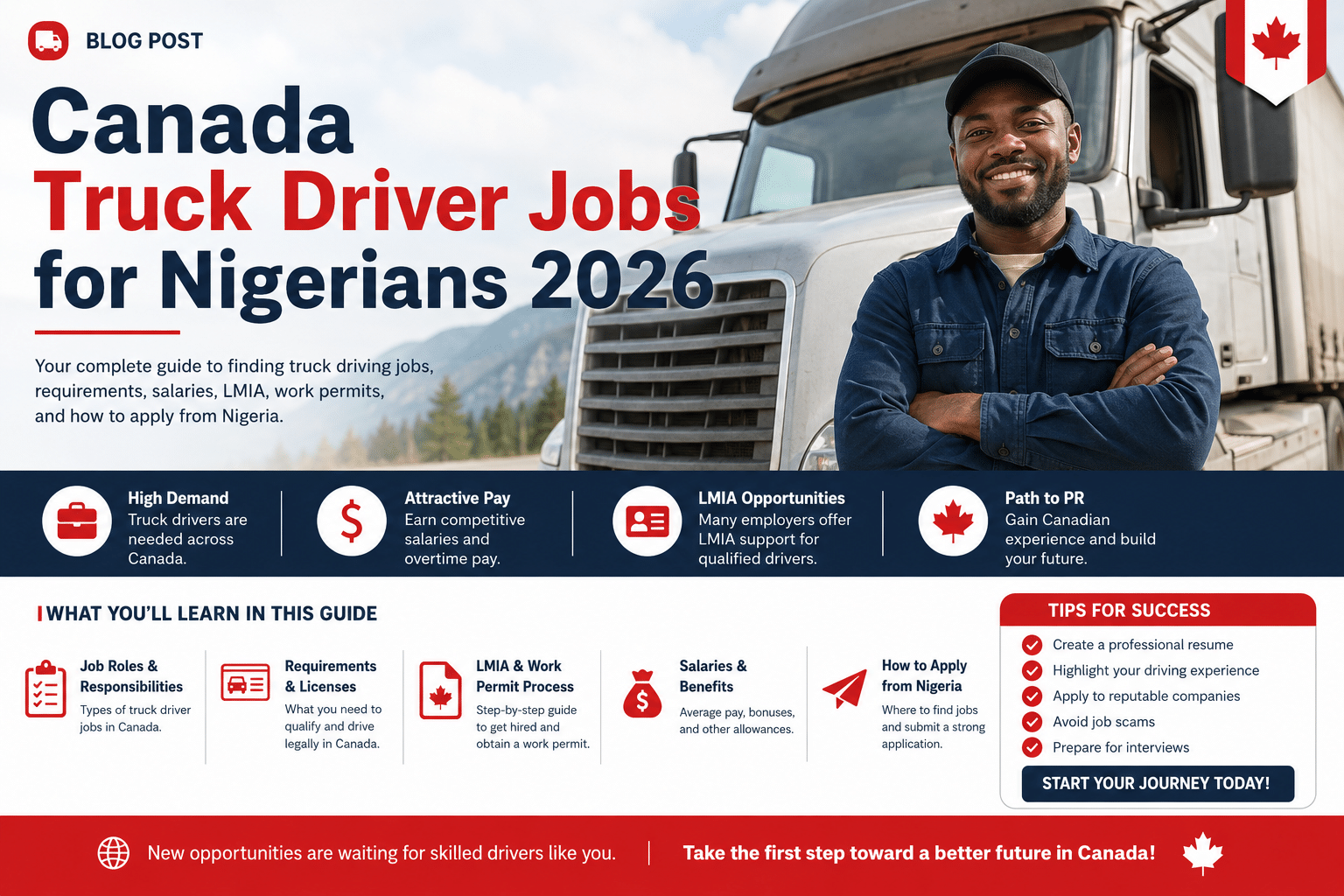
Canada truck driver jobs for Nigerians 2026 is an important search topic for Nigerian drivers who want to explore legitimate employment opportunities in Canada’s transportation and logistics industry. Canada has a large trucking sector that supports retail, construction, manufacturing, agriculture, and international trade. As a result, employers regularly advertise positions for transport truck drivers and long-haul drivers.
However, finding a job vacancy is only one part of the process. A Nigerian applicant who wants to work legally in Canada may need a valid job offer, the appropriate work authorization, and any licenses or certifications required for the position and province.
It is also important to understand that not every truck driver job offers visa sponsorship or is available to applicants living outside Canada. Some employers may recruit temporary foreign workers, while others may prefer applicants who already have Canadian work authorization. For this reason, applicants should carefully read every job advertisement instead of assuming that a vacancy automatically includes immigration support.
This guide explains how Nigerians can search for Canada truck driver jobs in 2026, understand licensing requirements, identify legitimate employers, prepare a competitive application, and follow the proper work permit process.
Are There Canada Truck Driver Jobs for Nigerians in 2026?
Yes. Nigerian citizens can apply for truck driving jobs in Canada when they meet the employer’s requirements and are eligible to work in Canada.
The key issue is not nationality alone. Employers generally focus on whether an applicant has the qualifications, driving experience, licenses, language ability where required, and legal authorization needed for the role.
Transport truck driving is classified under Canada’s National Occupational Classification system as NOC 73300.
Job opportunities may include positions such as:
- Long-haul truck driver
- Transport truck driver
- Heavy truck driver
- Tractor-trailer driver
- Freight driver
- Commercial truck driver
- Highway transport driver
- Delivery truck driver
- Team driver
The availability of these jobs changes over time. Applicants should therefore search current vacancies rather than relying on old articles that list expired jobs.
Why Truck Drivers Are Important in Canada
read also:Computer science scholarships for Nigerian students: free visa opportunity and how to apply
see also:Postgraduate Scholarships for Nigerians: Fully Funded Opportunities in 2026 and 20227
Truck drivers play an essential role in moving goods across Canada.
Commercial transportation supports:
- Supermarkets and retail stores
- Construction companies
- Warehouses
- Manufacturing businesses
- Farms and agricultural suppliers
- Ports and shipping operations
- Cross-border trade
- Energy and industrial projects
A shortage or disruption in transportation can affect the entire supply chain. This is one reason trucking companies continually recruit qualified drivers.
Nevertheless, applicants should avoid exaggerated claims that Canada has “guaranteed truck driver jobs for all foreigners.” Canadian employers must follow immigration and employment rules, and every applicant must qualify for both the job and the relevant work authorization.
Types of Truck Driver Jobs Available in Canada
Long-Haul Truck Driver
Long-haul drivers travel significant distances between cities, provinces, and sometimes international destinations.
Their responsibilities may include:
- Operating tractor-trailers and heavy trucks.
- Planning routes.
- Inspecting vehicles.
- Recording driving hours.
- Transporting freight safely.
- Communicating with dispatch.
- Completing delivery documentation.
Long-haul driving can require extended periods away from home, so applicants should consider whether this lifestyle matches their personal circumstances.
Local Truck Driver
Local drivers usually operate within a city or regional area.
These positions may offer more predictable schedules, although duties and working hours depend on the employer.
Heavy Truck Driver
Heavy truck drivers operate large commercial vehicles and may transport industrial materials, construction supplies, equipment, or other freight.
The specific licensee requirements depend on the vehicle and province.
Specialized Truck Driver
Some positions require additional qualifications.
Examples include:
- Dangerous goods transportation.
- Tanker driving.
- Refrigerated freight.
- Oversized loads.
- Construction materials.
- Cross-border transportation.
Specialized experience can make an applicant more attractive for certain roles, but additional certification may also be required.
Basic Requirements for Canada Truck Driver Jobs
Requirements vary by employer and province, but Canadian transport truck driver positions commonly involve a combination of education, training, licensing, and practical experience.
A Nigerian applicant may need to demonstrate:
- Relevant commercial driving experience.
- A valid driving history.
- Knowledge of road safety.
- Experience operating heavy or articulated vehicles.
- The ability to complete required training.
- Eligibility to obtain the appropriate Canadian commercial driver’s licensee.
- The ability to communicate effectively for work and safety purposes.
- Medical fitness where required.
- A clean or acceptable criminal and immigration record.
Some employers may require secondary school education, while other positions may focus more heavily on experience and licensing.
Canadian Truck Driving Licensee Requirements
One of the biggest challenges for foreign applicants is licensing.
Having a commercial driver’s licensee from Nigeria does not automatically mean that you can immediately operate every type of commercial truck in Canada.
Canadian provinces and territories regulate driver’s licensing.
For transport truck drivers, typical requirements can include:
- A Class 1 or Class A licensee for long combination vehicles.
- A Class 3 or Class D licensee for certain straight-body trucks.
- An air brake endorsement for vehicles equipped with air brakes.
- Additional certification for specialized vehicles or dangerous goods.
The exact requirements depend on where you will live and work.
Before accepting a job, ask the employer:
- Which Canadian license is required?
- Can my existing driving experience be recognized?
- Will I need to complete local driver training?
- Is a road test required?
- Are air brake or other endorsements necessary?
- Does the employer provide training or assistance?
Never assume that an employer will automatically convert a foreign license into a Canadian commercial license.
Can a Nigerian Apply for a Canadian Truck Driver Job From Nigeria?
Yes. Nigerians can search and apply for Canadian jobs from outside Canada.
However, receiving an interview or job offer is not the same as receiving permission to work in Canada.
For many foreign workers, an employer-specific work permit is the relevant pathway. This type of work permit is connected to a particular employer and may include conditions concerning the job, employer, location, and period of employment.
In many cases, the employer may need to obtain a Labor Market Impact Assessment, commonly called an LMIA.
An LMIA is generally an assessment connected to an employer’s request to hire a foreign worker.
A positive LMIA can demonstrate that there is a need for a foreign worker and that suitable Canadian citizens or permanent residents were not available for the role, subject to the requirements of the relevant program.
The worker does not apply for an LMIA on behalf of the employer. The Canadian employer is responsible for the LMIA process when an LMIA is required.
What Is an LMIA-Supported Truck Driver Job?
An LMIA-supported job is a position where the employer has followed the relevant process to seek approval to hire a temporary foreign worker.
Applicants searching for Canada truck driver jobs should look carefully for terms such as:
- LMIA available
- LMIA requested
- Temporary foreign workers welcome
- International applicants
- Employer-specific work permit
- Foreign worker recruitment
However, the wording of a job advertisement should not be treated as final immigration approval.
An applicant still needs to meet the requirements for the work permit.
How to Find Legitimate Canada Truck Driver Jobs for Nigerians 2026
One of the safest starting points is the Canadian government’s Job Bank.
Job Bank allows users to search for occupations and, in some cases, identify positions that may be relevant to temporary foreign workers.
When searching, try keywords such as:
- Truck driver
- Long-haul truck driver
- Transport truck driver
- Heavy truck driver
- NOC 73300
You can also search by province or city.
Other legitimate job-search methods include:
1. Company Career Websites
Visit the official websites of Canadian trucking and logistics companies.
Look for sections such as:
- Careers
- Jobs
- Driver recruitment
- Work with us
Applying through an official company website can reduce the risk of impersonation.
2. Provincial Job Resources
Some provinces provide employment information and resources for workers.
Check official provincial websites before relying on private blogs.
3. Professional Networks
LinkedIn and other professional networks may help applicants discover employers and recruiters.
However, applicants should verify that a recruiter genuinely represents the company before sharing documents or sending money.
How to Prepare a Canadian-Style Truck Driver Resume
Your resume should be clear, professional, and relevant to the job.
Include:
Personal Contact Information
Provide your name, professional email address, and telephone number.
Do not include unnecessary personal information.
Professional Summary
Briefly describe your experience.
For example:
Experienced commercial driver with several years of experience operating heavy vehicles, completing long-distance deliveries, performing vehicle inspections, and following transportation safety procedures.
Avoid copying this example word for word. Your summary should reflect your real experience.
Driving Experience
List:
- Employer names.
- Job titles.
- Dates of employment.
- Types of vehicles operated.
- Routes or distance covered.
- Major responsibilities.
Licenses and Certifications
Clearly identify your:
- Current driver’s license.
- Commercial driving qualifications.
- Safety certifications.
- Defensive driving training.
- Dangerous goods training, if applicable.
Key Skills
Relevant skills may include:
- Vehicle inspection.
- Route planning.
- GPS navigation.
- Cargo handling.
- Logbook compliance.
- Preventive maintenance.
- Communication with dispatch.
- Road safety.
Never claim experience or qualifications you do not have.
Documents Nigerian Applicants May Need
The exact requirements depend on the employer and immigration pathway, but applicants may need documents such as:
- Valid Nigerian passport.
- Professional resume.
- Employment reference letters.
- Driving license.
- Commercial driving certificates.
- Educational documents.
- Job offer or employment contract.
- LMIA-related documentation when applicable.
- Police certificate if requested.
- Medical examination results when required.
- Biometrics.
Your personalized document checklist can vary depending on your application.
For this reason, applicants should use the official Canadian immigration application system to determine the documents required for their particular situation.
Step-by-Step: How to Apply for Canada Truck Driver Jobs
Step 1: Assess Your Driving Experience
Review your work history honestly.
Consider:
- How many years have you driven commercially?
- What types of trucks have you operated?
- Have you driven long-distance routes?
- Do you have experience with articulated vehicles?
- Have you completed safety training?
Step 2: Prepare Your Resume
Create a Canadian-style resume focused on relevant experience.
Use clear job titles and measurable information where possible.
Step 3: Search for Current Vacancies
Use Job Bank, company websites, and other reliable employment platforms.
Avoid applying only to old job advertisements copied onto blogs.
Step 4: Read the Job Requirements
Check:
- Location.
- Salary.
- Working hours.
- Experience required.
- License requirements.
- Whether the employer is open to foreign workers.
- Whether LMIA support may be available.
Step 5: Apply Directly
Follow the instructions in the official job posting.
Do not pay someone simply to submit a standard job application.
Step 6: Attend Interviews
If selected, be prepared to discuss:
- Your driving experience.
- Safety procedures.
- Types of vehicles operated.
- Accident history, if relevant.
- Availability.
- Licensing requirements.
Step 7: Receive a Genuine Job Offer
A legitimate offer should contain meaningful employment information, including details about the employer and position.
Do not resign from your current job or pay large fees simply because you received an email claiming that you have been hired.
Verify the company independently.
Step 8: Follow the Work Permit Process
If an employer offers you a position and the role requires an employer-specific work permit, follow the official instructions.
Depending on the situation, you may need the employer’s LMIA decision letter or an offer of employment number for an LMIA-exempt position.
How Much Do Truck Drivers Earn in Canada?
Truck driver pay varies widely.
Factors affecting earnings include:
- Province.
- Type of driving.
- Years of experience.
- Distance travelled.
- Type of freight.
- Specialized certifications.
- Overtime arrangements.
- Company policies.
Current Job Bank postings in 2026 have shown truck driver and long-haul truck driver advertisements with hourly pay ranging from the mid-$20s to around $40 per hour in some examples, depending on the employer and location. Individual job offers can be higher or lower.
Applicants should examine the full employment conditions rather than focusing only on the advertised hourly wage.
Ask about:
- Guaranteed hours.
- Overtime.
- Benefits.
- Accommodation arrangements.
- Training costs.
- License costs.
- Deductions.
- Travel expenses.
Best Canadian Provinces to Search for Truck Driver Jobs
Job availability changes continuously, but applicants often find transportation opportunities in provinces with large populations, logistics networks, industrial activity, or significant long-distance freight movement.
These may include:
Ontario
Ontario has a large economy and extensive freight transportation network.
Major cities and logistics centers may provide a large number of job listings.
Alberta
Alberta’s economy includes energy, agriculture, construction, and transportation.
Truck drivers may work in long-haul and industrial transportation roles.
British Columbia
British Columbia has major ports, international trade connections, and significant freight activity.
Manitoba and Saskatchewan
These provinces support agriculture, manufacturing, and long-distance transportation.
Applicants should not choose a province based only on an article’s recommendation. Search current vacancies and compare licensing, living costs, climate, wages, and immigration options.
Can Truck Driving Lead to Permanent Residence in Canada?
A work permit and permanent residence are different immigration statuses.
Working in Canada as a truck driver does not automatically guarantee permanent residence.
However, Canadian work experience may potentially become relevant to an applicant’s eligibility under certain immigration programs, depending on the occupation, work experience, province, language results, education, and current immigration rules.
Possible pathways may include:
- Express Entry programs, where eligible.
- Provincial Nominee Programs.
- Other provincial or federal immigration streams.
Eligibility rules can change, and not every truck driver will qualify for permanent residence.
Workers should avoid employers or agents who promise “guaranteed Canadian PR” after a fixed number of months.
Important Changes and Work Permit Rules
Canadian immigration policies can change.
In 2026, applicants should pay close attention to the type of work permit they need and the conditions attached to it.
For an employer-specific work permit, the permit may identify:
- The employer.
- The type of work.
- The work location.
- The validity period.
A worker generally cannot simply change employers whenever they want without following the proper immigration process.
If you plan to change jobs, review the current requirements before starting work with a new employer.
Avoiding Canada Truck Driver Job Scams
Employment and immigration scams are a serious risk.
Be cautious of anyone who:
Promises a Guaranteed Visa
No agent can guarantee that Immigration, Refugees and Citizenship Canada will approve a work permit.
Sells an LMIA
A genuine LMIA is connected to an employer’s position and recruitment process. Applicants should be suspicious of individuals advertising “LMIA for sale.”
Requests Large Upfront Payments
Be cautious if someone demands a large payment before you have independently verified the employer and the recruitment process.
Uses Only WhatsApp or Social Media
A legitimate company may use WhatsApp for communication, but you should still independently verify the business.
Visit the company’s official website and use publicly listed contact information.
Sends a Suspicious Job Offer
Warning signs may include:
- Poorly written contracts.
- Free email accounts instead of official company addresses.
- Pressure to pay immediately.
- Unrealistically high salaries.
- No interview.
- No verifiable company information.
Questions to Ask a Canadian Trucking Employer
Before accepting a job offer, ask:
- What type of truck will I operate?
- What Canadian license is required?
- Do you recruit workers from outside Canada?
- Does the position require an LMIA?
- Has an LMIA been approved, or is an application still in progress?
- Who pays for training?
- What is the exact salary and number of working hours?
- Are overtime and benefits available?
- Where will I be based?
- Will I need to complete additional licensing or road testing after arrival?
Professional employers should be able to explain the essential terms of the position.
Tips to Improve Your Chances of Getting Hired
Build Relevant Experience
Experience with heavy trucks, long-distance driving, articulated vehicles, and safety procedures can strengthen your application.
Keep Your Driving Record Clean
Employers value safe drivers.
A history of serious violations can make employment more difficult.
Improve Communication Skills
Truck drivers may need to communicate with dispatchers, customers, border officials, and other workers.
Obtain Relevant Certifications
Where available, credible safety and commercial driving training can strengthen your profile.
Apply Consistently
Do not depend on one employer.
Create a structured application plan and apply to suitable positions regularly.
Customize Your Resume
Match your experience to the duties listed in the job advertisement.
Do not send exactly the same generic application to every employer.
Frequently Asked Questions
Can Nigerians apply for truck driver jobs in Canada?
Yes. Nigerian citizens can apply for Canadian truck driver positions if they meet the employer’s job requirements and qualify for the appropriate work authorization.
Do all Canadian truck driver jobs provide visa sponsorship?
No. Some jobs are intended for applicants who already have authorization to work in Canada. Always check whether an employer is willing and eligible to hire a temporary foreign worker.
Do I need an LMIA to work as a truck driver in Canada?
Many employer-specific work permit situations involve an LMIA, but some work permits can be LMIA-exempt. The exact requirement depends on the job and immigration category.
Can I buy an LMIA from an agent?
You should be extremely cautious of anyone offering to sell an LMIA. An LMIA is an employer-driven process and should not be treated as a product that a worker can simply purchase.
What license do I need to drive a truck in Canada?
The license depends on the province and type of vehicle. Long combination vehicles commonly require a Class 1 or Class A license, while other commercial trucks may require different license classes or endorsements.
Do I need Canadian experience before applying?
Not every employer requires Canadian experience. However, relevant professional commercial driving experience can improve your chances of being considered.
Can a truck driver get permanent residence in Canada?
Canadian work experience may be relevant to certain immigration pathways, but working as a truck driver does not automatically guarantee permanent residence.
How do I know whether a job offer is real?
Verify the employer independently, check the company’s official website, communicate through verified contact channels, and be suspicious of guaranteed visas or requests for unusual payments.
Final Thoughts
Canada truck driver jobs for Nigerians 2026 may offer genuine employment opportunities, but success depends on qualifications, licensing, employer requirements, and Canadian immigration rules.
The safest strategy is to search current jobs through official and reputable sources, prepare a professional resume, verify every employer, and follow the official work permit process.
Do not believe advertisements promising guaranteed jobs, guaranteed visas, or guaranteed permanent residence.
Instead, focus on building a strong driving profile, applying to legitimate employers, understanding Canadian commercial licensing requirements, and ensuring that every immigration step is supported by official documentation.
A well-prepared applicant with relevant commercial driving experience, a strong employment record, and a genuine job offer may be in a better position to pursue a lawful Canadian work opportunity.
Disclaimer: This article is for general educational and informational purposes only and is not legal or immigration advice. Canadian job vacancies, wages, licensing requirements, LMIA rules, and immigration policies can change. Always verify current requirements through official Canadian government sources and consult a qualified immigration professional for advice about your individual circumstances.
2026 fact-check notes for publication
Current Canadian Job Bank listings show active truck-driver and long-haul truck-driver vacancies, including postings marked “LMIA requested.” Examples in 2026 included jobs in Alberta, Ontario, British Columbia, Quebec, and Saskatchewan, with advertised wages varying by employer and location.
For NOC 73300, Transport truck drivers, Job Bank states that secondary school is usually required; training may be required; Class 1/A licenses are used for long combination vehicles; Class 3/D may apply to straight-body trucks; and air-brake or dangerous-goods certifications may be required depending on the work.
For foreign workers, Canada’s official guidance states that most people seeking an employer-specific work permit need a job offer, and the employer may need a positive LMIA unless the employment is LMIA-exempt. The employer—not the foreign worker—handles the LMIA application when one is required.
Applicants applying from outside Canada generally follow the official work-permit process, submit the required documents, pay applicable fees, and provide biometrics when required. Current government guidance lists a standard work-permit processing fee of CAD $155 and an individual biometrics fee of CAD $85, unless an exemption applies.