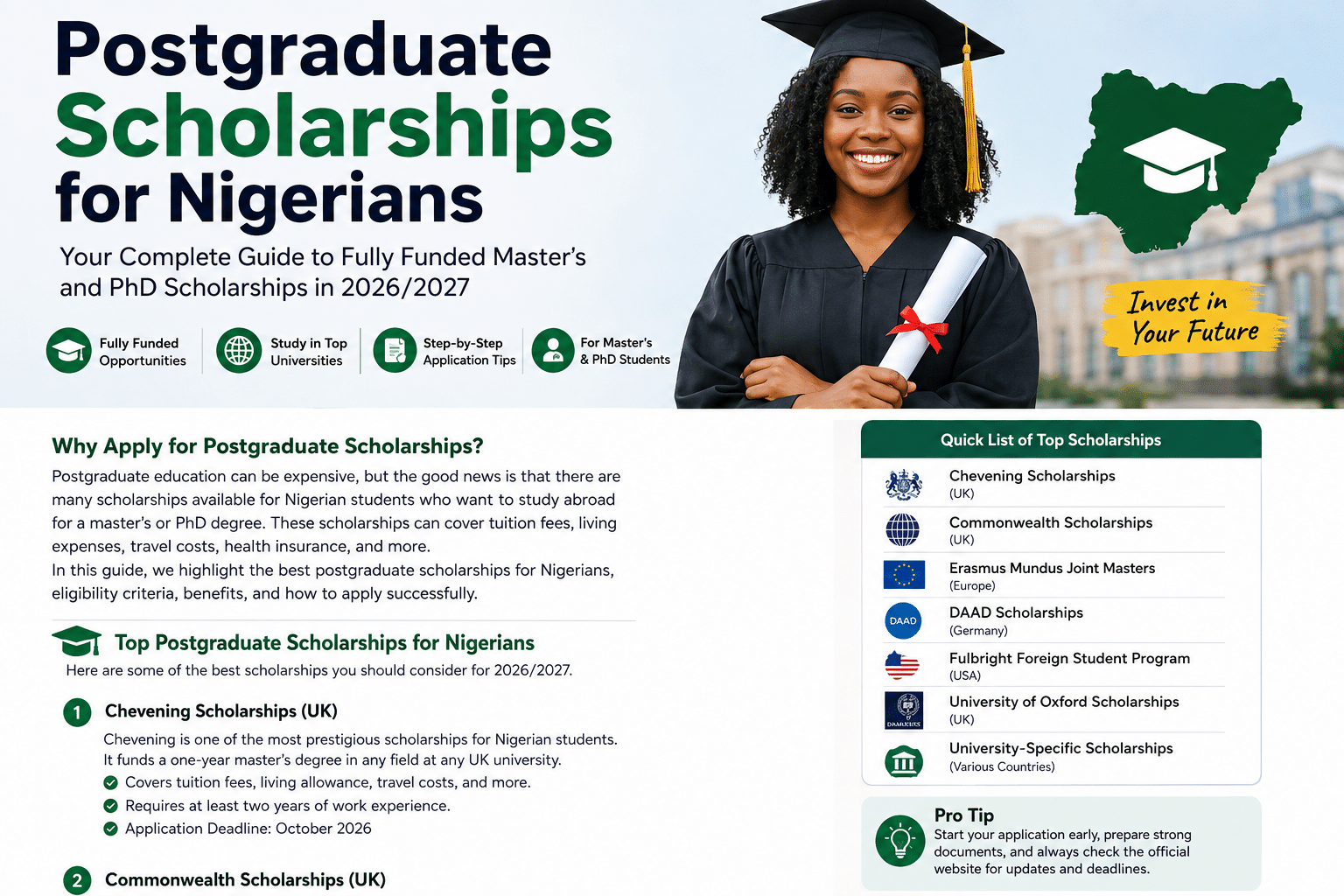
Finding postgraduate scholarships for Nigerians can make the difference between paying international tuition fees out of pocket and studying at a leading university with substantial or full financial support.
For Nigerian graduates planning to pursue a master’s degree, PhD, professional postgraduate program or research degree abroad, there are several major scholarship routes worth exploring. Some are specifically designed for students from developing countries, while others are open to applicants worldwide and accept Nigerians as part of their international applicant pool.
Popular opportunities include Chevening Scholarships, Commonwealth Scholarships, Erasmus Mundus Joint Masters, DAAD scholarships, Fulbright, and university-specific awards such as the University of Oxford Clarendon Fund.
However, scholarship availability, eligibility requirements and deadlines change from one academic year to another. A scholarship that was available to Nigerians last year may have different requirements this year, so applicants should always verify details on the official scholarship website before applying.
This guide explains some of the strongest postgraduate scholarships for Nigerians, what they can cover, who can apply, how to prepare a competitive application and how to avoid common scholarship mistakes and scams.
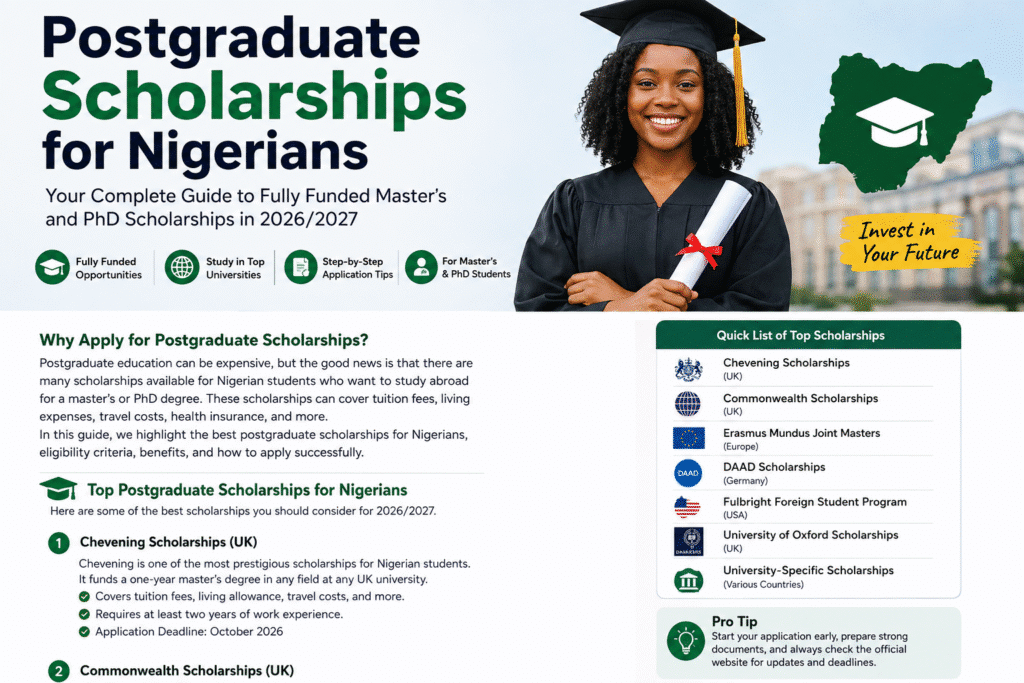
What Are Postgraduate Scholarships?
Postgraduate scholarships are financial awards designed to help students pursue education after completing an undergraduate degree.
They may support:
- Master’s degrees
- PhD programs
- Research degrees
- Professional postgraduate programs
- Joint master’s programs
- Academic fellowships and research placements
Some scholarships cover almost all major study costs, while others provide only tuition assistance or a contribution toward living expenses.
A fully funded scholarship generally provides significantly broader support than a tuition-only scholarship. Depending on the program, funding may include tuition fees, living expenses, travel costs, health insurance, visa-related expenses or other study allowances.
It is important, however, not to assume that every scholarship advertised as “fully funded” covers every expense. Always read the official funding conditions for the specific award.
Best Postgraduate Scholarships for Nigerians
There is no single scholarship that is best for every Nigerian applicant. Your ideal opportunity depends on your academic background, work experience, intended course, career goals and preferred destination.
The following programs are among the most useful places for Nigerians to begin their search.
1. Chevening Scholarships
Chevening is one of the most recognized postgraduate scholarship programs for Nigerians who want to study in the United Kingdom.
The program is funded by the UK Foreign, Commonwealth and Development Office and partner organizations. It supports exceptional applicants from eligible countries to undertake a one-year master’s degree in the UK.
Nigeria has its own Chevening country page, and the program is currently accepting applications for the 2027–2028 academic year. The current application deadline is 6 October 2026 at 11:00 UTC..
Chevening is particularly attractive to applicants who already have professional experience and can demonstrate leadership, influence and a clear plan for creating positive change.
Chevening eligibility for Nigerians
According to the official eligibility requirements, applicants must generally:
- Be a citizen of a Chevening-eligible country.
- Commit to returning to their home country for at least two years after the scholarship ends.
- Have at least two years of work experience, equivalent to 2,800 hours.
- Hold an undergraduate degree that qualifies them for a UK master’s program
- Apply to three eligible UK master’s courses.
- Obtain an unconditional offer from at least one selected course by the relevant deadline.
There is no upper age limit for Chevening, according to the program’s guidance.
What makes Chevening different?
read also:Fully Funded Scholarships UK for Nigerians: Free Visa Opportunity and How to Apply
see also:Trump Administration Visa Bond Countries: A Complete Guide to the U.S. Visa Bond Policy
Chevening is not simply looking for applicants with excellent grades.
The selection process places substantial emphasis on leadership, influencing skills, networking, career planning and the applicant’s ability to demonstrate meaningful impact.
This means a Nigerian applicant with a strong academic record but little evidence of leadership or professional impact may not necessarily be stronger than an applicant with slightly less impressive grades but substantial evidence of leadership and measurable achievements.
What courses can Chevening applicants choose?
Applicants select three eligible master’s courses.
The courses must meet Chevening’s requirements, including being full-time, based in the UK, taught master’s programs and normally between nine and 12 months in duration. Chevening does not fund PhD or DPhil programs through the standard scholarship.
A smart strategy is to select courses that are closely connected to your academic background and long-term career objectives.
Important Chevening warning
Chevening states that applicants must write their application answers themselves. The program explicitly says the use of AI software to generate answers for Chevening applications is prohibited and that it uses tools to identify fraud, plagiarism and AI-generated responses.
Therefore, applicants can use general scholarship resources to understand the process, but they should not submit AI-generated personal statements or essays as their own work.
2. Commonwealth Master’s Scholarships
The Commonwealth Master’s Scholarship is another major opportunity for Nigerians seeking postgraduate study in the UK.
The program is funded by the UK Foreign, Commonwealth and Development Office and is designed for talented candidates from eligible low- and middle-income Commonwealth countries.
Nigeria is explicitly included among the eligible countries.
The scholarship is intended for full-time taught master’s study at a UK university and focuses on candidates who can contribute to sustainable development.
For the 2027/28 academic year, the Commonwealth Scholarship Commission says applications are scheduled to open on 8 September 2026 and close at 16:00 BST on 20 October 2026.
That makes Commonwealth funding particularly relevant to Nigerians planning ahead for 2027 entry.
Who should consider a Commonwealth Master’s Scholarship?
This opportunity can be particularly attractive to applicants whose proposed study relates to development priorities.
The Commonwealth program has historically supported fields connected to areas such as:
- Science and technology
- Health systems
- Economic development
- Environmental sustainability
- Governance
- Education
- Other development-related priorities
The program is designed to help scholars gain skills that can contribute to sustainable development in their home countries.
Why Nigerians should consider Commonwealth scholarships
Nigeria’s inclusion in the eligible-country list makes this one of the most important UK scholarship opportunities for Nigerian graduates.
However, applicants should not wait until the final week before preparing.
A strong application can require:
- Academic transcripts
- References
- A clear study plan
- Evidence of relevant experience
- A convincing development-impact argument
- University applications
- Supporting documentation
Starting early gives you time to identify suitable courses and understand the requirements.
3. Commonwealth Shared Scholarships
Another opportunity Nigerians should investigate is the Commonwealth Shared Scholarship.
These awards are designed for candidates from eligible low- and middle-income Commonwealth countries who want to undertake full-time master’s study at participating UK universities.
Nigeria is included among the eligible countries.
The program is different from the standard Commonwealth Master’s Scholarship because participating UK universities play a significant role in the recruitment and funding arrangement.
The scholarship is aimed at candidates who would otherwise be unable to afford UK study and who have the potential to contribute to development in their home countries.
Commonwealth Shared Scholarship requirements
Current eligibility information includes requirements such as:
- Citizenship or qualifying refugee status in an eligible Commonwealth country
- Permanent residence in an eligible Commonwealth country
- A qualifying first degree
- Financial need
- Commitment to return home before the end of the UK visa
- Meeting the requirements for the selected master’s course
The precise requirements should always be checked for the relevant application cycle.
The CSC currently says applications for 2027/28 Commonwealth Shared Scholarships are scheduled to open in early November 2026 and close in mid-December 2026, with exact dates to be announced.
This makes the program worth adding to a Nigerian applicant’s scholarship calendar.
4. Erasmus Mundus Joint Masters Scholarships
If you are open to studying in Europe rather than focusing exclusively on the UK, Erasmus Mundus Joint Masters should be on your scholarship shortlist.
Erasmus Mundus Joint Masters are international master’s programs delivered by consortia of higher education institutions.
Students can study at universities in different countries as part of the same program.
The official Erasmus+ program states that students from around the world can apply and that full scholarships are available for the best-ranked students.
What does an Erasmus Mundus scholarship cover?
Depending on the program and scholarship arrangement, funding can contribute to:
- Participation costs
- Travel
- Visa costs
- Living allowance
The exact scholarship package should be confirmed for the particular master’s program.
How long are Erasmus Mundus programs?
Joint master’s programs generally last between one and two academic years, depending on the program structure and number of European Credit Transfer and Accumulation System credits.
When should Nigerians apply?
Erasmus Mundus applications are handled by the individual program rather than through one single central student application.
The official Erasmus+ guidance says that, in most cases, applications are submitted between October and January for courses beginning in the following academic year. However, deadlines differ between program.
This is why applicants should start researching the Erasmus catalogue several months before the expected deadline.
5. DAAD Scholarships for Nigerians
Germany is another destination worth considering when researching postgraduate scholarships for Nigerians.
The German Academic Exchange Service (DAAD) supports international students, researchers and academics through a large range of funding programs.
DAAD says its scholarships are aimed primarily at graduates, doctoral students and postdoctoral researchers, with funding available for study and research at universities and research institutions in Germany.
DAAD also offers programs aimed specifically at students from developing and emerging countries, including selected postgraduate programs.
What can DAAD scholarships cover?
The benefits depend on the particular scholarship.
DAAD explains that scholarships generally do not have to be repaid and may include a monthly scholarship payment, travel allowance and, in many cases, health, accident and personal liability insurance. Other benefits can depend on the program.
Because DAAD operates many different programs, there is no single universal eligibility requirement.
How Nigerians can find DAAD opportunities
The safest approach is to use the official DAAD Scholarship Database.
The database allows prospective applicants to search funding opportunities by country, academic level, subject and scholarship purpose.
This is much better than relying on a social media post claiming that “DAAD is offering 500 scholarships to Nigerians” without identifying the exact program.
A Nigerian applicant should search for the specific scholarship, read its eligibility rules and confirm the deadline before preparing an application.
6. Fulbright Foreign Student Program
Nigerians interested in postgraduate study in the United States can also investigate the Fulbright Foreign Student Program.
The program enables graduate students, young professionals and artists from outside the United States to study and conduct research in the U.S.
Fulbright says the Foreign Student Program operates in more than 160 countries and awards scholarships to approximately 4,000 foreign students each year.
Nigeria has a dedicated country listing within the Fulbright Foreign Student Program.
What should Nigerian applicants know?
Fulbright eligibility and selection procedures can vary significantly by country.
The official program advises applicants to use the information for their home country and to discuss the U.S. university admission and placement process with the relevant Fulbright office.
This is important because a Nigerian applicant should not assume that Fulbright requirements are identical to those for applicants from another country.
Before preparing your application, check the Nigeria-specific instructions and current application cycle.
7. University of Oxford Clarendon Scholarships
Some of the best postgraduate scholarships for Nigerians are not country-specific.
A good example is the Clarendon Fund at the University of Oxford.
Clarendon scholarships are open to applicants from around the world, and Oxford explicitly states that there are no restrictions based on nationality or country of ordinary residence. Nigerian students are represented among Clarendon scholars.
The scholarship supports graduate study at Oxford and covers course fees and provides a living-cost grant for eligible full-time scholars.
For the 2025–26 academic year, Oxford states that full-time Clarendon scholars received at least £20,780 as an annual living-expenses grant, although funding figures can change between academic years.
How do Nigerians apply for Clarendon?
One attractive feature of Clarendon is that there is normally no separate scholarship application.
Applicants who submit their graduate application by the relevant December or January deadline are automatically considered for Clarendon funding.
However, this does not mean that admission to Oxford automatically results in a scholarship.
Clarendon is highly competitive and selection focuses on outstanding academic merit and future potential.
For a Nigerian student with a strong academic record, this is an excellent example of why university-specific scholarships should be included in a postgraduate funding search.
Other Postgraduate Funding Opportunities Nigerians Should Research
The scholarships above are among the most prominent international opportunities, but they are not the only options.
Nigerian postgraduate applicants should also investigate:
University scholarships
Many universities offer scholarships directly to international students.
These can include:
- Merit scholarships
- Faculty scholarships
- Departmental awards
- Research studentships
- Tuition discounts
- International student scholarships
- Country-specific awards
- College scholarships
The advantage is that some university awards may be less restrictive than major government scholarships.
The disadvantage is that competition can still be intense, and funding may cover only part of the total cost.
Research scholarships
If you are applying for a PhD, research funding can be especially important.
Look for:
- Fully funded PhD positions
- Research assistantships
- Graduate teaching assistantships
- Doctoral studentships
- Faculty-funded research projects
- Supervisor-funded positions
For PhD applicants, identifying a potential supervisor whose research aligns closely with your proposed project can be an important part of the application process.
Scholarships offered by foundations
Private foundations, charities and development organizations sometimes fund postgraduate education.
However, applicants should carefully verify any foundation offering.
A genuine scholarship should have:
- A verifiable organization
- Clear eligibility requirements
- A transparent application process
- Official contact details
- Published terms and conditions
Be cautious if someone demands a large “registration fee” before revealing the scholarship.
How to Find Postgraduate Scholarships for Nigerians
Finding scholarships is not just about searching Google for “fully funded scholarships.”
A better approach is to create a systematic scholarship search.
Step 1: Decide what you want to study
Start with your intended field.
For example:
- Computer science
- Artificial intelligence
- Engineering
- Public health
- Business
- Economics
- Education
- International relations
- Environmental science
- Agriculture
- Law
- Development studies
Having a defined academic direction makes scholarship research much easier.
Step 2: Choose your preferred countries
Decide whether you are interested in:
- UK
- United States
- Germany
- Canada
- France
- Netherlands
- Sweden
- Finland
- Australia
- Other European countries
You do not necessarily have to choose one country.
A broader strategy can increase the number of opportunities you can consider.
Step 3: Search official scholarship databases
Do not rely exclusively on scholarship blogs.
Use official sources such as:
- Government scholarship websites
- University websites
- International scholarship databases
- Embassy websites
- Official education agencies
For example, DAAD provides its own scholarship database, while Erasmus Mundus directs students to individual program websites.
Step 4: Build a scholarship spreadsheet
Create a simple spreadsheet containing:
| Scholarship | Country | Degree | Deadline | Funding | Eligibility | Status |
|---|---|---|---|---|---|---|
| Chevening | UK | Master’s | Oct. 2026 | Major/full support | Work experience | Researching |
| Commonwealth Master’s | UK | Master’s | Sept.–Oct. 2026 cycle | Funded | Development focus | Researching |
| Erasmus Mundus | Europe | Master’s | Usually Oct.–Jan. | Full scholarships available | Program-specific | Researching |
| DAAD | Germany | Master’s/PhD | Varies | Program-specific | Program-specific | Researching |
| Fulbright | USA | Graduate | Country-specific | Program-specific | Country-specific | Researching |
| Clarendon | UK | Master’s/DPhil | Dec./Jan. course deadline | Fees + living grant | Academic excellence | Researching |
The dates above are examples based on current published information and should be verified for the specific program before applying.
Documents Nigerian Scholarship Applicants Should Prepare
Preparing documents early can significantly reduce application stress.
Common requirements include:
Academic transcripts
Request official transcripts from your university as early as possible.
Some universities take time to process transcript requests, especially when the institution has a high volume of requests.
Degree certificate
Have a clear digital copy available.
If your certificate has not yet been issued, check whether the scholarship accepts an official statement of completion or alternative evidence.
Curriculum vitae
Your CV should highlight relevant:
- Education
- Employment
- Research
- Leadership
- Volunteering
- Publications
- Professional certifications
- Awards
- Projects
Do not simply list everything you have ever done.
Focus on experiences relevant to the scholarship and your proposed field.
Personal statement
Your statement should explain why you want the program and how it connects to your future plans.
Avoid generic statements such as:
“I have always dreamed of studying abroad.”
Instead, explain the specific academic or professional problem you want to address.
Research proposal
PhD and research applicants may need a research proposal.
A strong proposal normally demonstrates:
- A clear research question
- Understanding of existing research
- A meaningful research gap
- Appropriate methodology
- Feasibility
- Expected contribution
Recommendation letters
Choose referees who know your academic or professional work well.
A senior person’s title alone does not guarantee a strong reference.
A detailed reference from someone who can provide specific evidence about your abilities is generally more useful than a vague letter from someone famous.
How to Write a Strong Scholarship Application
Winning a scholarship is rarely about using complicated English.
Selection committees want to understand:
- Who you are
- What you have achieved
- Why you need the opportunity
- Why the particular program fits you
- What you intend to do with the opportunity
Your application should therefore tell a coherent story.
For example:
Past: What experience shaped your academic or professional interests?
Present: What are you doing now to address the problem?
Future: How will postgraduate study help you achieve your next objective?
Impact: What will change because you gained the knowledge or qualification?
This structure is especially useful for development-focused scholarships.
How Nigerians Can Improve Their Scholarship Chances
There is no guaranteed formula for winning a scholarship, but several practices can make an application stronger.
Demonstrate measurable achievements
Instead of writing:
“I was involved in a community project.”
Explain what you actually achieved.
For example:
“I coordinated a five-person volunteer team that delivered digital-literacy workshops to 120 secondary-school students.”
Specific evidence is more persuasive than broad claims.
Connect your course to your career
Explain why the exact degree matters.
A scholarship committee should be able to understand why you need that particular program rather than simply wanting to study abroad.
Research the university
Mention relevant modules, research groups, facilities or academic strengths where appropriate.
For Chevening, for example, applicants are expected to research their selected courses and explain how their first-choice course connects to their background and career goals.
Avoid exaggeration
Never invent awards, employment history, publications, leadership roles or research experience.
Scholarship applications can be verified, and inaccurate information can damage your application.
Follow the instructions exactly
If an application asks for 500 words, do not submit 900 words.
If it asks for a specific document format, follow the instructions.
If it asks for three university choices, provide three appropriate choices.
Attention to detail matters.
Common Mistakes to Avoid
Applying only to famous scholarships
Chevening, Fulbright and Erasmus Mundus receive applications from highly qualified candidates around the world.
Do not make them your only options.
Research university scholarships, departmental awards and smaller funding opportunities as well.
Waiting until the deadline
Some documents take weeks to obtain.
Start early.
Using the same personal statement everywhere
A statement written for a UK leadership scholarship may not work for an academic research scholarship.
Tailor your application.
Ignoring eligibility requirements
Do not spend weeks preparing an application before checking whether you actually qualify.
For example, Chevening requires at least two years of qualifying work experience and a commitment to return home for at least two years after the scholarship.
Paying scholarship scammers
Be particularly careful with social media advertisements promising guaranteed scholarships.
The Commonwealth Scholarship Commission warns applicants about third parties requesting personal information or supporting documents and says supporting documentation should be submitted through official systems. (Commonwealth Scholarship Commission)
A scholarship that asks you to transfer money to a personal bank account should be treated with extreme caution.
Are There Postgraduate Scholarships for Nigerians Without Work Experience?
Yes.
Not every postgraduate scholarship requires professional work experience.
This is an important distinction.
Chevening, for example, requires at least two years of work experience.
But other scholarships, including university-based academic awards, may focus primarily on academic achievement and potential.
Oxford’s Clarendon Fund, for example, evaluates applicants based on academic merit and potential rather than imposing a nationality-specific work-experience requirement.
Erasmus Mundus eligibility is also program-specific, meaning applicants need to examine the requirements of the particular master’s program they want to join.
Therefore, if you are a recent Nigerian graduate without significant work experience, do not assume that postgraduate scholarships are unavailable to you.
Instead, focus on programs whose selection criteria match your profile.
Can Nigerians Get Fully Funded Master’s Scholarships Abroad?
Yes.
Nigerian students are eligible for a range of international scholarship opportunities, although eligibility and funding vary considerably by program.
Examples include:
- Chevening Scholarships
- Commonwealth Master’s Scholarships
- Commonwealth Shared Scholarships
- Erasmus Mundus Joint Masters scholarships
- Selected DAAD scholarships
- Fulbright opportunities
- Oxford Clarendon scholarships
- University-specific funding
The phrase “fully funded” should nevertheless be treated carefully.
One program may cover tuition and living expenses but not every travel expense. Another may cover tuition, living costs and travel. A third may provide a full tuition waiver but only a partial maintenance award.
Always read the official funding terms.
Postgraduate Scholarships for Nigerians: Master’s vs PhD
Your strategy should also depend on whether you want a master’s or PhD.
Master’s applicants
Master’s applicants should prioritize:
- Chevening
- Commonwealth Master’s
- Commonwealth Shared
- Erasmus Mundus
- DAAD master’s programs
- University scholarships
- Clarendon
PhD applicants
PhD applicants should investigate:
- Commonwealth PhD opportunities where eligible
- DAAD doctoral funding
- Fulbright
- University-funded PhD positions
- Faculty research studentships
- Research assistantships
- Supervisor-funded projects
- University-specific doctoral scholarships
PhD funding is often closely connected to a specific research project, department or supervisor.
Therefore, doctoral applicants should spend significant time researching universities and potential supervisors.
A Practical Scholarship Timeline for Nigerians
A well-organized timeline can make the application process easier.
August–September
Use this period to:
- Identify scholarships
- Research courses
- Check eligibility
- Prepare your CV
- Contact referees
- Request transcripts
- Research universities
For 2026, Chevening applications opened on 4 August and close on 6 October 2026.
The Commonwealth Master’s Scholarship application cycle for 2027/28 is scheduled to open on 8 September 2026. (Commonwealth Scholarship Commission)
October–November
Focus on:
- Scholarship essays
- University applications
- Research proposals
- References
- Supporting documents
This is also an important period for monitoring Erasmus Mundus programs.
December–January
Many university scholarships and Erasmus Mundus programs have deadlines around this period, although exact dates differ.
Oxford Clarendon applicants, for example, must submit their graduate applications by the relevant December or January deadline to be considered for the scholarship.
February–June
This period can involve:
- Interviews
- Scholarship decisions
- University admission decisions
- Additional documentation
- Funding confirmations
Applicants should continue searching for other opportunities rather than assuming that one pending application will succeed.
Frequently Asked Questions About Postgraduate Scholarships for Nigerians
Which country offers the best postgraduate scholarships for Nigerians?
There is no single best country.
The UK has major opportunities such as Chevening and Commonwealth Scholarships. Europe offers Erasmus Mundus and various national and university scholarships. Germany has DAAD funding, while the United States offers opportunities such as Fulbright.
Your best destination depends on your academic field, career goals, degree level and eligibility.
What is the easiest fully funded scholarship for Nigerians?
There is no genuinely “easy” fully funded international scholarship.
Major scholarships can be highly competitive.
Instead of looking for the easiest scholarship, look for scholarships where your profile is a strong match.
Can a Nigerian with a second-class lower degree get a scholarship?
Possibly.
Some scholarships and universities have strict academic requirements, while others assess applicants more holistically.
Do not automatically exclude yourself based on degree classification. Read the eligibility rules for each program carefully.
Can I apply for several scholarships at the same time?
Usually, yes, although individual programs can have restrictions concerning simultaneous funding or accepting multiple awards.
Applying to several suitable scholarships can be a sensible strategy.
Do I need IELTS for postgraduate scholarships?
Not necessarily.
English-language requirements are usually determined by the university or scholarship program.
For example, Chevening itself does not impose an English-language requirement, but UK universities have their own English-language requirements.
Therefore, check the requirements of both the scholarship and your university.
Can I get a scholarship if I have already completed a master’s degree?
It depends on the scholarship.
Some awards are intended for first master’s degrees, while others permit applicants who already hold a master’s qualification.
Chevening, for example, states that having a master’s degree does not automatically prevent someone from applying for another master’s degree.
Always check the specific program rules.
Are postgraduate scholarships for Nigerians free to apply for?
Many major government-funded scholarships do not charge an application fee.
However, applicants may still have costs associated with university applications, document certification, language tests, transcripts or other requirements.
Never assume that every website claiming to advertise a scholarship is official.
Final Advice for Nigerians Searching for Postgraduate Scholarships
The biggest mistake you can make when searching for postgraduate scholarships for Nigerians is to focus only on scholarship lists and ignore the actual selection criteria.
Successful applications usually start with a strong match between the applicant, program and scholarship.
Start by defining your academic goal.
Then identify universities offering the program you want.
After that, look for scholarships that support those universities or fields.
Finally, study the selection criteria and build your application around genuine evidence from your academic, professional, research, leadership or community experience.
For current opportunities, use official scholarship sources. Chevening publishes country-specific information and application timelines; the Commonwealth Scholarship Commission publishes its scholarship programs and eligible-country information; Erasmus+ provides its official Joint Masters catalogue; DAAD maintains a scholarship database; Fulbright provides country-specific guidance; and Oxford publishes its graduate funding requirements.
For Nigerians, the opportunities are broader than one famous scholarship. A thoughtful search can include government-funded awards, university scholarships, joint international master’s programs, doctoral studentships and research funding.
Most importantly, do not pay an individual or unofficial agent simply because they promise to guarantee a scholarship. Verify the program through the scholarship provider or university, submit documents through the official application system and keep copies of everything you submit.