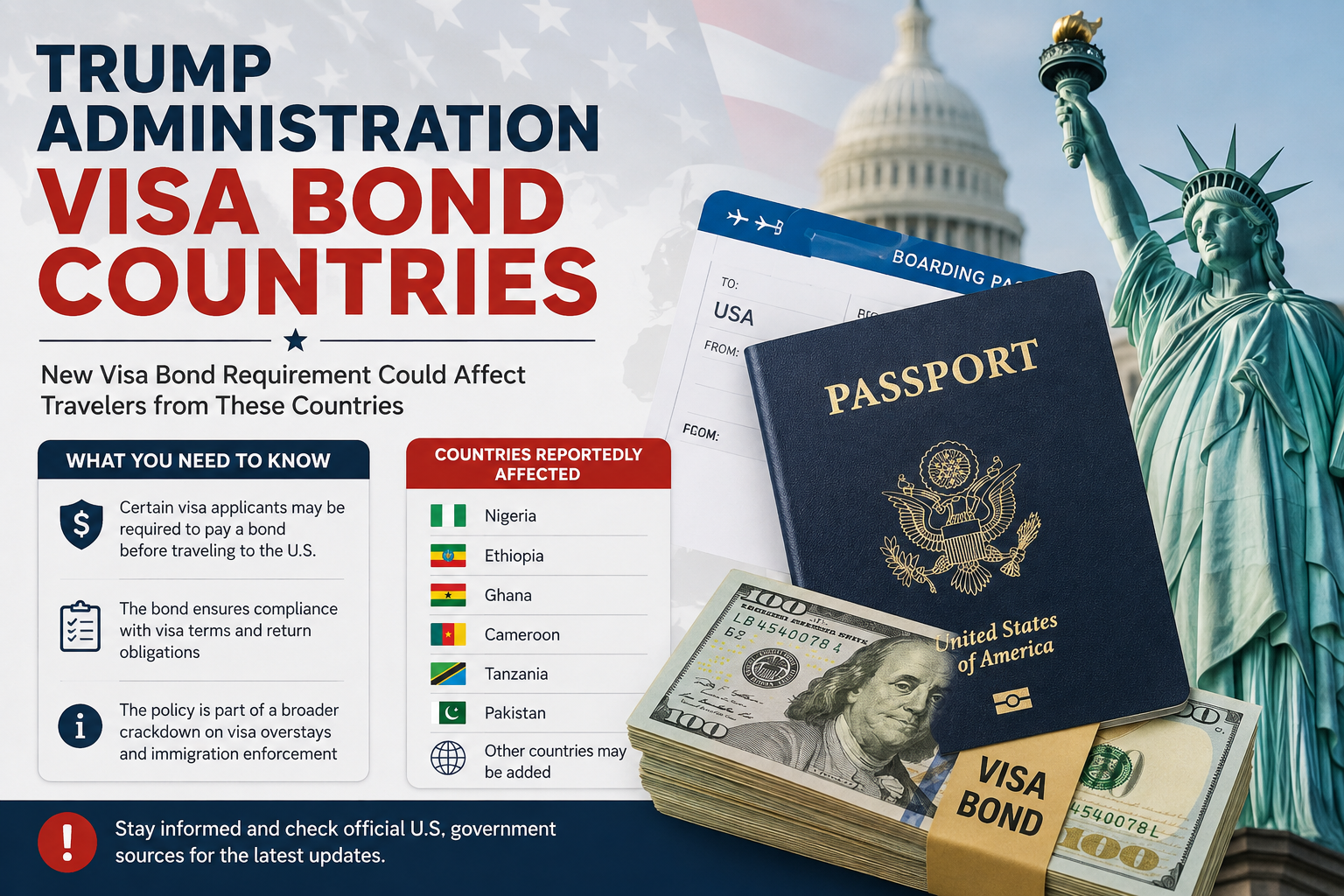
The phrase Trump administration visa bond countries has become an important search topic for travelers, students, families, immigration applicants, and people planning temporary visits to the United States. The subject concerns a U.S. visa policy that allows consular officers to require certain applicants for B-1/B-2 visitor visas to post a financial bond before a visa may be issued.
A visa bond is not automatically required for every applicant from a particular country. Instead, the policy can apply when the U.S. Department of State designates a country for participation in a visa bond pilot program and an applicant is otherwise required to post a bond as part of the visa process. The rules, participating countries, effective dates, and implementation details can change, so applicants should always verify current information through official U.S. government sources before paying money or making travel arrangements.
This guide explains what the visa bond policy means, why countries may be included, how the bond process works, what applicants should understand about refunds and compliance, and how to avoid misinformation and immigration scams.
Important: Immigration rules and country designations can change. This article is for general informational purposes and does not provide legal advice.
What Are Trump Administration Visa Bond Countries?
In this context, Trump administration visa bond countries refers to countries whose nationals may be subject to a U.S. visitor-visa bond requirement under a Department of State pilot program or other applicable visa bond authority.
The U.S. government has explained that the visa bond process may involve applicants for B-1 business visitor or B-2 tourist visas. A consular officer may determine that a bond is required for an eligible applicant under the terms of the applicable program. The bond is designed to encourage compliance with the conditions of temporary admission to the United States.
A key point for applicants is that a country appearing on an official visa bond list does not necessarily mean that every citizen of that country will automatically pay a bond. Visa adjudication remains individualized, and applicants must meet the relevant requirements for visa eligibility. The exact procedure depends on the current Department of State notice and instructions.
see also: Canada Construction Jobs for Nigerians 2026: Visa Sponsorship & How to Apply
read also: Canada Construction Jobs for Nigerians 2026: Visa Sponsorship & How to Apply
Why Does the United States Require a Visa Bond?
The purpose of a visa bond is connected primarily to immigration compliance. U.S. authorities may use bond programs as part of an effort to address concerns such as visa overstays and failures to comply with the terms of temporary admission.
For a visitor visa, the U.S. government generally expects the traveler to enter temporarily and leave the United States according to the authorized period of stay. A visa itself does not guarantee admission, and the length of an individual’s permitted stay is determined by U.S. immigration authorities at the port of entry or through other applicable procedures.
A bond requirement creates an additional financial condition. If the traveler complies with the terms of the bond and meets the applicable departure requirements, the bond may be canceled or released according to the rules governing the program. If the conditions are violated, the government may pursue forfeiture under the applicable legal and administrative process.
The policy therefore serves as a compliance mechanism rather than a substitute for the normal visa application process.
Which Visa Categories Can Be Affected?
The visa bond policy discussed under the Trump administration’s pilot program has focused on B-1 and B-2 nonimmigrant visas.
These categories generally include:
- B-1 visas: Temporary business-related visits, subject to the specific limits of U.S. immigration law.
- B-2 visas: Tourism, visiting friends or relatives, and certain other permitted temporary activities.
- B-1/B-2 visas: Combination visitor visas that may allow both qualifying business and tourism activities.
The visitor visa system should not be confused with employment-based immigration. A B-1 or B-2 visitor visa generally does not authorize ordinary employment in the United States.
Applicants searching for information about Trump administration visa bond countries should therefore avoid assuming that the policy applies to every type of U.S. visa. Student, employment, immigrant, and other visa categories operate under different rules unless an official policy specifically states otherwise.
How Countries May Be Selected for a Visa Bond Program
Country selection is one of the most frequently misunderstood parts of the visa bond policy.
The Department of State has indicated that factors used in connection with visa bond programs can include immigration compliance data and other considerations described in the governing public notices. Depending on the version of the program, relevant factors may include visa overstay rates, deficiencies in screening or identity verification, or other conditions identified by U.S. authorities.
However, it is important not to assume that inclusion on a visa bond list is a permanent judgment about an entire country’s citizens.
Government programs can be revised. Countries may be added, removed, or affected by a new notice. The effective period of a pilot program may also change.
For this reason, a responsible article about Trump administration visa bond countries should avoid publishing an old country list as though it will remain permanently valid.
Before applying, travelers should check the latest official announcement from the U.S. Department of State.
How Much Can a U.S. Visa Bond Cost?
The amount of a visa bond can vary according to the applicable government program and the determination made in the individual case.
Under the Trump administration’s visa bond pilot framework, bond amounts discussed by the Department of State have included $5,000, $10,000, and $15,000.
The consular officer may determine the appropriate amount under the applicable rules. Applicants should not assume that they can choose whichever amount they prefer.
A visa bond can therefore represent a significant financial obligation.
This creates an important distinction between a visa application fee and a visa bond:
- A visa application fee is generally a required payment associated with submitting or processing an application.
- A visa bond is a separate financial security requirement that may apply only in cases covered by the applicable program.
- Paying a bond does not automatically guarantee that a person will receive a visa.
- A person should never send money to an unofficial individual, social media account, or unverified immigration agent claiming to arrange a U.S. visa bond.
Applicants should follow only the payment instructions provided through official U.S. government channels.
The Visa Bond Application Process
The precise process can change, but the general structure typically involves several stages.
Step 1: Complete the Required Visa Application
Applicants seeking a visitor visa normally begin by completing the required U.S. nonimmigrant visa application process, including the DS-160 where applicable.
Applicants should provide accurate and complete information. Misrepresentation or false documentation can create serious immigration consequences.
Step 2: Attend the Visa Interview
Many applicants will be required to attend an interview at a U.S. embassy or consulate, depending on their circumstances and current visa processing rules.
During the application process, the consular officer considers whether the applicant qualifies for the requested visa.
Step 3: Determine Whether the Bond Requirement Applies
If the applicant is subject to the relevant visa bond program, the consular officer may provide instructions concerning the bond requirement.
Applicants should not independently attempt to purchase a bond before receiving official instructions.
Step 4: Follow the Official Bond Instructions
Where a bond is required, the applicant must follow the procedure specified by the U.S. government.
This step is particularly important because immigration scams frequently involve fake payment requests. A legitimate process should be supported by official instructions from the responsible U.S. government agency.
Step 5: Receive a Final Visa Decision
The existence of a bond process should not be interpreted as an unconditional approval.
Applicants must still satisfy the requirements for the visa. The U.S. government can refuse a visa application if the applicant does not qualify under applicable immigration law.
Does Paying a Visa Bond Guarantee Approval?
No.
One of the most important facts about the Trump administration visa bond countries policy is that a bond should not be treated as a way to buy a visa.
Visa applicants must still establish eligibility for the requested nonimmigrant visa. For visitor visas, applicants may need to demonstrate that they intend to make a temporary trip and meet the requirements of U.S. immigration law.
A visa officer considers the circumstances of the individual case.
This means:
- Paying a required bond does not guarantee admission to the United States.
- A visa does not guarantee entry at a U.S. port of entry.
- U.S. Customs and Border Protection officers make admission decisions at the border or airport.
- Travelers must comply with the conditions of their admission after arriving in the United States.
What Happens to the Visa Bond After the Traveler Leaves the United States?
The treatment of a visa bond depends on compliance with its conditions and the procedures established by the responsible U.S. government authorities.
In general, the traveler may need to comply with requirements related to departure and other conditions of the bond.
Applicants should carefully review the official instructions they receive because the process for canceling or releasing a bond may require specific documentation or confirmation.
A common mistake is to assume that leaving the United States automatically completes every administrative step. Depending on the applicable program, additional procedures may be required.
Travelers should keep records of:
- Their travel itinerary.
- Entry and departure information.
- Copies of relevant visa and bond documents.
- Communications from U.S. immigration authorities.
- Evidence of compliance where required.
What Can Cause a Visa Bond to Be Forfeited?
The specific consequences depend on the legal terms governing the bond and the facts of the individual case.
Potential concerns can include failing to comply with the conditions under which the bond was issued, such as an unauthorized overstay or other violations specified in the bond agreement.
A person facing a possible immigration violation should seek qualified legal advice rather than relying exclusively on social media posts or unofficial websites.
Immigration consequences can be serious. An overstay or violation may affect future visa applications and can potentially lead to additional restrictions under U.S. immigration law.
Visa Bond Countries and Visa Overstay Concerns
The visa bond discussion is closely connected to the issue of visa overstays.
A visa overstay generally occurs when a person remains in the United States beyond the period of authorized stay. The authorized period is not always the same as the expiration date printed on the visa.
This distinction is extremely important.
For example, a visitor may hold a visa that remains valid for multiple years but receive authorization to stay in the United States for a much shorter period on a particular trip.
Travelers should check the information provided in their admission record and comply with the authorized departure date or obtain a lawful extension or other immigration benefit when eligible.
Failure to understand this distinction can lead to serious problems.
Trump Administration Immigration Policy and the Visa Bond Debate
The visa bond policy should be understood within the broader context of the Trump administration’s approach to immigration enforcement and visa compliance.
Supporters of stronger visa enforcement argue that financial bonds may encourage compliance and reduce the risk of unauthorized overstays.
Critics may argue that large financial requirements can create unequal barriers for applicants based on economic resources and may discourage legitimate travel, family visits, and business activity.
Both perspectives form part of the broader public debate surrounding immigration policy.
For applicants, however, the practical question is more immediate: Does the current U.S. government policy apply to my nationality and visa category?
The answer must come from current official information rather than from outdated viral lists.
How to Find the Current Trump Administration Visa Bond Countries List
The safest approach is to check official U.S. government sources.
Applicants should look for announcements from the U.S. Department of State concerning visa bonds, visitor visa restrictions, or pilot programs.
Useful official resources may include:
- The U.S. Department of State.
- The Bureau of Consular Affairs.
- U.S. embassies and consulates.
- U.S. Customs and Border Protection, where relevant to travel and admission.
- USCIS, where relevant to immigration status or applications after arrival.
Be cautious with websites that use headlines such as “100% guaranteed U.S. visa” or “pay now to secure your American visa bond.”
No private agent can guarantee that a U.S. consular officer will approve a visa.
Current Update: The Visa Bond Program Changed in 2026
The original article framework above requires an important update. The U.S. Department of State’s official information shows that the earlier Visa Bond Pilot Program was followed by a rule establishing a permanent Visa Bond Program. Under the final rule, covered B-1/B-2 applicants may be required to post a bond of up to $20,000, depending on the applicable determination. (Public Inspection Federal Register)
The Department of State’s country-specific visa bond page, last updated May 13, 2026, listed 50 countries and stated that an otherwise eligible B-1/B-2 applicant traveling on a passport issued by one of those countries must post a bond under the program instructions. The earlier published amounts on that page were $5,000, $10,000, or $15,000, while the later final rule authorizes bonds of up to $20,000. Because implementation details can change, applicants should rely on the latest official instructions provided by the Department of State and the U.S. embassy or consulate handling their case.
Trump Administration Visa Bond Countries: Current List
Based on the U.S. Department of State’s official Countries Subject to Visa Bonds page, the following countries were listed as subject to the visa bond requirement as of the page’s May 13, 2026 update:
- Algeria
- Angola
- Antigua and Barbuda
- Bangladesh
- Benin
- Bhutan
- Botswana
- Burundi
- Cabo Verde
- Cambodia
- Central African Republic
- Côte d’Ivoire
- Cuba
- Djibouti
- Dominica
- Ethiopia
- Fiji
- Gabon
- The Gambia
- Georgia
- Grenada
- Guinea
- Guinea-Bissau
- Kyrgyz Republic
- Lesotho
- Malawi
- Mauritania
- Mauritius
- Mongolia
- Mozambique
- Namibia
- Nepal
- Nicaragua
- Nigeria
- Papua New Guinea
- São Tomé and Príncipe
- Senegal
- Seychelles
- Tajikistan
- Tanzania
- Togo
- Tonga
- Tunisia
- Turkmenistan
- Tuvalu
- Uganda
- Vanuatu
- Venezuela
- Zambia
- Zimbabwe.
The Department of State also published different implementation dates for countries added to the program. For example, Nigeria was listed with an implementation date of January 21, 2026, while other countries entered the program at different points between August 2025 and April 2026.
What the Visa Bond Requirement Means for Nigerian Applicants
Nigeria is specifically included on the Department of State’s official visa bond country list. Therefore, Nigerians applying with a Nigerian passport for a covered B-1/B-2 visitor visa should pay close attention to the current bond instructions.
However, the bond is only one part of the immigration process.
An applicant must still:
- Complete the required visa application.
- Attend an interview when required.
- Meet the legal requirements for the requested visa.
- Provide truthful and accurate information.
- Follow any bond instructions issued by the consular officer.
- Comply with the conditions of admission if the visa is issued.
The Department of State has also warned applicants not to submit Form I-352 or pay a visa bond until directed to do so by a consular officer. Applicants who are instructed to post a bond receive an official payment link through the government’s Pay.gov system. The Department specifically warns against using third-party websites for visa bond payments.
Important: A Visa Bond Does Not Guarantee a U.S. Visa
One of the most important points for anyone searching for Trump administration visa bond countries is that money alone cannot secure visa approval.
The Department of State explicitly states that a bond does not guarantee visa issuance. Paying money before receiving official instructions can also create problems, and payments made without the required consular direction may not be refundable.
This means applicants should be extremely cautious of:
- Visa agents promising guaranteed approval.
- Social media accounts selling “bond slots.”
- Websites requesting unofficial bond payments.
- Individuals claiming they can influence a consular officer.
- Messages asking applicants to transfer money to a private bank account.
- Fraudulent immigration consultants using government logos.
A legitimate U.S. visa decision is made through the official immigration and consular process.
Form I-352 and the Visa Bond Process
The Department of State’s country list explains that covered applicants must submit Department of Homeland Security Form I-352 when instructed to post the bond.
Form I-352 is associated with immigration bonds and guarantees of compliance with specific immigration obligations.
The general process described by the Department includes:
- Applying for the B-1/B-2 visa.
- Attending the visa interview.
- Receiving a determination from the consular officer.
- Receiving instructions if a bond is required.
- Completing the required Form I-352.
- Using the official government payment process.
- Following the specific terms and conditions of the bond.
Applicants should not treat Form I-352 as an ordinary form that can be completed independently in advance without instructions.
The safest approach is to wait until the U.S. government provides the required direction.
Required Ports of Entry and Departure Rules
Another important part of the visa bond system concerns travel procedures.
The Department of State states that visa holders who post a visa bond may be required to enter and exit the United States through designated ports of entry.
This requirement is significant because an applicant could potentially obtain a valid visa and still create problems by failing to follow the specific conditions attached to the bond.
Travelers should therefore review:
- Their visa instructions.
- Their bond conditions.
- Any designated airport, land border, or port requirements.
- Their authorized period of stay.
- Their departure obligations.
Never assume that a previous travel pattern will automatically satisfy the requirements of a visa bond.
Visa Bond Countries Are Not the Same as Travel Ban Countries
A major source of confusion is the difference between a visa bond country list and a country subject to visa issuance restrictions or suspensions.
These are separate policies.
For example, the Department of State announced that, effective January 1, 2026, nationals of certain countries became subject to full or partial suspensions of visa issuance under a separate presidential proclamation. The official notice lists Nigeria among countries subject to partial suspension affecting B-1/B-2 visitor visas, F and M student visas, J exchange visitor visas, and immigrant visas, subject to stated exceptions.
This means an applicant should not assume that being listed as a visa bond country automatically means that a bond payment will solve every visa issue.
Different immigration restrictions can overlap.
For example, an applicant’s nationality may involve:
- A visa bond requirement.
- A separate visa issuance restriction.
- Additional screening.
- A reduced visa validity period.
- A country-specific exception.
- A national-interest or other applicable waiver process.
Therefore, applicants must check the exact current rule that applies to their visa category and nationality.
Why Was the Visa Bond Program Introduced?
The original temporary final rule establishing the Visa Bond Pilot Program identified several factors that could be used when selecting countries for the program.
These included:
- High visa overstay rates.
- Deficiencies in screening or vetting information.
- Citizenship-by-investment concerns where citizenship was obtained without a residency requirement.
The Department of State explained that these factors could indicate a greater risk that an applicant might overstay or fail to maintain the required nonimmigrant status.
It is important, however, not to interpret country-level statistics as proof that an individual applicant intends to violate immigration law.
Visa applications are still based on the applicable legal framework and individual circumstances.
Understanding the Difference Between a Visa and Authorized Stay
Many travelers make the mistake of focusing only on the expiration date printed on a U.S. visa.
A visa is generally a travel document that allows a foreign national to travel to a U.S. port of entry and request admission.
It is not automatically a guarantee of entry.
After arrival, U.S. Customs and Border Protection determines whether the traveler may be admitted and under what conditions.
The period of authorized stay may be different from the validity period of the visa itself.
For this reason, a traveler should carefully check the information associated with their admission and avoid remaining in the United States beyond the authorized period.
For visa bond holders, compliance with immigration requirements is especially important because the terms of the bond may be directly connected to maintaining status and departing as required.
Can a Family Member or Another Person Pay the Bond?
The Department of State states that a visa bond may be paid by the applicant or by a third party, such as a friend, family member, or business associate.
The third-party payor may be located inside or outside the applicant’s home country. However, the payment must still follow the official process and should only be made after the consular officer provides instructions.
Applicants should be cautious when accepting financial assistance from unknown individuals or companies.
Never provide passport details, bank information, or immigration documents to an unverified person simply because they claim they can sponsor or arrange a visa bond.
What Happens if an Applicant Cannot Afford the Visa Bond?
A visa bond can represent a substantial financial requirement.
The permanent program’s final rule authorizes a bond of up to $20,000 for covered B-1/B-2 applicants, depending on the applicable determination. (Public Inspection Federal Register)
Applicants who cannot meet a required bond should not attempt to:
- Use false bank documents.
- Borrow money through fraudulent schemes.
- Submit fake sponsorship letters.
- Pay an unofficial agent.
- Misrepresent their financial circumstances.
Providing false information to U.S. immigration authorities can have serious consequences.
Instead, applicants should carefully review whether:
- They qualify for the visa they are requesting.
- Their trip can be postponed.
- Another lawful immigration category may be relevant to their circumstances.
- An immigration attorney or qualified legal professional should review their case.
How to Avoid U.S. Visa Bond Scams
The growth of online searches for Trump administration visa bond countries has created an opportunity for scammers.
Here are several warning signs.
1. Guaranteed Visa Approval
No private agent can guarantee that the U.S. government will approve a visa.
2. Payment Through Personal Accounts
Be suspicious if someone requests payment through a personal bank account, cryptocurrency wallet, gift card, or informal money-transfer method.
3. Pressure to Pay Immediately
Scammers often create artificial urgency by claiming that a “visa bond deadline” will expire within hours.
Always verify the information independently.
4. Fake Government Websites
Check the domain carefully. Official U.S. government websites generally use government domains such as .gov.
5. Unsolicited Social Media Messages
An unexpected message claiming that you have been selected for a U.S. visa or bond program should be treated with caution.
The Department of State specifically directs applicants to use official government systems and warns that the U.S. government is not responsible for money paid outside its approved systems.
Frequently Asked Questions About Trump Administration Visa Bond Countries
Which countries are subject to the U.S. visa bond requirement?
As of the Department of State’s May 13, 2026 update, 50 countries were listed as subject to the visa bond requirement, including Nigeria, Ghana was not listed, while countries such as Algeria, Bangladesh, Ethiopia, Nepal, Uganda, Venezuela, Zambia, and Zimbabwe were included. The full list is provided earlier in this article.
Is Nigeria on the Trump administration visa bond list?
Yes. Nigeria was listed by the U.S. Department of State as a country subject to visa bonds, with an implementation date of January 21, 2026.
How much is the U.S. visa bond?
The earlier Department of State country list described bond amounts of $5,000, $10,000, or $15,000. A later final rule establishing the permanent program authorizes bonds of up to $20,000. Applicants should verify the current amount applicable to their individual case through official instructions.
Does paying a visa bond guarantee approval?
No. The Department of State states that posting a bond does not guarantee visa issuance.
Can I pay the visa bond before my interview?
You should not pay or attempt to post a bond unless a consular officer directs you to do so.
Does the visa bond apply to every U.S. visa?
No. The program discussed here concerns covered B-1/B-2 temporary business and tourism visa applicants. Other visa categories have separate rules and may be affected by different immigration policies.
Is a visa bond the same as the visa application fee?
No. A visa application fee and a visa bond are different financial requirements. A bond is a security mechanism connected to compliance with the conditions established under the applicable program.
Can the list of visa bond countries change?
Yes. Immigration policies, country designations, and program requirements can change. Applicants should always check the latest official U.S. Department of State information before applying or making payments.
Final Thoughts
The topic Trump administration visa bond countries is important because the U.S. visa bond policy can create substantial financial and procedural obligations for affected B-1/B-2 applicants.
The most important lesson is simple: do not rely on outdated lists, social media rumors, or private agents promising guaranteed results.
The official Department of State information identified 50 countries as subject to visa bond requirements in its May 2026 update, including Nigeria. The earlier pilot program described bonds ranging from $5,000 to $15,000, while the later final rule establishing a permanent program authorizes bonds of up to $20,000.
Applicants should also remember that visa bond requirements may operate alongside other immigration restrictions. A country can be affected by more than one U.S. immigration policy, so paying a bond does not automatically overcome a separate visa suspension or establish eligibility for a visa.
Before submitting an application, paying a fee, or making travel arrangements, review the latest information from the U.S. Department of State visa bond information and follow the instructions provided by the U.S. embassy or consulate handling your case.
Disclaimer: This article is for general educational and informational purposes. U.S. immigration law and visa policies can change, and individual circumstances differ. This content is not legal advice. For case-specific legal guidance, consult a qualified U.S. immigration attorney or another appropriately authorized immigration professional.